
Flashcards
As level PE Physiology
Cards in this deck (105)
- 1What are the health related fitness components of fitness?Stamina
muscular endurance
Strength
Speed
Power
Flexibility - 2Definition of stamina?to delay the onset of fatigue
- 3What are the skill related components?reaction time
agility
co-ordination
balance - 4What can affect your energy intake and energy output?Genes, amount of muscle, training level and your event
- 5How do you work out BMI?Weigth in KG divided by height in metres squared
- 6Explain the mechanics of breathing inAir is taken in and your external intercostal muscles and diaphragm contract to lower the partial pressure of the lung which increase in volume to allow more oxygen to be taken in
- 7Explain the mechanics of breathing outAs you are trying to rid the waste product of respiration, carbon dioxide your internal intercostal muscles contract and the partial pressure of your lungs increase to force the carbon dioxide out of the lungs
- 8Tidal volume?considered your normal breathing rate, amount of air moving in and out
- 9exspiratory reserve volume?the amount of air that could be used when breathing out
- 10inspiratory reserve volume?amount of air that could be used when breathing in
- 11vital capacity?maximum amount of air breathed in and out
- 12Residual reserve volume?amount of air left in the lungs after breathing out
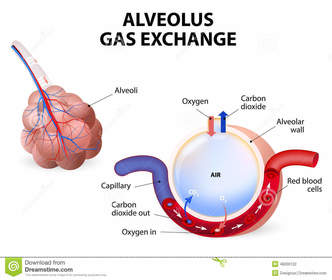
- 134 features of the alveolicovered in capillaries
moist lining-allowing for quicker gaseous exchange
tin membrane-decreases diffusion pathway
capillaries one cell thick - 14—example
- 15What is a baroreceptor?measures the pressure of heat
- 16chemoreceptor?detects change in PH/acid
- 17proprioceptors?detects movement
- 18Hemoglobin?when it forms with oxygen to form oxyhaemoglobin
can carry 4 oxygen's at a time
determined by the partial pressure of oxygen - 19myoglobin?has a higher affinity of oxygen
only found in the skeletal muscles - 20carbon dioxide in the blood?5% dissolves in plasma
20% combines with haemoglobin
75%combines with water forming bicarbonate ions what makes the blood acidic - 21oxygen in the blood?oxygen enters the red blood cells
combines with heamoglobin
forms oxyhaemoglobin - 22saturation of haemoglobin?when lots of oxygen is available, all haemoglobin carries 4 oxygen molecules so is fully saturated
when there is not much oxygen around oxyhaemoglobin splits, releasing oxygen into the working muscles - 23—a temperature increase leads to a stepper concentration gradient meaning more diffusion has happened
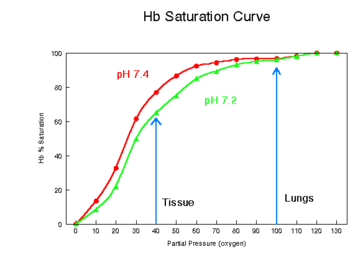
- 24During exercise?temperature increases leading to more CO2 being produced
both of these increase the amount of oxygen released into the muscles - 25Working muscles?higher temperature and more co2 meaning more oxygen leaves the haemoglobin
- 26—structure of the heart
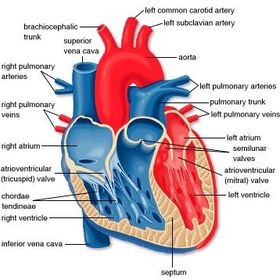
- 27What is systole pressure?it is when the ventricles contract
- 28What is diastole pressure?when the ventricles relax
- 29Why is the left side of the heart bigger than the right?because it has stronger thicker walls to get blood pumped around the body
- 30What do all veins have present in them?valves
- 31What do valves do?they prevent backflow and maintains high pressure in the veins
- 32What does myogenic mean?generates its on beat
- 33Key term to look out for:myo: means anything to do with muscle
- 34What is the conductivity sequence of the heart?sino atrial node(san)
artial ventricular node
bundle of HIS
purkinje fibres - 35The SAN......?sets the heart rate at about 120 beats per minute
- 36what does the nerves do?it acts as the brake and accelerator
- 37The role of the sympathetic nerve?helps to speed up your heart rate
- 38The vagus nerve?slows down your heart rate
- 39Causes of change in heart rate?exercise=more co2 in the blood
increased acidity
detected by chemoreceptors
impulses are then sent to the medulla - 40The components of the circulatory system?Arteries- thick muscular walls, takes blood away from the heart, high elastic pressure
Arterioles
Capillary- tiny very thin walls of diffusion of substances in and out
Venules
Veins- thin walled, carry blood back into the heart, wide lumen to maintain velocity of blood - 41When blood is further away from the heart the pressure is?lower
- 42What happens to the velocity once past the capillaries?decreases
- 43Explain how the venous return mechanism works?It works by the skeletal pump, blood is maintained by the pocket of valves in the veins, also with the contraction of your leg muscles compresses veins, respiratory pump
- 44An increased ejection fraction means?An increase in stroke volume
- 45What does the release of adrenaline do to the force of contraction?increases the force of contraction
- 46When resting your ventricles do not?fully empty during contraction
- 47When does the cardiovascular drift change?Changes to cardiac output, stroke volume and heart rate during a period of steady state exercise
- 48During steady state exercise?Lasting for 60 minutes
Cardiac output stays constant
stroke volume decreases
heart rate increases - 49—blood pressure and velocity graph

- 50With the redistribution of blood; what happens during exercise?1) vasodilation to exercising muscles
2) vasodilation to the heart
3) vasodilation to skin arterioles - 51Why?1)more blood more oxygen
2)more blood oxygen
3)more blood- cooling - 52vasconstriction at the?Kidneys, liver, guts- reduced importance
To inactive muscles- reduced importance
No change in supply to the brain - 53Explain how redistribution of blood occurs during exercise?When doing exercise you're respiring as your muscles need oxygen and to get rid of carbon dioxide, vasodilation in your blood vessels increase the amount of blood to your muscles which need oxygen and glucose. Vasoconstriction to the active muscles the lumen will narrow and decrease the amount of blood flow, carbon dioxide will increase
- 54Why a performers stroke volume decreases during a run of constant pace and workload?During exercise loss of fluid at sweat
reduced venous return
stroke volume decreases
starling law of the heart
cardiovascular drift - 55Explain how it is possible for a trained and untrained individual to have the same cardiac output for a given workload?They have the same physique
untrained heart rate and low stroke volume
Trained low heart rate large stroke volume - 56Effects of exercise on the cv and respiratory systems?Heart gets bigger-hypertrophy or athletes heart
Hence more muscle- more powerful contraction
increased resting heart rate and stroke volume increases
Same cardiac output
more blood-haemoglobin and better oxygen transport so improved stamina
more capillaries to muscles/ lungs
higher Vo2 difference
more efficient gas exchange - 57In a flow diagram?Bigger heart
stronger contraction
larger ejection fraction
increased stroke volume
same cardiac output
increased maximum cardiac output and decreased resting heart rate - 58Explain the terms bradycardia and athletes heart?Bradycardia- reduction in resting heart rate
Athlete heart- increased chamber size/ hypertrophy - 59What physiological factors are responsible for these conditions?Increase stroke volume
cardiac output maintained with fewer beats
More cardiac muscle
increased mitochondria
more capillaries
improved stronger contraction
decreased firing of SAN
Increased vagus stimulation - 60—example of the different muscle groups
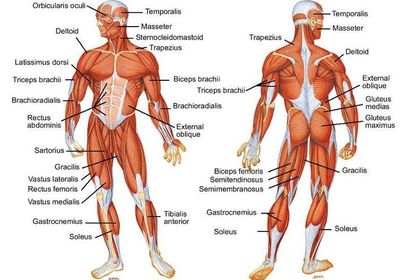
- 61What is adduction?Movement towards the body
- 62What is abduction?Movement away from the body
- 63Flexion?E.g. a bicep curl
so getting smaller - 64Extension?Getting bigger
- 65Name the type of joint, joint action and main agonist when throwing at the elbow and at the shoulder?Elbow: type of joint-hinge
Joint action- extension
main agonist triceps brachii
shoulder: Type of joint- ball and socket
joint action- horizontal flexion - 66—Skeleton example

- 67What is the articulating bones, movement possible and a common sporting example at the knee?Bones: Tibia and femur
Movement possible: Extension and flexion
Example: Kicking a ball and leg extension - 68At the hip?Bones: Pelvis and femur
Movement possible: extension, flexion, abduction and adduction
Example:Kicking a ball - 69Wrist?Bones: Carpuls, ulna and radius
Movement possible: flexion, extension pronation and spination
example: dart throw or javelin throw - 70At the elbow?Bones: Humerous and radius
movement possible: flexion and extension
example: javelin throw, bicep curl - 71At shoulder?Bones: scapule, humerous and clavicle
movement possible: rotation, abduction, adduction. horizontal flexion, extension
example:butterfly crawl - 72Ankle?Bones: Fibula. tibia and tarsals
movement possible: plantar flexion and dorsi flexion
example: kicking a ball or ballet - 73Exceptions to the rule: Squat in the downwards phase?Type of contraction eccentric
muscle lengthens
agonist controlling decent
hip flexion gluteals
knee flexion quadriceps
ankle dorsi flexion and gastronemius - 74At the press up lowering yourself down?joint action flexion
muscle action eccentric
agonist- triceps brachii - 75Bicep curl downwards phase?Joint action- extension
muscle contraction-eccentric
agonist- bicep brachii - 76What is an concentric (isotonic) contraction?Where it is shortening as the insertion move towards the origin so the joint angle decreases e.g. bicep curl
- 77Eccentric contraction?Where it is lengthening acting as a break
the insertion moves away from the origin so an increase in joint angle - 78A static contraction?Where there is no movement
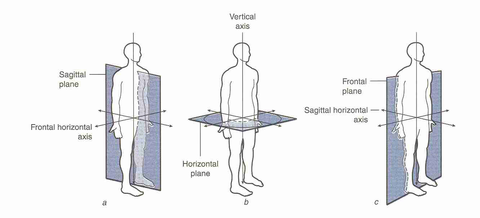
- 79Something to remember about axis and planes?that you move through a plane and rotate round an axis
- 80Name the planes and axis you rotate and break in a tennis serve?you break the horizontal and sagital plane
and twisting on the vertical plane - 81A cartwheel?the sagital horizontal axis
- 82—Example
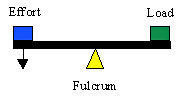
- 83What are the 3 components?Fulcrum
load
Effort - 84Something to remember the order is?FLE think 1 2 3
- 85What class is this?1st class and is anything to do with throwing
- 86—2nd class
e.g. running so involves plantar flexion
- 87—3rd class and concerns all other joints

- 88Mechanical advantage and disadvantage of 3rd class?long resistance arm and short effort arm
good range/ speed of movement
weak force applied - 89Mechanical advantage and disadvantage of 2nd class?short resistance arm and longer effort arm
good force applied
weal range of movement - 90Physiological benefits of a warm up?Improves oxygen delivery to muscles due to increased heart rate and vasodilation of blood vessels
Increase venous return and therefore stroke volume
Increased temperature reduces viscosity of the blood improving blood flow
Increased muscle muscle temp means greater elasticity of muscle fibres leading to a greater force of contraction
Increased temp helps to facilitate enzyme activity
Increased speed of nerve impulsion's
Can reduce the delayed onset of muscle soreness(DOMS) - 91Of a cool down?Maintains cardio respiratory functioning which helps to speed up recovery processes
Keeps blood vessels dilated to bring oxygen in to remove lactic acid
Helps to minimise DOMS - 92Psychological benefits of a warm up and cool down?Helps to mentally prepare the performer
Allow a chance for feedback to occur - 93What is an active stretch?Involves the performer undertaking a stretch with no external assistance
- 94Passive stretch?Involves the assistance of a partner or equipment e.g. towel or rubber band
- 95Static stretching?Involves the lengthening of a muscle which is held for a short period of time (15-20 seconds)
- 96Ballistic stretching?Involves bouncing in and out of a stretched position, uses the momentum of the body to force the muscle beyond
- 97Dynamic stretching?Involves taking the muscle through a full range of motion in a gradual and controlled way
- 98What is safe practice?Ensure the body and muscles are fully warmed up before attempting to perform any stretch
Always use static stretching before dynamic
Ballistic should only be performed under direct supervision - 99What is specificity?All training must be relevant to the activity or sport
- 100Progression?As the body become better at coping with training greater demands are required to ensure improvement continues
- 101Overload?The performer must find the training taxing, so it must be pitched at higher levels/ intensity
- 102Reversibility?If the training load decreases or stops all together the benefits prior training can be lost
- 103Tedium?Training sessions should use a range of different methods and intensity to help reduce boredom
- 104What can in be remembered as?SPORT
- 105What is the FITT principle?Frequency-how often we train
Intensity-how hard we train
Time- How long we train
Type-What type of training we use
Information
- Description
- P.E AS Flashcards on As level PE Physiology , created by Josh Toplis on 19/10/2015.
- Created by
- Josh Toplis
- Views
- 97
- Rating