
38293648
Description
![Frida Macedo [STUDENT]](https://lh3.googleusercontent.com/a/ALm5wu2blSBVbeDIitTax-536zzz3mSKZHGyEFhWA--pgQ=s96-c?sz=45 "Frida Macedo [STUDENT]")
Flashcards by Frida Macedo [STUDENT], updated more than 1 year ago
![Frida Macedo [STUDENT]](https://lh3.googleusercontent.com/a/ALm5wu2blSBVbeDIitTax-536zzz3mSKZHGyEFhWA--pgQ=s96-c?sz=32 "Frida Macedo [STUDENT]")
|
Created by Frida Macedo [STUDENT]
about 3 years ago
|
|
| Question | Answer |
| Nervous system (function) | Monitors the body's internal and external environments. Integrates sensory information. coordinates voluntary and involuntary responses of other organ systems. |
| Nervous system | Monitors the body's internal and external environment. Integrates sensory information. Coordinates voluntary and involuntary responses of many other organ systems. |
| CNS (central nervous system) | Brain and Spinal cord- integrates and coordinates the processing of sensory data and the transmission of motor commands. (intelligence, memory, emotion) |
| PNS (Peripheral nervous system) | All the neural tissue outside the CNS (check the overview of CNS and PNS relationship) |
| Efferent division/ Afferent division | A-sensory information is carried to the PNS. E-CNS sends motor commands to the PNS to muscles and glands. |
| Somatic Nervous system (an efferent division of the PNS) | Provides control over skeletal muscle |
| Autonomic nervous system (visceral motor system) | provides automatic involuntary regulation of smooth muscle, cardiac muscle, and glandular secretions |
| ANS (sympathetic division and parasympathetic) | ANS- provides automatic involuntary regulation of smooth muscle, cardiac muscle, and glandular secretions |
| Sympathetic division | accelerate the heart |
| parasympathetic division | slows the heart |
| Neuron | the basic unit of the nervous system involves communications of neurons with other cells |
| neuroglia | regulate the environment around neurons, provide a supporting framework for neural tissues, and act as phagocytes. (also called glial cells and outnumber neurons) |
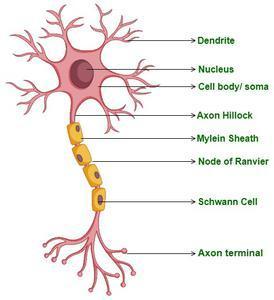
| Representative neuron | has- a cell body, several dendrites, axon terminals, |
| neuron | |
| Multipolar neuron | has two or more dendrites and a single axon (most common) control skeletal muscles |
| unipolar neuron | dendrites and axons are continuous, cell body lies off to one side. Action potential begins at the base of the dendrites and the rest of the process is an axon; Sensory neurons of the peripheral nervous system |
| Bipolar neuron | have two processes- one dendrite and one axon with a cell body between them; occur in special sense organs, relay information like sight, smell, hearing receptors. |
| Sensory neuron (afferent) | 10 million, received information from sensory receptors that were monitoring the external and internal environments and then relayed information to other neurons. |
| External receptors (somatic sensory receptors) | provide information about the external environment by touch, temperature, and pressure sensations, more complex taste sight equilibrium, and hearing. |
| Proprioceptors (somatic sensory receptors) | monitor the position and movement of skeletal muscles and joints |
| Visceral/ internal receptors | monitor the activities of the digestive, respiratory, cardiovascular, urinary, and reproductive systems; distention deep pressure and pain. |
| Motor neurons (efferent) | carry instructions from the CNS to other organs, organ system |
| Somatic/visceral motor neurons | S- nervate skeletal muscles V-innervate all other effectors |
| Interneurons (association) | brain and spinal cord, distribute sensory information, and coordination of motor activity. |
| Astrocytes (neuroglia) CNS | secretes chemicals that maintain the blood-brain barrier |
| Oligodendrocytes (neuroglia) CNS | myelin; serves as electrical insulation and increases speed at which an action potential travels along the axon |
| microglia (neuroglia) CNS | derived from white blood cells that migrate into the CNS, engulf cellular waste and pathogens. |
| Ependymal (neuroglia) CNS | line the central canal of the spinal cord and the ventricles of the brain. |
| graded potential | changes in the membrane potential that cannot spread far from the site of stimulation. |
| action potential | propagated change in the membrane potential of the entire plasma membrane |
Want to create your own Flashcards for free with GoConqr? Learn more.