
Flashcards
BISC 100 - Lecture 21 : Cellular reproduction
Cards in this deck (13)
- 1PROKARYOTES vs EUKARYOTES reproductionPROKARYOTIC CELL (e.g. Bacteria)
Cells divide by
BINARY FISSION (less complex)
Chromosomes are
replicated forming
SISTER CHROMATIDS
(identical copies of
each chromosome)
Sister chromatids
assigned to
daughter cells by
MITOSIS - 2THE CELL CYCLEThe cell cycle multiplies cells
– The cell cycle consists of two major phases:
INTERPHASE: Occupies the major portion
of the cell cycle: G1
, S & G2
Mitotic Phase: Mitosis and Cytokinesis - 3During interphase: Chromosomes....duplicate and cell
parts are made - 4G1 phase of cell cycleCell continues to grow
• Organelles replicate (so that there
is plenty to distribute among the
daughter cells) - 5S phase (Synthesis phase)DNA replication
Each chromosome forms TWO SISTER CHROMATIDS
joined by a CENTROMERE - 6G2 phase cell cycleCell continues to grow
• Structures such as microtubules that
are directly involved in cell division are
synthesized and organized - 7MITOSISAsexual reproduction of cells
2 daughter cells that are identical to the
original cell (mutations: some variation)
MITOSIS has 4 PHASES
PROPHASE
METAPHASE
ANAPHASE
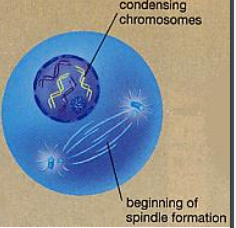
TELEOPHASE - 81. PROPHASECentrioles duplicate
and separate
Mitotic spindle
apparatus starts to form
Chromosomes (already
duplicated) condense
(why is it necessary?)
Nucleolus disappears
Nuclear membrane
breaks down
Microtubules attach to
the KINETOCHORE
Duplicated chromosomes
are pulled towards the
center of the cell - 92. METAPHASECHROMOSOMES align
at the center of the cell
(METAPHASE PLATE)
MITOTIC SPINDLES
linking CHROMOSOMES
to each pole are completed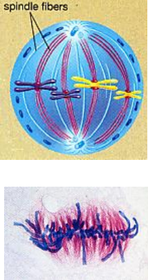
- 103. ANAPHASE• Microtubule spindles
contract
• SISTER CHROMATIDS
separate
• They are pulled towards
opposite poles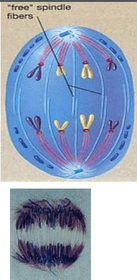
- 114. TELEOPHASESISTER CHROMATIDS
(now can refer to as
non-duplicated
chromosomes)
reach the poles of the cell
Chromosomes
(non duplicated)
de-condense
Nucleus reforms
CYTOKINESIS initiated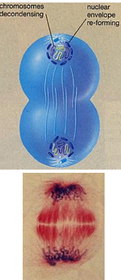
- 12CYTOKINESISDivision of the cytoplasm into 2 new cells
DIFFERENT between ANIMAL & PLANT cells
CYTOKINESIS in an ANIMAL CELL
Analogy:
Fluid-filled balloon - string around it is pulled tight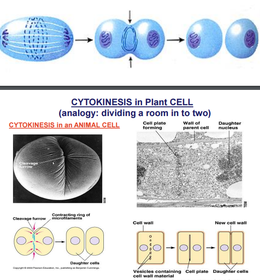
- 13What Is Cancer?Cancer is unrestrained cell growth and division
caused by damage to genes regulating the cell
division cycle.
Ex. The “guardian Angel gene”
p53 (tumor suppressor gene)
• This gene plays a key role in G1 check point.
The gene’s product p53 protein monitors the
integrity of DNA.
• If damage detected, halts the cell division and
stimulates the activity of enzymes to repair the
damage then allows to divide.
• If can’t be repaired, p53 directs the cell to
“commit suicide”, activating the cell’s
apoptosis program.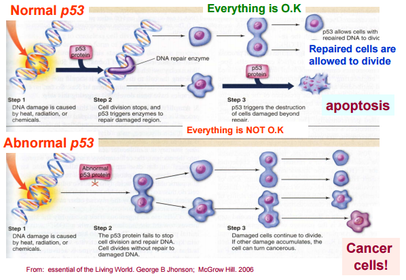
Information
- Description
- User has deleted their subject information Flashcards on BISC 100 - Lecture 21 : Cellular reproduction, created by Deleted user on 10/08/2016.
- Created by
- Deleted user
- Views
- 51
- Tags
- History
-
- Created by Chelsi Souch · Aug 10, 2016
- Copied by Chelsi Souch · Aug 10, 2016
- Rating