
Flashcards
BISC 100 - Lecture 23: DNA RNA

Cards in this deck (16)
- 1CELLS CONTAIN THOUSANDS OF DIFFERENT PROTEINSunique AA sequence
unique 3-D structure
a specific function
CELLS ALSO CONTAIN MEMBRANE SYSTEMS
AND ORGANELLES etc.
CELL MUST HAVE INFORMATION TO ORGANIZE ITSELF IN THIS
WAY AND, WHEN A CELL DIVIDES, THIS INFORMATION MUST BE
PASSED TO THE NEXT GENERATION - 2THE SEARCH FOR THE GENETIC MATERIALThe DNA molecule contains instructions for
the development and functioning of all
living organisms - 3FREDERICK GRIFFITHSMOVEMENT OF A SUBSTANCE
FROM ONE STRAIN OF
BACTERIA TO ANOTHER
TRANSFORMS
HARMLESS STRAINS
INTO PATHOGENIC
(disease causing) STRAINS - 4OSWALD AVERYREMOVED ALL PROTEIN
FROM R BACTERIA
BUT TRANSFORMING
ACTIVITY NOT REDUCED
DETAILED CHEMICAL AND BIOCHEMICAL
TESTS SHOWED THAT THE “TRANSFORMING
PRINCIPLE” PASSED FROM DEAD TO LIVING
BACTERIA WAS DNA!
DNA is the HEREDITARY MATERIAL! - 5THE GENTIC INSTRUCTION OF VIRUSES ARE CONTAINED IN DNABACTERIOPHAGE (bacteria infecting viruses)
INFECTING BACTERIAL CELL - 6ROSALIND FRANKLINX-RAY CRYSTALLOGRAPHIC
STRUCTURE OF DNA - 7WATSON AND CRICK (1953)PROPOSED THE STRUCTURE
OF DNA:
* That there were two
strands of nucleotides
in DNA
* That ONLY certain
combinations of bases
could pair with each
other
NOBEL PRIZE IN 1962 - 8DNA POLYNUCLEOTIDE
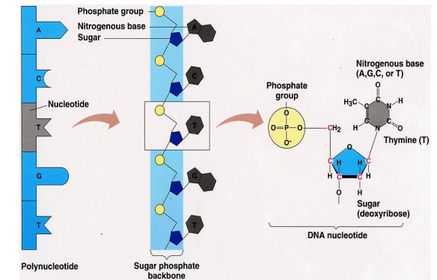
- 9CHEMICAL PROPERTIES OF THE THREE CHEMICAL COMPOUNDS IN NUCLEOTIDES• Phosphate group: Acidic and negatively
charged in basic pH
• Sugar : Pentose (5C)
Ribose in RNA and Deoxyribose in DNA
• Nitrogenous bases: A, T, G, C, U
(Adenine, Thymine, Guanine,Cytosine, Uracil)
A, G have two ring structure: Purines
G, C, U have one ring structure: Pyrimidines - 10DNA vs RNADNA has deoxyribose pentose sugar
RNA has Ribose pentose sugar
• DNA double stranded
RNA single stranded
• DNA has Pyrimidine: Thymine, Cytosine
RNA has pyrimidine: Uracil, Cytocine
Both have the purines: Adenine and Guanine - 11DNA REPLICATION Making more DNA in a cellOccurs in S phase of cell cycle
٭ Depends on specific base pairing
٭ Requires complete and faithful copies
of DNA be produced
٭ Each half of the double helix can act as a
template upon which, a new missing half
is built
٭ Each new double helix consists of one old and
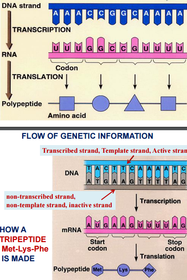
one new strand (semi-conservative ) - 12How does information in DNA is given to make proteins?Takes place via TWO processes:
1. Information in DNA is first
TRANSCRIBED INTO THAT OF RNA
2. Information in RNA is then
TRANSLATED INTO PROTEINS
(Nucleic acid language to Protein language)
– In eukaryotic cells,
• Transcription occurs in the nucleus.
• Translation occurs in the cytoplasm - 13FLOW OF GENETIC INFORMATION
- 14Translation is divided into three phases:•Initiation
• Elongation
• Termination - 15MUTATIONS: 2 Types1. Base substitutions
Point mutation
2. Base insertions
or Deletions
Frame shift mutations
Mutations may result from
• errors in DNA replication
transcription or recombination (crossing over) or
• physical or chemical agents
e.g., UV irradiation and chemicals called mutagens.
– Mutations are often harmful but are also useful in
nature and the laboratory as a source of genetic
diversity, which makes evolution by natural selection
possible - 16There are many ways chromosomes may rearrange: Chromosomes break naturally or due to exposure to radiation1. Duplication
2. Translocation
3. Inversion
4. Deletions
Information
- Description
- Flashcards on BISC 100 - Lecture 23: DNA RNA, created by Chelsi Souch on 10/08/2016.
- Created by
- Chelsi Souch
- Views
- 122
- Rating