
Flashcards
Surgery
Cards in this deck (88)
- 1For a Coeliotomy where should the incision be?Ventral midline 5cm caudal to Xiphoid and as far possible before mammary tissue
- 2How should you incise the lines alba?Lift with forceps and make a stab incision with a scalpel then cut along with scissor, round side down
- 3What do you need to record before you start an ET?How many corpus lutea
- 4Once the ovaries are exposed, what are the steps for ET?Stab incision into uterine horn after bifurcation by a small curved haemostat, insert catheter and inflate
Inject 20mL fluid into lumen near utero-tubal junction with blunt 20G needle
Collect fluid into petri dish - 5What do you need to suture after an ET?The uterine horn with a single stitch
- 6What fluid is used for ET?Phosphate buffered saline
- 7How do you close the peritoneum and abdominal wall?Simple interrupted
Do not have to include peritoneum
Monofilament synthetic absorbable, size 0 or larger - 8How do you close the SQ?Simple continuous or subcuticular suture
2/0 or 3/0 monofilament synthetic absorbable - 9How do you close the skin?Simple interrupted or interrupted vertical mattress
2/0 coated multifilament often non absorbable - 10What needs to be done before ET for the donor and recipient?Donor - super ovulated
Recipient - synchronised with donor - 11What day does ET occur in a cow?Day 7
- 12What is the different in technique of ET between large and small animals ?Small animals done surgically and large animals done through cervix
- 13Why can't older animals be ET donors?Do not respond well to super ovulation and may only have single embryo
- 14How does super ovulation occur?Prevents the dying of the first wave of follicles
FSH to grow follicles, LH to prevent death and PG to remove CL - 15What is the estimated survival of GDV?50%
- 16What are the two types of GDV?Air swallowed and stomach twisted
Large quantities of dead food in working dogs and stomach twisted - 17What is the normal rotation in a GDV?Ventromedially to lie on the left side of abdomen
- 18What is some anaesthetic considerations for GDV?Painful disease so requires higher level of anaesthetic
Higher risk
Pain relief - 19Why is GDV associated with shock?Decreased venous return and hypovolaemia
- 20What are the breed predisposition for GDV?Great dane, hunt away and GSD
- 21What are the GI effects of GDV?Accumulation of gas increases pressure
Capillary collapse and necrosis of mucosa
Haemorrhage into stomach
Bacterial infection - 22What are the CV and respiratory effects of GDV?Pain causes tachycardia and tachypnoea
Decreased venous return
Compressed diaphragm reduces ventilation - 23How do you differentiate from dilation and volvulus?Dilation won't be that sick, just uncomfortable
- 24What diagnostics should you do for GDV?Emergency so only radiographs to confirm
- 25What can be a good prognostic factor of GDV?Lactate
- 26What is the emergency stabilisation of GV?Catheter, fluids, pain meds and oxygen
Decompression
Antibiotics
If have poor pulse and BP - lidocaine - 27How do you decompress a GDV?Large long 14-16G bore needle into stomach
Stomach tube
Can remove contents during surgery - 28How can you prevent an awake patient from biting a stomach tube?Cardboard tape roll in patients mouth
- 29What indication on surgery suggests direction of twist?Omentum stretched over stomach then twist is clockwise
- 30How do you derotate a GDV/Grabbing duodenum and rotating while pushing stomach down
- 31What suggests necrotic GDV?Shiny, silver, grey or green is necrotic
Doesn't bleed - 32Which Gastropexy is preferred?Incisional
- 33How do you preform a GDV?Incise abdominal wall muscles
Assistant everts wall
Pinch stomach wall to separate submucosa and mucosa and tunnel under with haemostat and cut over the top - 34When is the best time to preform an OVE?Before second season or coming into heat (5-6 months)
- 35What is the difference between dogs and cats for OVE incision?Dogs - cranial extent of umbilicus scar
Cats - between umbilicus and pubis - 36What is a flank spay CI for?Point cats as fur may grow back a different colour
- 37What animal has a long term risk of EAN?Bitches - urinary incontinence
- 38Which animals should you break vs stretch ligament in for OVE?Cat - stretch
Dog - break - 39What type of ligature is used on the ovarian pedicle?Circumferential
- 40What does IM pins and cerclage prevent?IM pins stop bending
Cerclage wire stops shearing and rotation - 41What is a reconstructable fracture?Anatomical reconstructed
Primary bone healing
Load sharing with implants - 42What is a non reconstructible fracture?Cannot put them back together to make load sharing so implant takes all weight
Biological repair
Leave fracture and blood supply intact - 43When can you use an IM pin without cerclage?Interlocking simple fractures in young patients
Transverse fracture - 44When is cerclage CI?Young animals as may cause ring bark bone
- 45What bone should you never put an IM ipn in?Femur, tibia and humerus
- 46What should you ensure your pin in in ?Medullary bone from either end
- 47When is IM CI?Communited fractures, open fractures, wide bones
Never as sole means of fixation for transverse - 48What bones do you approach normograde for IM?Femur to avoid hip joint and sciatic nerve
Tibia to avoid stifle joint - 49What is dowel pinning?IM pin that has no access points (all internal)
- 50When do you use dowel pinning?Paired bones as stability is from multiple pins and splint
Metacarpal bones as no way of pinning without damaging joint - 51What is the benefit of a Jacobs Chuck over a electric drill?Complete sterility
- 52How do you not hold a Jacobs Chuck?Back end in the palm (pin may go through)
- 53What is the minimum cerclage wires you can use?2
- 54What wire sizes are appropriate for different sizes of animals?Large dog - 18G
Medium dog - 20G
Small dog and cat - 22G - 55What part of the bone must you place your cerclage?Narrowest
- 56What is interfragmentary cerclage?Small IM pins have cerclage wire looped around external part
- 57What is tension banding?Compression using two wires in the bone in a figure of 8
- 58What are the problems of cerclage?Loose loops damage blood supply
Prevent bone growth in young animals - 59What may cause implant failure?Incorrect placement
Undersized or of poor quality
Infection
Excessive movement
Damage to BV - 60What are the potential outcomes of fracture repair failure?Malunion - functional or non-functional
Delayed Union
Non-union
Sequestrum and involucrum - 61What does hypertrophic bone activity appear like?Elephants food
Indicates lack of stability - 62What increases the risk of surgical infection?Long surgeries, implant use, tissue trauma
- 63Why does implant use increase the risk of surgical infectionAllows biofilm to form which harbours bacteria and the body cannot fight
If the immune system is compromised or there is movement bacteria is release and spread haematogenously - 64What is done to reduce the risk of sruvial infection?High dose of IV cephalosporin at induction
- 65What type of fracture still has a high risk of infection despite proper care?Grade 3 open fracture - skin, muscle and ligament removes with a possible open joint
- 66What should be done with an open fracture to reduce contamination?Cover as soon as possible
Only use sterile equipment
High hygiene standards to prevent contamination from hospital bacteria - 67What is a dystrophic non union?Bone has been remodelled at the end
- 68What is the different types of inactive non unions?Dystrophic, necrotic, defective, and atrophic
- 69What is a defective inactive non union?May not try to bridge the bone gap
- 70What is atrophic inactive non union?May never heal completely
- 71What is inactive non unions common in toy breeds?Small amount of blood supply from muscle and medullar cavity
- 72What is most important for recruitment of new blood supply for bone?Extra osseous muscle
- 73How do toy breed fractures heal?Primary bone healing - anatomical reconstruction and complete immobilisation (plate)
- 74What are the different types of plates?Compression, neutralisation, bridging
- 75Where should the plates be placed?On the tension side of the bone
- 76What is a compression plate used for?Load sharing transverse or very short oblique
- 77What is a neutralisation plate used for?Oblique fractures to stop rotation
- 78What does a bridging plate do?Takes all the load across a fracture
- 79What size should a bridging plate be?The entire length of the bone
- 80What should be done before you do the lateral fabellar suture?Arthrotomy to examine ligament and meniscus for damage
- 81How do you preform a lateral fabellar suture?Pass suture around cranial half of fabellar proximal to distal
Drill hole with IM pin through tibial crest from lateral to medial
Crimp suture - 82What can be used to repair the tendon and ligament?3-loop pulley or locking loop suture
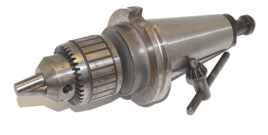
- 83What type of instrument is this and what is it used for?Jacobs chuck
IM pin insertion - 84What type of repair is this?Hemi-cerclage
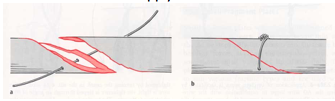
- 85What type of repair is this?Inter-fragmentary K wires
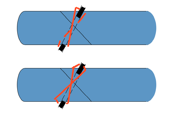
- 86What type of repair is this?Lateral fabella suture for cruciate repair
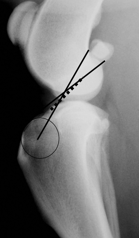
- 87What type of repair is this?Locking loop suture
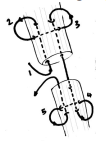
- 88What type of repair is this?Three loop pulley system
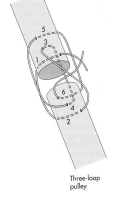
Information
- Description
- Level 4 Medicine (Practicals) Flashcards on Surgery, created by Siobhan Ellis on 28/09/2016.
- Created by
- Siobhan Ellis
- Views
- 2
- Rating