
Flowchart
Untitled
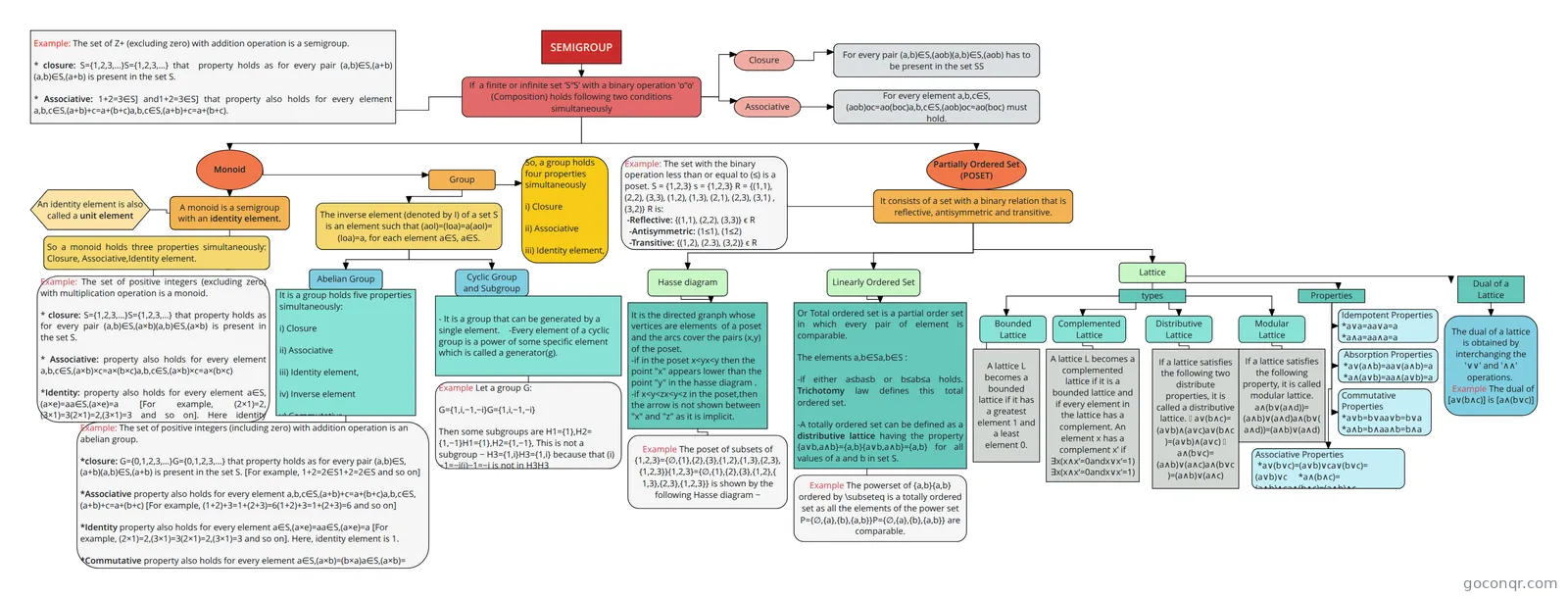
Flowchart: semigroup, monoid and group
Flowchart content
SEMIGROUP
If a finite or infinite set ‘S′‘S′ with a binary operation ‘ο′‘ο′ (Composition) holds following two conditions simultaneously
Closure
Associative
For every pair (a,b)∈S,(aοb)(a,b)∈S,(aοb) has to be present in the set SS
For every element a,b,c∈S,(aοb)οc=aο(bοc)a,b,c∈S,(aοb)οc=aο(bοc) must hold.
Example: The set of Z+ (excluding zero) with addition operation is a semigroup.
* closure: S={1,2,3,…}S={1,2,3,…} that property holds as for every pair (a,b)∈S,(a+b)(a,b)∈S,(a+b) is present in the set S.
* Associative: 1+2=3∈S] and1+2=3∈S] that property also holds for every element a,b,c∈S,(a+b)+c=a+(b+c)a,b,c∈S,(a+b)+c=a+(b+c).
Monoid
A monoid is a semigroup with an identity element.
An identity element is also called a unit element
So a monoid holds three properties simultaneously: Closure, Associative,Identity element.
Example: The set of positive integers (excluding zero) with multiplication operation is a monoid.
* closure: S={1,2,3,…}S={1,2,3,…} that property holds as for every pair (a,b)∈S,(a×b)(a,b)∈S,(a×b) is present in the set S.
* Associative: property also holds for every element a,b,c∈S,(a×b)×c=a×(b×c)a,b,c∈S,(a×b)×c=a×(b×c)
*Identity: property also holds for every element a∈S,(a×e)=aa∈S,(a×e)=a [For example, (2×1)=2,(3×1)=3(2×1)=2,(3×1)=3 and so on]. Here identity element is 1.
Group
Abelian Group
Cyclic Group and Subgroup
The inverse element (denoted by I) of a set S is an element such that (aοI)=(Iοa)=a(aοI)=(Iοa)=a, for each element a∈S, a∈S.
So, a group holds four properties simultaneously
i) Closure
ii) Associative
iii) Identity element,
iv) Inverse element.
It is a group holds five properties simultaneously:
i) Closure
ii) Associative
iii) Identity element,
iv) Inverse element
v) Commutative.
- It is a group that can be generated by a single element. -Every element of a cyclic group is a power of some specific element which is called a generator(g).
Example Let a group G:
G={1,i,−1,−i}G={1,i,−1,−i}
Then some subgroups are H1={1},H2={1,−1}H1={1},H2={1,−1}, This is not a subgroup − H3={1,i}H3={1,i} because that (i)−1=−i(i)−1=−i is not in H3H3
Partially Ordered Set (POSET)
It consists of a set with a binary relation that is reflective, antisymmetric and transitive.
Example: The set with the binary operation less than or equal to (≤) is a poset. S = {1,2,3} s = {1,2,3} R = {(1,1), (2,2), (3,3), (1,2), (1,3), (2,1), (2,3), (3,1) , (3,2)} R is: -Reflective: {(1,1), (2,2), (3,3)} ϵ R -Antisymmetric: (1≤1), (1≤2) -Transitive: {(1,2), (2.3), (3,2)} ϵ R
Hasse diagram
It is the directed granph whose vertices are elements of a poset and the arcs cover the pairs (x,y) of the poset.
-if in the poset x<yx<y then the point "x" appears lower than the point "y" in the hasse diagram .
-if x<y<zx<y<z in the poset,then the arrow is not shown between "x" and "z" as it is implicit.
Example The poset of subsets of {1,2,3}={∅,{1},{2},{3},{1,2},{1,3},{2,3},{1,2,3}}{1,2,3}={∅,{1},{2},{3},{1,2},{ 1,3},{2,3},{1,2,3}} is shown by the following Hasse diagram −
Linearly Ordered Set
Example: The set of positive integers (including zero) with addition operation is an abelian group.
*closure: G={0,1,2,3,…}G={0,1,2,3,…} that property holds as for every pair (a,b)∈S,(a+b)(a,b)∈S,(a+b) is present in the set S. [For example, 1+2=2∈S1+2=2∈S and so on]
*Associative property also holds for every element a,b,c∈S,(a+b)+c=a+(b+c)a,b,c∈S,(a+b)+c=a+(b+c) [For example, (1+2)+3=1+(2+3)=6(1+2)+3=1+(2+3)=6 and so on]
*Identity property also holds for every element a∈S,(a×e)=aa∈S,(a×e)=a [For example, (2×1)=2,(3×1)=3(2×1)=2,(3×1)=3 and so on]. Here, identity element is 1.
*Commutative property also holds for every element a∈S,(a×b)=(b×a)a∈S,(a×b)=(b×a) [For example, (2×3)=(3×2)=3(2×3)=(3×2)=3 and so on]
Or Total ordered set is a partial order set in which every pair of element is comparable.
The elements a,b∈Sa,b∈S :
-if either a≤ba≤b or b≤ab≤a holds. Trichotomy law defines this total ordered set.
-A totally ordered set can be defined as a distributive lattice having the property {a∨b,a∧b}={a,b}{a∨b,a∧b}={a,b} for all values of a and b in set S.
Example The powerset of {a,b}{a,b} ordered by \subseteq is a totally ordered set as all the elements of the power set P={∅,{a},{b},{a,b}}P={∅,{a},{b},{a,b}} are comparable.
Lattice
Bounded Lattice
Complemented Lattice
Distributive Lattice
Modular Lattice
types
Properties
If a lattice satisfies the following property, it is called modular lattice. a∧(b∨(a∧d))=(a∧b)∨(a∧d)a∧(b∨(a∧d))=(a∧b)∨(a∧d)
If a lattice satisfies the following two distribute properties, it is called a distributive lattice. a∨(b∧c)=(a∨b)∧(a∨c)a∨(b∧c)=(a∨b)∧(a∨c) a∧(b∨c)=(a∧b)∨(a∧c)a∧(b∨c)=(a∧b)∨(a∧c)
A lattice L becomes a complemented lattice if it is a bounded lattice and if every element in the lattice has a complement. An element x has a complement x’ if ∃x(x∧x′=0andx∨x′=1)∃x(x∧x′=0andx∨x′=1)
A lattice L becomes a bounded lattice if it has a greatest element 1 and a least element 0.
Idempotent Properties *a∨a=aa∨a=a *a∧a=aa∧a=a
Absorption Properties *a∨(a∧b)=aa∨(a∧b)=a *a∧(a∨b)=aa∧(a∨b)=a
Commutative Properties *a∨b=b∨aa∨b=b∨a *a∧b=b∧aa∧b=b∧a
Associative Properties *a∨(b∨c)=(a∨b)∨ca∨(b∨c)=(a∨b)∨c *a∧(b∧c)=(a∧b)∧ca∧(b∧c)=(a∧b)∧c
Dual of a Lattice
The dual of a lattice is obtained by interchanging the '∨∨' and '∧∧' operations. Example The dual of [a∨(b∧c)] is [a∧(b∨c)]
Information
- Description
- Flowchart on Untitled, created by STEFFI BECERRA TAPIA on 15/05/2020.
- Created by
- STEFFI BECERRA TAPIA
- Views
- 0
- Rating