
Flowchart
ATRIUM CAPABILITIES
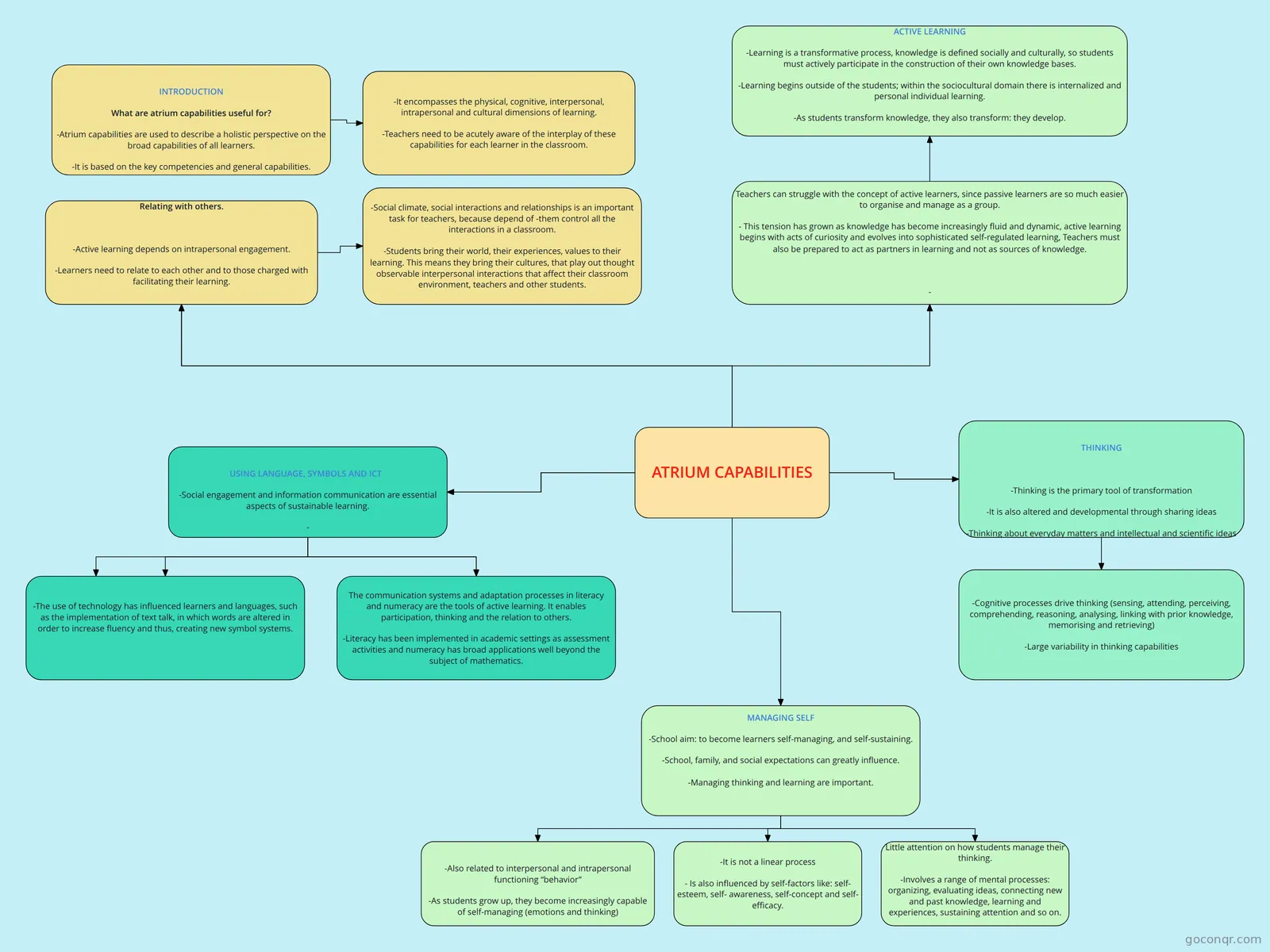
Flowchart: Atrium capabilities
Flowchart content
INTRODUCTION
What are atrium capabilities useful for?
-Atrium capabilities are used to describe a holistic perspective on the broad capabilities of all learners.
-It is based on the key competencies and general capabilities.
THINKING
-Thinking is the primary tool of transformation
-It is also altered and developmental through sharing ideas
-Thinking about everyday matters and intellectual and scientific ideas needs to be integrated
USING LANGUAGE, SYMBOLS AND ICT
-Social engagement and information communication are essential aspects of sustainable learning.
-
-
MANAGING SELF
-School aim: to become learners self-managing, and self-sustaining.
-School, family, and social expectations can greatly influence.
-Managing thinking and learning are important.
ATRIUM CAPABILITIES
The communication systems and adaptation processes in literacy and numeracy are the tools of active learning. It enables participation, thinking and the relation to others.
-Literacy has been implemented in academic settings as assessment activities and numeracy has broad applications well beyond the subject of mathematics.
-The use of technology has influenced learners and languages, such as the implementation of text talk, in which words are altered in order to increase fluency and thus, creating new symbol systems.
Little attention on how students manage their thinking.
-Involves a range of mental processes: organizing, evaluating ideas, connecting new and past knowledge, learning and experiences, sustaining attention and so on.
-
-Also related to interpersonal and intrapersonal functioning “behavior”
-As students grow up, they become increasingly capable of self-managing (emotions and thinking)
-Cognitive processes drive thinking (sensing, attending, perceiving, comprehending, reasoning, analysing, linking with prior knowledge, memorising and retrieving)
-Large variability in thinking capabilities
ACTIVE LEARNING
-Learning is a transformative process, knowledge is defined socially and culturally, so students must actively participate in the construction of their own knowledge bases.
-Learning begins outside of the students; within the sociocultural domain there is internalized and personal individual learning.
-As students transform knowledge, they also transform: they develop.
Teachers can struggle with the concept of active learners, since passive learners are so much easier to organise and manage as a group.
- This tension has grown as knowledge has become increasingly fluid and dynamic, active learning begins with acts of curiosity and evolves into sophisticated self-regulated learning, Teachers must also be prepared to act as partners in learning and not as sources of knowledge.
-
Relating with others.
-Active learning depends on intrapersonal engagement.
-Learners need to relate to each other and to those charged with facilitating their learning.
-It encompasses the physical, cognitive, interpersonal, intrapersonal and cultural dimensions of learning.
-Teachers need to be acutely aware of the interplay of these capabilities for each learner in the classroom.
-Social climate, social interactions and relationships is an important task for teachers, because depend of -them control all the interactions in a classroom.
-Students bring their world, their experiences, values to their learning. This means they bring their cultures, that play out thought observable interpersonal interactions that affect their classroom environment, teachers and other students.
-It is not a linear process
- Is also influenced by self-factors like: self-esteem, self- awareness, self-concept and self-efficacy.