
Flowchart
Subordination I: Adjunct clauses

Flowchart content
Adjunct clauses
often called 'circumstantial clauses' as they describe the circumstances of the main clause verb and flesh out some aspects of its meaning.
Adjunct clauses are subordinate clauses , ie clauses that are somehow dependent of a main clause and do not themselves constitute an 'independent thought' or statement. Traditionally divided according to the following properties:
B
what structural function does the subordinate clause serve vis-a-vis the main clause. Adjuncts typically serve an adverbial function (they describe the main clause verb)
A
What is the role of the subordinate clauses in terms of meaning. For example, adjunct clauses add further information about the manner, time and place of the main clause situation.
C
whether the subordinate clause show some explicit grammatical marker of its subordinate status, and if so, of what sort. similarly, what is the effect that this has on the clasue form.
Unmarked adjunct clauses
expresses relative past & present
Marked adjunct clasues
show no explicit marker of their subordinate status
Formed out of closed group of verbal (one) and non-verbal forms and constructions:
Unmarked adjunct clasuses are unmarked in terms of both from and meaning
marks exact meaning- and structural interrelationship between the main and circumstantial clause
MEg used wide range of prepositions to intruduce adjunct clauses where the preposition signals that a clause serves as an adjunct and there are two important types
there is no subordinating word or other element(such as the English and Swedish adjunct markers when, because or när etc.) nor are there forms used in such clauses specialized for adjunct use.
The construction (subject) + Hr +infinitive
Present sDm=f
The adverbial sentence
Past passive sDm A
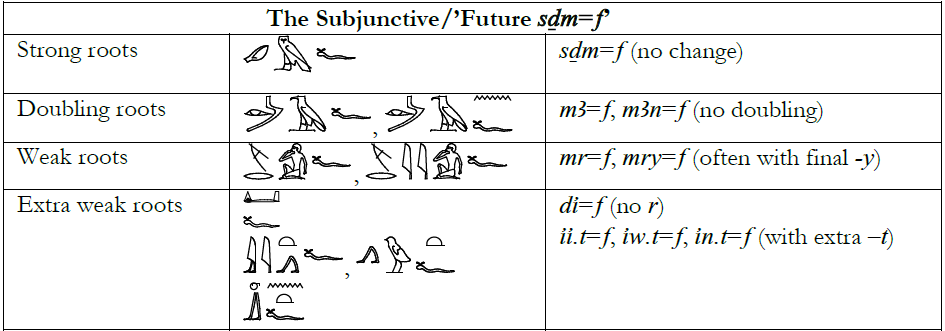
Subjunctive sDm=f
characteristic and favoured feature of narrative texts
Most commom prepositions



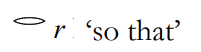
Bare sDm=f
ntt-introduced clauses:
the clause following the preposition is preceded by ntt. restricted to prepositions expressing cause
Geminating sDm=f
Subjunctive sDm=f
'so-that' expresses relative future






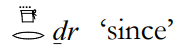
unlike the un-marked adjunct clauses both types of marked preposition introduced adjunct clauses show the exact grammatical relation between main- and the subordinate clause and the status of the latter as an adjunct is explicitly marked by the preposition
Negative Adjunct clauses
The negations n-sDm=f and n sDm-n=f that can be used in unmarked relative past and present adjunct clauses can also be used marked adjunct clauses after causal prepositions in combination with the introducing element ntt
NEGATION
The negations n-sDm=f and n sDm-n=f can be used in unmarked relative past and present adjunct clauses without any introducing element
only used in adjuncts
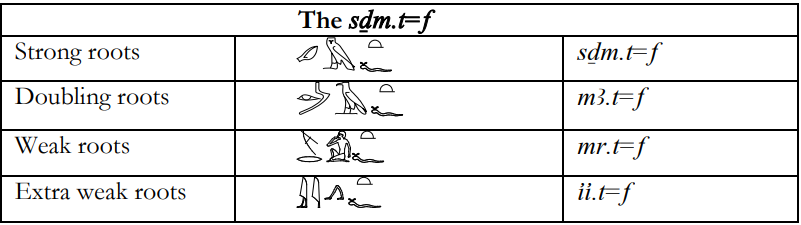
The sDm.t=f form (not an independent verb form)
Characteristic of the sDm.t=y is the .t ending in all root classes
found in three fixed environments:
After the negation n meaning 'x had not yet heard' (n sDm.t=f)
after the preposition r meaning 'until hea hears/has heard' (r sDm.t=f)
After the preposition Dr meaning 'before he hears' (Dr sDm.t=f)
expresses relative past, present and future
expresses relative future
expresses relative present
the stative
The sDm-n=f
expresses relative past
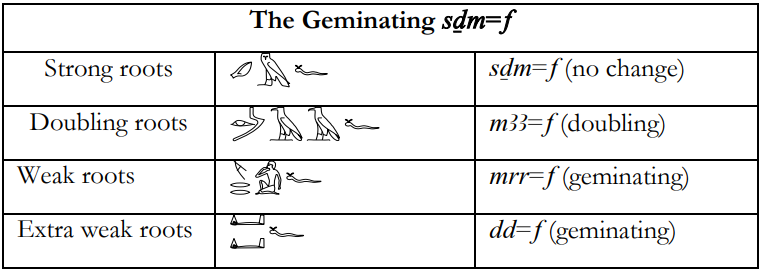
doubles the last but one consonant in weak and extra weak roots
Information
- Description
- bachelors degree Egyptology (MEg II) Flowchart on Subordination I: Adjunct clauses, created by Henric Gravander on 17/08/2018.
- Created by
- Henric Gravander · Aug 2018
- Updated
- Aug 19, 2018
- Views
- 100
- Tags
- Rating