
Mind map
ISCHEMIC STROKE
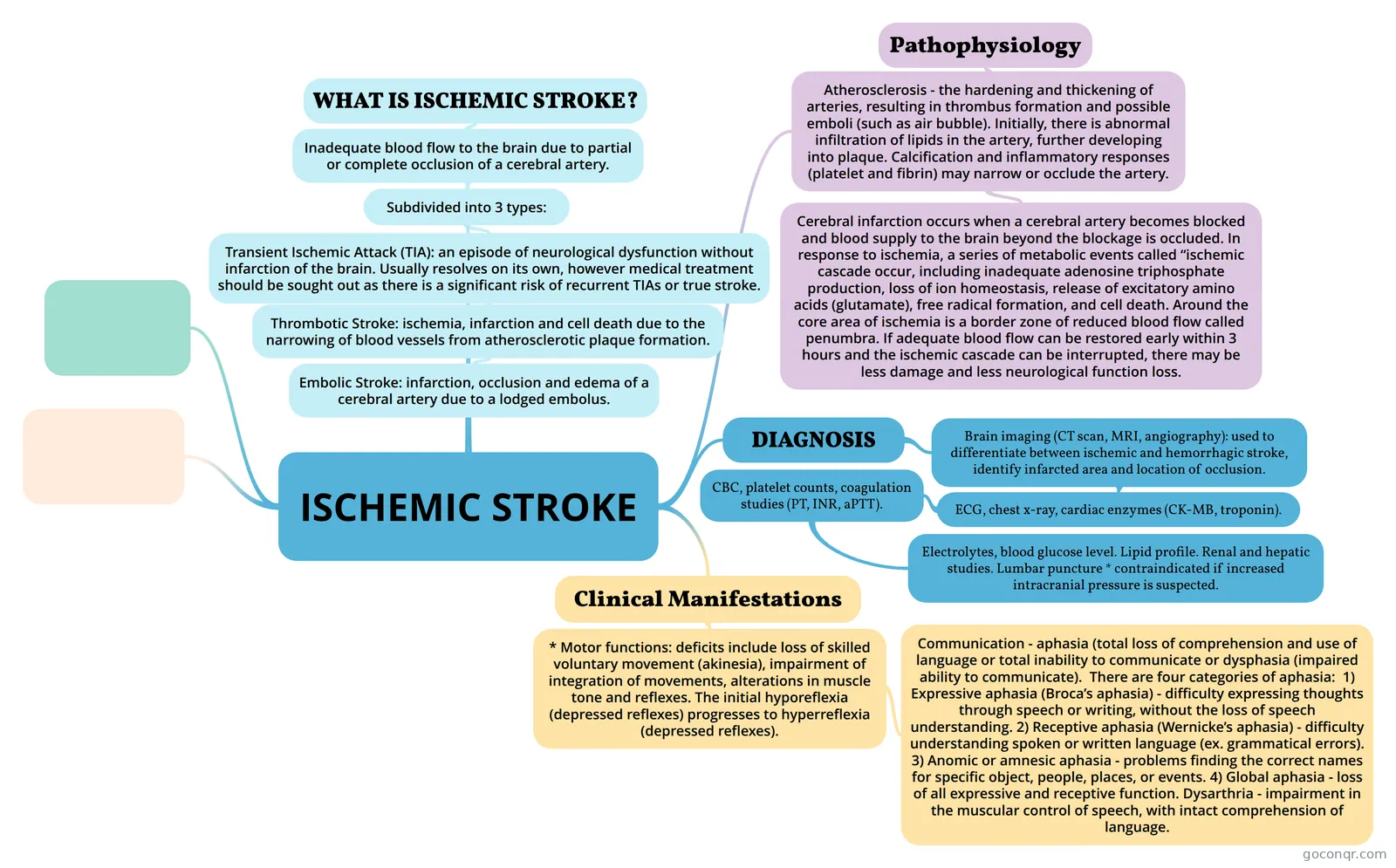
Mind map: Ischemic stroke
Map content
ISCHEMIC STROKE
Clinical Manifestations
- * Motor functions: deficits include loss of skilled voluntary movement (akinesia), impairment of integration of movements, alterations in muscle tone and reflexes. The initial hyporeflexia (depressed reflexes) progresses to hyperreflexia (depressed reflexes).
- Communication - aphasia (total loss of comprehension and use of language or total inability to communicate or dysphasia (impaired ability to communicate). There are four categories of aphasia: 1) Expressive aphasia (Broca’s aphasia) - difficulty expressing thoughts through speech or writing, without the loss of speech understanding. 2) Receptive aphasia (Wernicke’s aphasia) - difficulty understanding spoken or written language (ex. grammatical errors). 3) Anomic or amnesic aphasia - problems finding the correct names for specific object, people, places, or events. 4) Global aphasia - loss of all expressive and receptive function. Dysarthria - impairment in the muscular control of speech, with intact comprehension of language.
- * Motor functions: deficits include loss of skilled voluntary movement (akinesia), impairment of integration of movements, alterations in muscle tone and reflexes. The initial hyporeflexia (depressed reflexes) progresses to hyperreflexia (depressed reflexes).
Atherosclerosis - the hardening and thickening of arteries, resulting in thrombus formation and possible emboli (such as air bubble). Initially, there is abnormal infiltration of lipids in the artery, further developing into plaque. Calcification and inflammatory responses (platelet and fibrin) may narrow or occlude the artery.
- Pathophysiology
- Cerebral infarction occurs when a cerebral artery becomes blocked and blood supply to the brain beyond the blockage is occluded. In response to ischemia, a series of metabolic events called “ischemic cascade occur, including inadequate adenosine triphosphate production, loss of ion homeostasis, release of excitatory amino acids (glutamate), free radical formation, and cell death. Around the core area of ischemia is a border zone of reduced blood flow called penumbra. If adequate blood flow can be restored early within 3 hours and the ischemic cascade can be interrupted, there may be less damage and less neurological function loss.
Inadequate blood flow to the brain due to partial or complete occlusion of a cerebral artery.
- WHAT IS ISCHEMIC STROKE?
- Subdivided into 3 types:
- Transient Ischemic Attack (TIA): an episode of neurological dysfunction without infarction of the brain. Usually resolves on its own, however medical treatment should be sought out as there is a significant risk of recurrent TIAs or true stroke.
- Thrombotic Stroke: ischemia, infarction and cell death due to the narrowing of blood vessels from atherosclerotic plaque formation.
- Embolic Stroke: infarction, occlusion and edema of a cerebral artery due to a lodged embolus.
- Thrombotic Stroke: ischemia, infarction and cell death due to the narrowing of blood vessels from atherosclerotic plaque formation.
- Transient Ischemic Attack (TIA): an episode of neurological dysfunction without infarction of the brain. Usually resolves on its own, however medical treatment should be sought out as there is a significant risk of recurrent TIAs or true stroke.
DIAGNOSIS
- Brain imaging (CT scan, MRI, angiography): used to differentiate between ischemic and hemorrhagic stroke, identify infarcted area and location of occlusion.
- ECG, chest x-ray, cardiac enzymes (CK-MB, troponin).
- CBC, platelet counts, coagulation studies (PT, INR, aPTT).
- Electrolytes, blood glucose level. Lipid profile. Renal and hepatic studies. Lumbar puncture * contraindicated if increased intracranial pressure is suspected.
- CBC, platelet counts, coagulation studies (PT, INR, aPTT).
- ECG, chest x-ray, cardiac enzymes (CK-MB, troponin).
- Brain imaging (CT scan, MRI, angiography): used to differentiate between ischemic and hemorrhagic stroke, identify infarcted area and location of occlusion.
Information
- Description
- Mind Map on ISCHEMIC STROKE, created by Jericho David Pataueg on 18/10/2017.
- Created by
- Jericho David Pataueg
- Views
- 2
- Rating