
Mind map
Principles: Histology
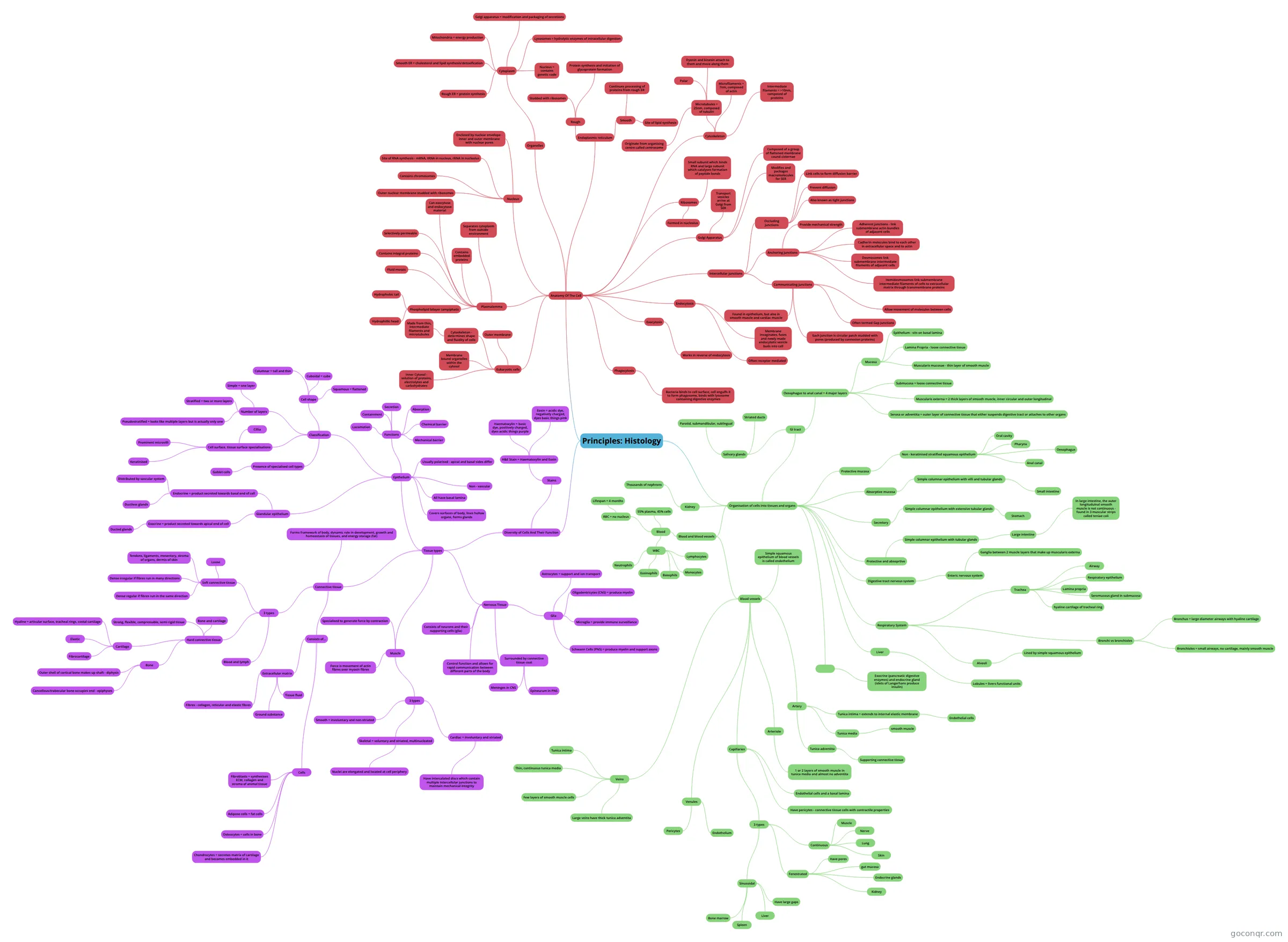
Mind map: Histology Principles
Map content
Principles: Histology
Anatomy Of The Cell
- Eukaryotic cells
- Outer membrane
- Inner Cytosol - solution of proteins, electrolytes and carbohydrates
- Cytoskeleton - determines shape and fluidity of cells
- Made from thin, intermediate filaments and microtubules
- Membrane bound organelles within the cytosol
- Plasmalemma
- Separates cytoplasm from outside environment
- Phospholipid bilayer (ampiphatic
- Hydrophillic head
- Hydrophobic tail
- Contains integral proteins
- Can exocytose and endocytose material
- Fluid mosaic
- Selectively permeable
- Contains embedded proteins
- Organelles
- Cytoplasm
- Mitochondria = energy production
- Rough ER = protein synthesis
- Smooth ER = cholesterol and lipid synthesis/detoxification
- Golgi apparatus = modification and packaging of secretions
- Lysosomes = hydrolytic enzymes of intracellular digestion
- Nucleus = contains genetic code
- Cytoplasm
- Cytoskeleton
- Microfilaments = 7nm, composed of actin
- Intermediate filaments = >10nm, composed of proteins
- Microtubules = 25nm, composed of tubulin
- Originate from organising centre called centrosome
- Polar
- Dyenin and kinesin attach to them and move along them
- Nucleus
- Enclosed by nuclear envelope - inner and outer membrane with nuclear pores
- Outer nuclear membrane studded with ribosomes
- Contains chromosomes
- Site of RNA synthesis - mRNA, tRNA in nucleus, rRNA in nucleolus
- Ribosomes
- Formed in nucleolus
- Small subunit which binds RNA and large subunit which catalyses formation of peptide bonds
- Endoplasmic reticulum
- Rough
- Studded with ribosomes
- Protein synthesis and initiation of glycoprotein formation
- Smooth
- Continues processing of proteins from rough ER
- Site of lipid synthesis
- Rough
- Golgi Apparatus
- Composed of a group of flattened membrane cound cisternae
- Transport vesicles arrive at Golgi from SER
- Modifies and packages macromolecules for SER
- Intercellular junctions
- Occluding junctions
- Link cells to form diffusion barrier
- Prevent diffusion
- Also known as tight junctions
- Anchoring junctions
- Provide mechanical strength
- Adherent junctions - link submembrane actin bundles of adjacent cells
- Cadherin molecules bind to each other in extracellular space and to actin
- Desmosomes link submembrane intermediate filaments of adjacent cells
- Hemidesmosomes link submembrane intermediate filaments of cells to extracellular matrix through transmembrane proteins
- Communicating junctions
- Allow movement of molecules between cells
- Often termed Gap Junctions
- Each junction is circular patch studded with pores (produced by connexion proteins)
- Found in epithelium, but also in smooth muscle and cardiac muscle
- Occluding junctions
- Endocytosis
- Membrane invaginates, fuses and newly made endocytotic vesicle buds into cell
- Often receptor mediated
- Exocytosis
- Works in reverse of endocytosis
- Phagocytosis
- Bacteria binds to cell surface, cell engulfs it to form phagosome, binds with lysosome containing digestive enzymes
- Eukaryotic cells
Diversity of Cells And Their Function
- Stains
- H&E Stain = Haematoxylin and Eosin
- Eosin = acidic dye, negatively charged, dyes basic things pink
- Haematoxylin = basic dye, positively charged, dyes acidic things purple
- H&E Stain = Haematoxylin and Eosin
- Tissue types
- Epithelium
- Covers surfaces of body, lines hollow organs, forms glands
- All have basal lamina
- Non - vascular
- Usually polarised - apical and basal sides differ
- Functions
- Mechanical barrier
- Chemical barrier
- Absorption
- Secretion
- Containment
- Locomotion
- Classification
- Cell shape
- Squamous = flattened
- Cuboidal = cube
- Columnar = tall and thin
- Number of layers
- Simple = one layer
- Stratified = two or more layers
- Pseudostratified = looks like multiple layers but is actually only one
- Cell surface, tissue surface specialisations
- Prominent microvilli
- Cillia
- Keratinised
- Presence of specialised cell types
- Goblet cells
- Cell shape
- Glandular epithelium
- Endocrine = product secreted towards basal end of cell
- Distributed by vascular system
- Ductless glands
- Exocrine = product secreted towards apical end of cell
- Ducted glands
- Endocrine = product secreted towards basal end of cell
- Connective tissue
- Forms framework of body, dynamic role in development, growth and homeostasis of tissues, and energy storage (fat)
- 3 types
- Soft connective tissue
- Loose
- Tendons, ligaments, mesentery, stroma of organs, dermis of skin
- Dense irregular if fibres run in many directions
- Dense regular if fibres run in the same direction
- Hard connective tissue
- Bone and cartilage
- Strong, flexible, compressable, semi-rigid tissue
- Cartilage
- Hyaline = articular surface, tracheal rings, costal cartilage
- Elastic
- Fibrocartilage
- Bone
- Outer shell of cortical bone makes up shaft - diphysis
- Cancellous/trabecular bone occupies end - epiphyses
- Blood and lymph
- Soft connective tissue
- Consists of...
- Extracellular matrix
- Fibres - collagen, reticular and elastic fibres
- Ground substance
- Tissue fluid
- Cells
- Fibroblasts = synthesises ECM, collagen and stroma of animal tissue
- Adipose cells = fat cells
- Osteocytes = cells in bone
- Chondrocytes = secretes matrix of cartilage and becomes embedded in it
- Extracellular matrix
- Muscle
- Specialised to generate force by contraction
- Force is movement of actin fibres over myosin fibres
- 3 types
- Smooth = involuntary and non-striated
- Skeletal = voluntary and striated, multinucleated
- Nuclei are elongated and located at cell periphery
- Cardiac = involuntary and striated
- Have intercalated discs which contain multiple intercellular junctions to maintain mechanical integrity
- Nervous Tissue
- Consists of neurons and their supporting cells (glia)
- Control function and allows for rapid communication between different parts of the body
- Surrounded by connective tissue coat
- Meninges in CNS
- Epineurum in PNS
- Glia
- Astrocytes = support and ion transport
- Oligodentricytes (CNS) = produce myelin
- Microglia = provide immune surveillance
- Schwann Cells (PNS) = produce myelin and support axons
- Epithelium
- Stains
Organisation of cells into tissues and organs
- GI tract
- Salivary glands
- Parotid, submandibular, sublingual
- Striated ducts
- Oesophagus to anal canal = 4 major layers
- Mucosa
- Epithelium - sits on basal lamina
- Lamina Propria - loose connective tissue
- Muscularis mucosae - thin layer of smooth muscle
- Submucosa = loose connective tissue
- Muscularis externa = 2 thick layers of smooth muscle, inner circular and outer longitudinal
- Serosa or adventita = outer layer of connective tissue that either suspends digestive tract or attaches to other organs
- Mucosa
- Salivary glands
- Protective mucosa
- Non - keratinised stratified squamous epithelium
- Oral cavity
- Pharynx
- Oesophagus
- Anal canal
- Non - keratinised stratified squamous epithelium
- Absorptive mucosa
- Simple columnar epithelium with villi and tubular glands
- Small intestine
- Simple columnar epithelium with villi and tubular glands
- Secretory
- Simple columnar epithelium with extensive tubular glands
- Stomach
- Simple columnar epithelium with extensive tubular glands
- Protective and absoprtive
- Simple columnar epithelium with tubular glands
- Large intestine
- In large intestine, the outer longituduinal smooth muscle is not continuous - found in 3 muscular strips called teniae coli
- Large intestine
- Simple columnar epithelium with tubular glands
- Kidney
- Thousands of nephrons
- Digestive tract nervous system
- Enteric nervous system
- Ganglia between 2 muscle layers that make up muscularis externa
- Enteric nervous system
- Respiratory System
- Trachea
- Airway
- Respiratory epithelium
- Lamina propria
- Seromucous gland in submucosa
- hyaline cartilage of tracheal ring
- Bronchi vs bronchioles
- Bronchus = large diameter airways with hyaline cartilage
- Bronchioles = small airways, no cartilage, mainly smooth muscle
- Alveoli
- Lined by simple squamous epithelium
- Trachea
- Liver
- Lobules = livers functional units
- Exocrine (pancreatic digestive enzymes) and endocrine gland (islets of Langerhans produce insulin)
- Blood and blood vessels
- Blood
- 55% plasma, 45% cells
- RBC = no nucleus
- Lifespan = 4 months
- WBC
- Neutrophils
- Eosinophils
- Basophils
- Monocytes
- Lymphocytes
- Blood vessels
- Artery
- Tunica intima = extends to internal elastic membrane
- Endothelial cells
- Tunica media
- smooth muscle
- Tunica adventita
- Supporting connective tissue
- Tunica intima = extends to internal elastic membrane
- Simple squamous epithelium of blood vessels is called endothelium
- Arteriole
- 1 or 2 layers of smooth muscle in tunica media and almost no adventita
- Capillaries
- Endothelial cells and a basal lamina
- Have pericytes - connective tissue cells with contractile properties
- 3 types
- Continuous
- Muscle
- Nerve
- Lung
- Skin
- Fenestrated
- Have pores
- gut mucosa
- Endocrine glands
- Kidney
- Sinusoidal
- Have large gaps
- Liver
- Spleen
- Bone marrow
- Continuous
- Venules
- Endothelium
- Pericytes
- Veins
- Tunica intima
- Thin, continuous tunica media
- Few layers of smooth muscle cells
- Large veins have thick tunica adventita
- Artery
- Blood
- GI tract
Information
- Description
- Mind Map on Principles: Histology, created by Joanne McEwan on 27/10/2017.
- Created by
- Joanne McEwan
- Views
- 4
- Rating
More on Cell Organelles and Cytoplasm