
Mind map
QUANTUM PHYSICS
Map content
QUANTUM PHYSICS
wave-particle duality: sth. bH either as a particle or as a wave (depends on the situation it is placed).
- wave nature: interference, diffraction. particle nature: photoelectric effect.
- have wave-like properties/natures or particle-like properties/natures
- de Broglie wavelength/ matter wavelength: λ=h/p
- de Brogile use E=mc^2, E=hf, so mc^2=hf, mc^2=h(c/λ), hence mc=h/λ=p.
- it links particle property of momentum with wave property of wavelength.
- small λ need large p, large KE needed. vice versa.
- e.g. 'everyday' particles: λ<<X(gap), λ is so small that wave properties/ diffraction is insignificant
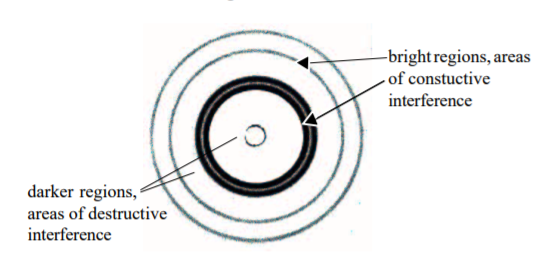
- pheno. moving electrons show wave-like properties (diffraction and interference patterns)
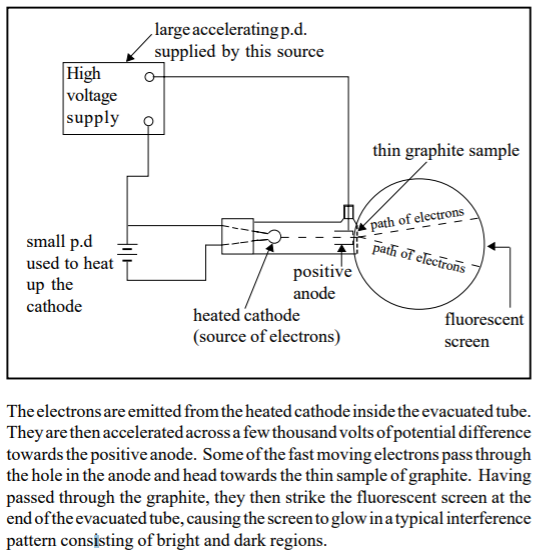
- experi evidence: electrons travelling through a small gap towards a thin sample of graphite. they then strike the fluorescent screen producing diffraction rings on it. (while small gap: the size of gap is comparable to atom spacing/λ of e-).
- so how do patterns on flourscent screen formed: 1.e- behaves as wave(has λ). 2.strong diffraction condition... 3.regular patterns of graphite atoms formed acts as a grating allowing constructive interference to produce patterns on screen. (only for x-rays)
- so why diffraction observed: beam is be focused. when it passes a gap and a sheet of graphite, it produces a relatively broad area of illumination on the screen.
- apparatus: electrongun
- Atomic spacing: noticeable diffraction appears by using a given wave passes through a thin sample of material for which X(gap/ atomic spacing) ≈ λ
- Evidence for particulate nature of e-: e- is acclerated by the large electric field (caused by high p.d. between cathod and anode)
- pheo. show particle-like properties: 1. passes them between charged plates (correct direction shown +,- charged), 2. passes them in magnetic field (circular path in direction indicates +,-charged)
Particulate nature of EM
- or saying quantum nature of EM raidation. EM radiation comes as a stream of packets of energy, known as photons.
- [pheno] Photoelectric effect: EM ms, e- emitted [fEM ≥ fo]. photoelectrons, KE varies up to max.
- when EM radiation falls on a metal surface, e- are emitted as long as the f of the EM radiation is above a certain 'threshold' frequency of metal. -->the emitted e- is called photoelectrons, having KE ranging from 0 to maximum value.
- [demo] Gold leaf electroscope: simple demonstration
- Initially electroscope is negatively charged. (it cinsists of a zinc plate and conductor, gold leaf...) UV light shone in the clean zinc plate, if f(UV)≥fo of zinc, e- emitted from the zinc plate so its less negatively charged, gold leaf falls. 注意:1. UV ligt is not charged. 2. only e- be emitted from metal surface.
- Another Initially elctroscope be positively charged, (lack of e-). e- emitted and hence become less repulsive??
- Juicing
- take place only if E≥φ/f≥fo
- e.g Chloe use dim/faint altroviolet, e- emitted. using strong infrared, e- aren't.
- E-W=0 e- just released at fo while fo=W/h
- in real process e- then lose energy so collide with e- in the metal. thereform warm up the metal.
- E-W>0 excess energy to free e- from the metal surface
- in further process, EM radiation is emitted as energy transfered from e- to photon. e- drop to some energy state.
- E-W<0
- independent of light brightness, I=P/A=N(Ei)/(tA), I∝N/t
- no delay between illumination and emission/ e- emit instantaneously: light travels as photons so transfer energy in discrete packets
- for which cannot be explained by wave theory but particulate theory.
- X classical: 1. Regardless of f, e- will be emitted if A/ E is big enough 2. P∝A^2--> A↑ KE↑
- A: Amplitude E: Energy for EM
- √ particle theories: 1. Regardless of A/ E, e- will be emitted if fo is achieved.
- take place only if E≥φ/f≥fo
- Collision theory
- photons: packets of energy: v=c, m=0, Qp=0, photon energy: (Ei)(N)=△E=hf=hc/λ, P=N(Ei)/t, I=P/Area
- 具象化波. 也具象化能量. EM radiation 是由 photon 组成, 每一个 photon vi=c, Ei 由总能量/个数.
- Intensity/Brightness: =incident power/illuminated area
- E∝f
- e.g. in collision theory, decreas incident f, energy observed hf by every e- decreases.
- I∝N/t
- e.g. in collision theory: doubled the intensity, doubled the number of electrons emitted per second as doubled number of photons per second. (注意回答的要correspondent)
- to explain Photoelectric effect : photons, Ee-=Eph=hf in collision [enough Ee-]. photonelectrons, KE RANGING FROM 0 TO MAX.
- 1.light consists of photons, hf is photon energy observed by every e- in collision [ as long as e- observed enough energy it can escape from metal surface]. 2.e- emitted called photonelectrons, have KE ranging from 0 to max. 3.Q: why KE ranges from 0 to max: (1)e- at metal surface has KEmax= hf-Φ, known as Einstein's equation. Φ(work function) is the minimum energy required to free e- from metal surface. (2)Electrons below surface need energy to reach the surface, so they have KE<hf-Φ.
- △E=△Ee- => hf=(Einside)+(φ)+(Ek) --> hf=φ+Ekmax, called Einstein's photoelectric equation
- [key]Energy delivered by the photon= energy delivered to the electrons. hf: total energy of photon transfered into E for e- to the metal surface + E for e- to escape the surface + E remains appears as kinetic energy of e-. For Einstein's: electrons at metal surface do not need 'energy' to reach the surface so KEmax.
- 1.Planck's constant 6.63×10^-34 Js
- φ: min E re e- escape its surface, φ=hfo OR E(ms)
- min amount of energy required by a e- to escape its surface. since a photon with f<fo of metal, energy hf is not enough to free a electrons, so Φ=hfo.
- fo: min f re free e- from sm. (property of metal)
- fo: threshold frequency: min f required to free a e- from the surface of a metal.
- it is a property of metal... different metals have different threshold frequency. hence different metals have different work functions.
- Planck's constant(h): graph of KE ∝ f. given gradient
- this graph also shows: interseptions:fo- x interception, KEmax- y interception.
- graph of KE ∝ λ ==
- photons: packets of energy: v=c, m=0, Qp=0, photon energy: (Ei)(N)=△E=hf=hc/λ, P=N(Ei)/t, I=P/Area
Modelling with particles and waves
- Particle models
- macrophenomena explained 1.electricity, flow of e-, current. 2.solids, crystalline materials, mechanical properties. 3.chemistry, atomic structure, chemical reactions.
- Wave models
- phenomena explained. varying quantities,phenonmena. 1.displacement, waves on strings.
- Particle models
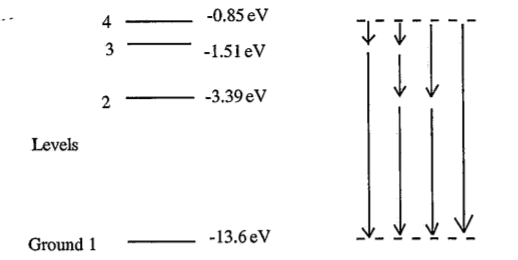
Energy levels: discrete EL occupied, GS & ES
- 1. a distribution of discrete (specific) energy levels can be occupied by electrons in an atom. 2. it consists of ground state (minimum PE state, lower level) and excited state (max PE state, upper level).
- Transition: exact amount, 1-1 E=hf
- 1. delocalised e- need to absorb exact amount of energy to a higher level provided by photon. 2. in one to one interaction of e- and photon, all energy E=hf is absorbed by each e-.
- Emission spectrum
- Absorption spectrum
Discovery of Electron
- Electron kinetic energy
- 1 eV= e×V
- is the energy transferred when an electron travels through a potential difference of one volt.
- △E=△Ek, QV=1/2m(v^2)
- charge e. potential difference V. (额外解释)when a charged particle is accelerated through a V, its KE increases.
- 1 eV= e×V
- Electron gun
- Low-voltage supply heats the cathode, so that electrons can escape from its surface by thermionic emission. the positive anode attracts the electrons.
- thermionic emission is known as if a metal cathode is heated, electrons leave the surface without needing a high voltage.
- Electron kinetic energy
h determined by gradient of V∝1/λ
Images and files in the map
Information
- Description
- OCR A OCRA PHYSICS Mind Map on QUANTUM PHYSICS, created by C D on 24/11/2017.
- Created by
- C D
- Views
- 3
- Rating