
Mind map
Chapter 3- Motion
Map content
Chapter 3- Motion
Distance and speed
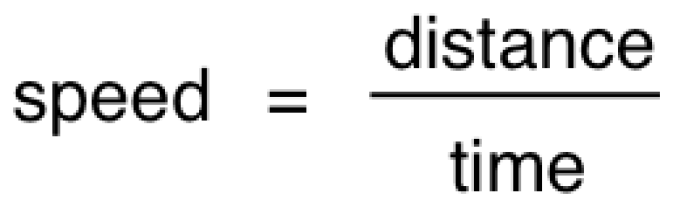
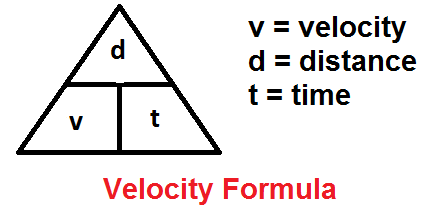
- Average speed (ms^-1) = distance traveled (m) / time taken (s)
- Distance-time graphs represent the motion of objects
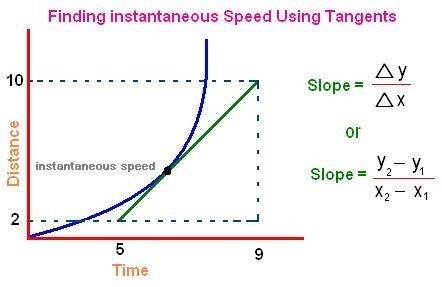
- Gradient = Average speed
- Instantaneous speed is the speed of an object at an instance, this can be done by working out the gradient of the tangent at that point
Displacement and velocity
- Average velocity (ms^-1) = change in displacement (m) / time taken (s)
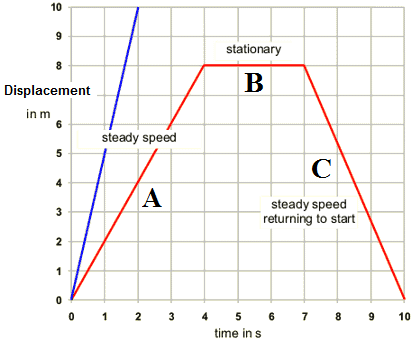
- Displacement-time graphs
- Gradient= Average velocity
- Area underneath the graph= Displacement
A vector is a quantity that has both magnitude and direction
- A scalar is quantity that only has magnitude
Acceleration
- "The rate of change of velocity"
- a=Δv/Δt
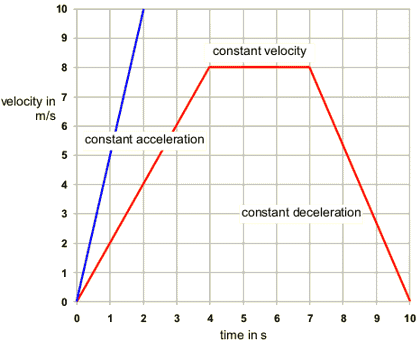
- Negative acceleration is when the objects acceleration is acting in the opposite direction to the velocity, hence the object is slowing down
- Acceleration can be determined from a Velocity-time graphs
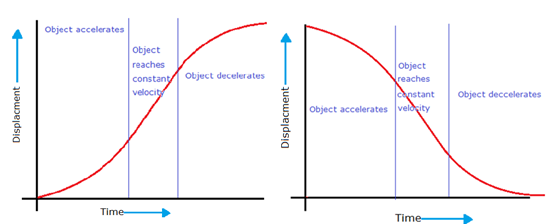
- Acceleration can also be noticeable on a displacement-time graph, this will appear as a curve
- "The rate of change of velocity"
Car stopping distance
- This is the total distance from when the driver first sees the reason to stop to when the vehicle stops
- Thinking distance + Braking distance= Stopping distance
- Thinking distance= Speed*Reaction time
- Reaction time can be affected by numerous factors
- Tiredness
- Alcohol/drugs
- Distractions
- Reaction time can be affected by numerous factors
- Braking distance can be affected by numerous factors
- Friction between wheels and road
- Mass of vehicle
- Braking force
- Thinking distance= Speed*Reaction time
- Thinking distance + Braking distance= Stopping distance
- This is the total distance from when the driver first sees the reason to stop to when the vehicle stops
Free fall and g
- The value of g can be determined in a few ways
- 1) use a stroboscope and camera, to show the position of the ball at regular intervals
- 2) Light gates could also be used, which stop/start a timer when the beams of light are interrupted
- 3) Using trapdoors, the ball falls once the current turns off, the magnet demagnetises and the timer starts. The ball falls until it hits the trapdoor, braking the circuit and stopping the timer
- The main idea is to drop a mass over a known distance, and time it
- The value of g can be determined in a few ways
Projectile motion
- Assuming no air resistance:
- Vertical velocity changes because of acceleration due to g
- Horizontal velocity remains constant (no acceleration)
- Angle θ calculated using inverse tan of y/x
- Time of flight calculated with s=ut+1/2 at^2, with Pythagoras and vectors used to work out velocity components
- The flight path is symmetrical
- Time of flight calculated with s=ut+1/2 at^2, with Pythagoras and vectors used to work out velocity components
- Angle θ calculated using inverse tan of y/x
- Horizontal velocity remains constant (no acceleration)
- Vertical velocity changes because of acceleration due to g
- Assuming no air resistance:
Images and files in the map


Information
- Description
- Mind Map on Chapter 3- Motion, created by Connor O'Hare on 20/12/2017.
- Created by
- Connor O'Hare
- Views
- 17
- Rating