
Mind map
Operations Management
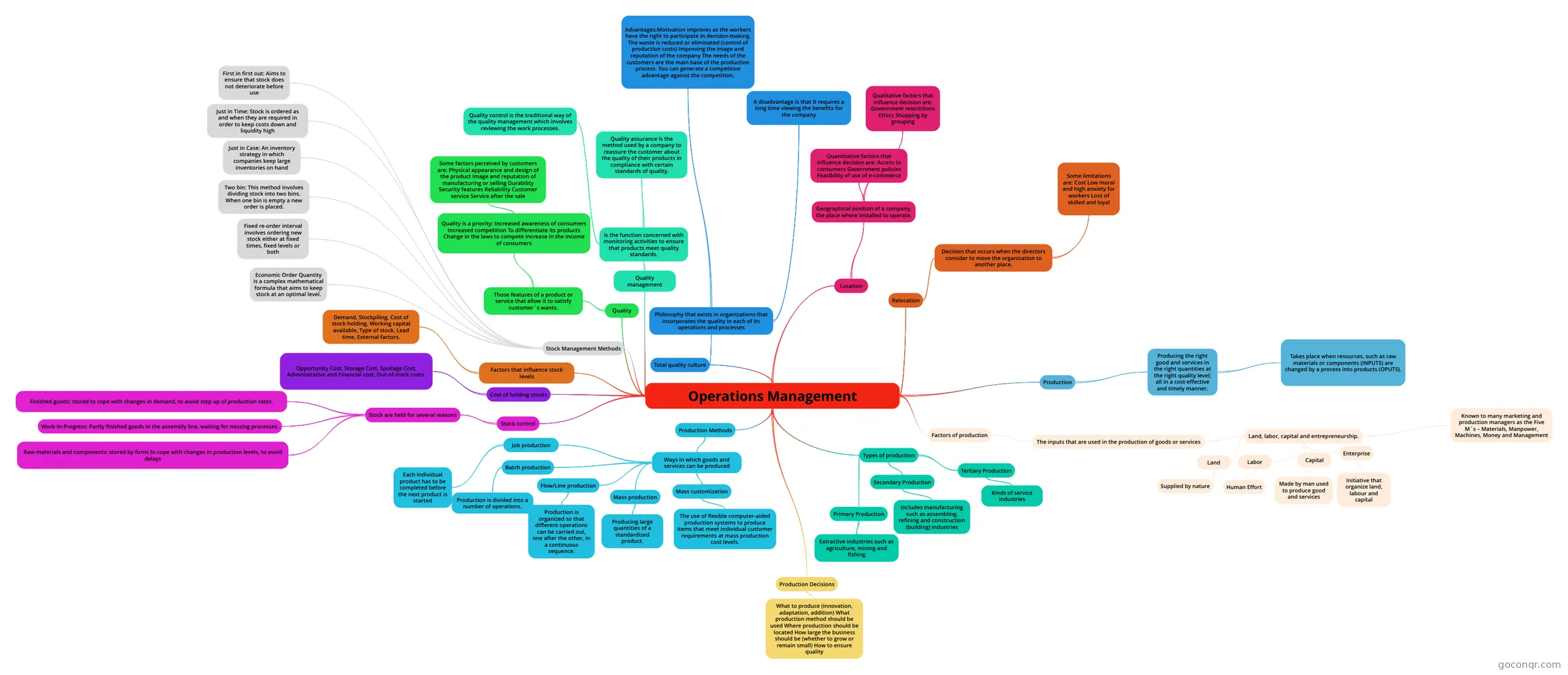
Mind map: Operations management
Map content
Operations Management
Production
- Producing the right good and services in the right quantities at the right quality level; all in a cost-effective and timely manner.
- Takes place when resources, such as raw materials or components (INPUTS) are changed by a process into products (OPUTS).
- Producing the right good and services in the right quantities at the right quality level; all in a cost-effective and timely manner.
Factors of production
- The inputs that are used in the production of goods or services
- Land, labor, capital and entrepreneurship.
- Known to many marketing and production managers as the Five M´s – Materials, Manpower, Machines, Money and Management
- Land
- Supplied by nature
- Labor
- Human Effort
- Capital
- Made by man used to produce good and services
- Enterprise
- Initiative that organize land, labour and capital
- Land, labor, capital and entrepreneurship.
- The inputs that are used in the production of goods or services
Types of production
- Primary Production
- Extractive industries such as agriculture, mining and fishing
- Secondary Production
- Includes manufacturing such as assembling, refining and construction (building) industries
- Tertiary Production
- Kinds of service industries
- Primary Production
Production Decisions
- What to produce (innovation, adaptation, addition) What production method should be used Where production should be located How large the business should be (whether to grow or remain small) How to ensure quality
Production Methods
- Ways in which goods and services can be produced
- Job production
- Each individual product has to be completed before the next product is started
- Batch production
- Production is divided into a number of operations.
- Flow/Line production
- Production is organized so that different operations can be carried out, one after the other, in a continuous sequence.
- Mass production
- Producing large quantities of a standardized product.
- Mass customization
- The use of flexible computer-aided production systems to produce items that meet individual customer requirements at mass production cost levels.
- Job production
- Ways in which goods and services can be produced
Stock control
- Stock are held for several reasons
- Raw materials and components: stored by firms to cope with changes in production levels, to avoid delays
- Finished goods: stored to cope with changes in demand, to avoid step up of production rates.
- Work-In-Progress: Partly finished goods in the assembly line, waiting for missing processes.
- Stock are held for several reasons
Cost of holding stocks
- Opportunity Cost, Storage Cost, Spoilage Cost, Administrative and Financial cost, Out-of-stock costs.
Factors that influence stock levels
- Demand, Stockpiling, Cost of stock holding, Working capital available, Type of stock, Lead time, External factors.
Stock Management Methods
- Economic Order Quantity is a complex mathematical formula that aims to keep stock at an optimal level.
- Fixed re-order interval involves ordering new stock either at fixed times, fixed levels or both
- Two bin: This method involves dividing stock into two bins. When one bin is empty a new order is placed.
- Just in Case: An inventory strategy in which companies keep large inventories on hand
- Just in Time: Stock is ordered as and when they are required in order to keep costs down and liquidity high
- First in first out: Aims to ensure that stock does not deteriorate before use
Quality
- Those features of a product or service that allow it to satisfy customer´s wants.
- Quality is a priority: Increased awareness of consumers Increased competition To differentiate its products Change in the laws to compete Increase in the income of consumers
- Some factors perceived by customers are: Physical appearance and design of the product Image and reputation of manufacturing or selling Durability Security features Reliability Customer service Service after the sale
- Quality is a priority: Increased awareness of consumers Increased competition To differentiate its products Change in the laws to compete Increase in the income of consumers
- Those features of a product or service that allow it to satisfy customer´s wants.
Quality management
- Is the function concerned with monitoring activities to ensure that products meet quality standards.
- Quality control is the traditional way of the quality management which involves reviewing the work processes.
- Quality assurance is the method used by a company to reassure the customer about the quality of their products in compliance with certain standards of quality.
- Is the function concerned with monitoring activities to ensure that products meet quality standards.
Total quality culture
- Philosophy that exists in organizations that incorporates the quality in each of its operations and processes
- Advantages:Motivation improves as the workers have the right to participate in decision-making. The waste is reduced or eliminated (control of production costs) Improving the image and reputation of the company The needs of the customers are the main base of the production process. You can generate a competitive advantage against the competition.
- A disadvantage is that It requires a long time viewing the benefits for the company
- Philosophy that exists in organizations that incorporates the quality in each of its operations and processes
Location
- Geographical position of a company, the place where installed to operate.
- Quantitative factors that influence decision are: Access to consumers Government policies Feasibility of use of e-commerce
- Qualitative factors that influence decision are: Government restrictions Ethics Shopping by grouping
- Geographical position of a company, the place where installed to operate.
Relocation
- Decision that occurs when the directors consider to move the organization to another place.
- Some limitations are: Cost Low moral and high anxiety for workers Loss of skilled and loyal
- Decision that occurs when the directors consider to move the organization to another place.
Information
- Description
- Mind Map on Operations Management, created by Raúl Castañón on 20/02/2018.
- Created by
- Raúl Castañón
- Views
- 0
- Rating