
Mind map
colonic polyps
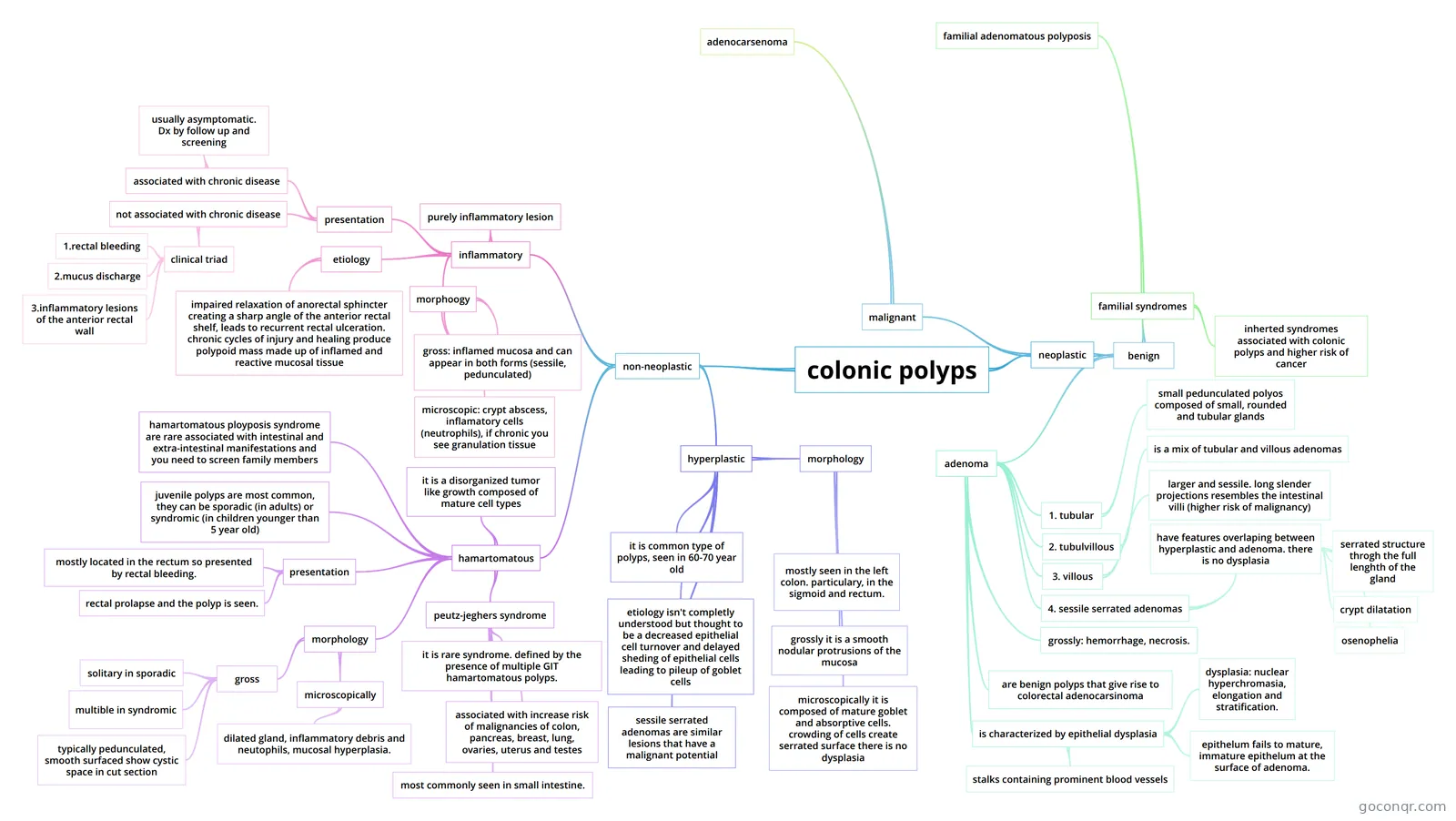
Mind map: Colonic polyps
Map content
colonic polyps
non-neoplastic
- inflammatory
- purely inflammatory lesion
- presentation
- associated with chronic disease
- usually asymptomatic. Dx by follow up and screening
- not associated with chronic disease
- clinical triad
- 1.rectal bleeding
- 2.mucus discharge
- 3.inflammatory lesions of the anterior rectal wall
- clinical triad
- associated with chronic disease
- etiology
- impaired relaxation of anorectal sphincter creating a sharp angle of the anterior rectal shelf, leads to recurrent rectal ulceration. chronic cycles of injury and healing produce polypoid mass made up of inflamed and reactive mucosal tissue
- morphoogy
- gross: inflamed mucosa and can appear in both forms (sessile, pedunculated)
- microscopic: crypt abscess, inflamatory cells (neutrophils), if chronic you see granulation tissue
- hamartomatous
- it is a disorganized tumor like growth composed of mature cell types
- hamartomatous ployposis syndrome are rare associated with intestinal and extra-intestinal manifestations and you need to screen family members
- juvenile polyps are most common, they can be sporadic (in adults) or syndromic (in children younger than 5 year old)
- presentation
- mostly located in the rectum so presented by rectal bleeding.
- rectal prolapse and the polyp is seen.
- morphology
- gross
- solitary in sporadic
- multible in syndromic
- typically pedunculated, smooth surfaced show cystic space in cut section
- microscopically
- dilated gland, inflammatory debris and neutophils, mucosal hyperplasia.
- gross
- peutz-jeghers syndrome
- it is rare syndrome. defined by the presence of multiple GIT hamartomatous polyps.
- associated with increase risk of malignancies of colon, pancreas, breast, lung, ovaries, uterus and testes
- most commonly seen in small intestine.
- hyperplastic
- it is common type of polyps, seen in 60-70 year old
- etiology isn't completly understood but thought to be a decreased epithelial cell turnover and delayed sheding of epithelial cells leading to pileup of goblet cells
- sessile serrated adenomas are similar lesions that have a malignant potential
- morphology
- mostly seen in the left colon. particulary, in the sigmoid and rectum.
- grossly it is a smooth nodular protrusions of the mucosa
- microscopically it is composed of mature goblet and absorptive cells. crowding of cells create serrated surface there is no dysplasia
- inflammatory
neoplastic
- benign
- adenoma
- 1. tubular
- small pedunculated polyos composed of small, rounded and tubular glands
- 2. tubulvillous
- is a mix of tubular and villous adenomas
- 3. villous
- larger and sessile. long slender projections resembles the intestinal villi (higher risk of malignancy)
- 4. sessile serrated adenomas
- have features overlaping between hyperplastic and adenoma. there is no dysplasia
- serrated structure throgh the full lenghth of the gland
- crypt dilatation
- osenophelia
- have features overlaping between hyperplastic and adenoma. there is no dysplasia
- are benign polyps that give rise to colorectal adenocarsinoma
- is characterized by epithelial dysplasia
- dysplasia: nuclear hyperchromasia, elongation and stratification.
- epithelum fails to mature, immature epithelum at the surface of adenoma.
- stalks containing prominent blood vessels
- grossly: hemorrhage, necrosis.
- 1. tubular
- familial syndromes
- familial adenomatous polyposis
- inherted syndromes associated with colonic polyps and higher risk of cancer
- adenoma
- malignant
- adenocarsenoma
- benign
Information
- Description
- Mind Map on colonic polyps, created by Raghad Ar-riees on 20/02/2018.
- Created by
- Raghad Ar-riees
- Views
- 4
- Rating
More on Gastrointestinal Cancers