
Mind map
dd208 Problem People,Problem Places
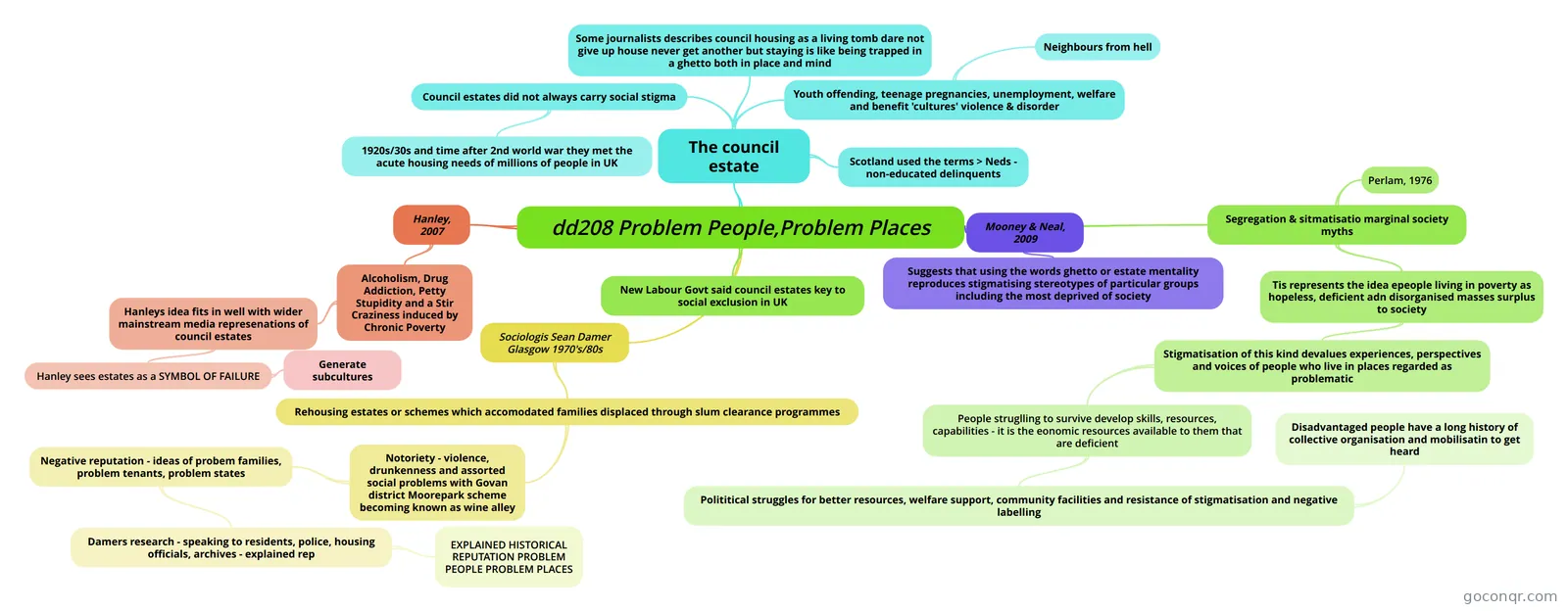
Mind map: DD208 Problem People, Problem Places
Map content
dd208 Problem People,Problem Places
The council estate
- Youth offending, teenage pregnancies, unemployment, welfare and benefit 'cultures' violence & disorder
- Neighbours from hell
- Scotland used the terms > Neds - non-educated delinquents
- Some journalists describes council housing as a living tomb dare not give up house never get another but staying is like being trapped in a ghetto both in place and mind
- Council estates did not always carry social stigma
- 1920s/30s and time after 2nd world war they met the acute housing needs of millions of people in UK
- Youth offending, teenage pregnancies, unemployment, welfare and benefit 'cultures' violence & disorder
Hanley, 2007
- Alcoholism, Drug Addiction, Petty Stupidity and a Stir Craziness induced by Chronic Poverty
- Hanleys idea fits in well with wider mainstream media represenations of council estates
- Hanley sees estates as a SYMBOL OF FAILURE
- Generate subcultures
- Hanley sees estates as a SYMBOL OF FAILURE
- Hanleys idea fits in well with wider mainstream media represenations of council estates
- Alcoholism, Drug Addiction, Petty Stupidity and a Stir Craziness induced by Chronic Poverty
New Labour Govt said council estates key to social exclusion in UK
Mooney & Neal, 2009
- Suggests that using the words ghetto or estate mentality reproduces stigmatising stereotypes of particular groups including the most deprived of society
Sociologis Sean Damer Glasgow 1970's/80s
- Rehousing estates or schemes which accomodated families displaced through slum clearance programmes
- Notoriety - violence, drunkenness and assorted social problems with Govan district Moorepark scheme becoming known as wine alley
- Negative reputation - ideas of probem families, problem tenants, problem states
- Damers research - speaking to residents, police, housing officials, archives - explained rep
- EXPLAINED HISTORICAL REPUTATION PROBLEM PEOPLE PROBLEM PLACES
- Damers research - speaking to residents, police, housing officials, archives - explained rep
- Negative reputation - ideas of probem families, problem tenants, problem states
- Notoriety - violence, drunkenness and assorted social problems with Govan district Moorepark scheme becoming known as wine alley
- Rehousing estates or schemes which accomodated families displaced through slum clearance programmes
Segregation & sitmatisatio marginal society myths
- Perlam, 1976
- Tis represents the idea epeople living in poverty as hopeless, deficient adn disorganised masses surplus to society
- Stigmatisation of this kind devalues experiences, perspectives and voices of people who live in places regarded as problematic
- People struglling to survive develop skills, resources, capabilities - it is the eonomic resources available to them that are deficient
- Polititical struggles for better resources, welfare support, community facilities and resistance of stigmatisation and negative labelling
- Disadvantaged people have a long history of collective organisation and mobilisatin to get heard
- Polititical struggles for better resources, welfare support, community facilities and resistance of stigmatisation and negative labelling
- People struglling to survive develop skills, resources, capabilities - it is the eonomic resources available to them that are deficient
- Stigmatisation of this kind devalues experiences, perspectives and voices of people who live in places regarded as problematic
Information
- Description
- Mind Map on dd208 Problem People,Problem Places, created by henfriend on 10/09/2014.
- Created by
- henfriend
- Views
- 34
- Rating