
Mind map
Quantum
Map content
Quantum
Photons
- Photons are the quanta (small things) of electromagnetic radiation
- E = hf or E = hc/λ
- h = plancks constant
- The higher the frequency the more energy the photons carry
- eV = ½mv²
- 1eV = 1.6 x 10^-19 J
- This is because 1V = 1J carried by 1C of charge - and charge of e- = 1.6 x 10^-19
Plancks constant
- Current will only flow through an LED after a minimum voltage is placed upon it - called the threshold voltage
- The threshold voltage needed to give the e- the same energy as the photons emitted (e- goes down energy level to release photon)
- All of the e- KE after it accelerated over a potential difference releases a photon
- By finding the threshold voltage you can estimate plancks constant by E = hc/λ -> h = eV λ/ c as E = eV
The photoelectric effect
- This shows the particle behaviour of light
- The photoelectric effect is when light with a high enough frequency is shone onto a surface of a metal and causes e- to be emitted
- For most metals the frequency lies in the U.V. range
- The photoelectric effect
- 1) Free e- on the surface of a metal absorb energy from the light making them vibrate
- 2) If an e- absorbs enough energy the bonds holding them to the metal breaks and the e- is released
- 3) The electrons emitted are called photoelectrons
- Conclusions from experiment
- 1) For a given metal no photoelectrons are emitted if the radiation has a frequency below the threshold frequency
- 2) The photoelectrons are emitted with a variety of kinetic energies ranging from 0 to a max value - the value of kinetic energy increases with frequency
- 3) The number of photoelectrons emitted per second is proportional to the intensity of the light
- Each e- absorbs 1 photon at a time so all the energy it needs to gain to leave the metal is needed in 1 photon
- The work function Φ is the minimum energy needed to break an e- free from a metal which is specific to each metal
- For e- to be released hf > Φ
- f = Φ/h (this is threshold frequency)
Energy levels and photon emission
- Energy levels are arbituary levels given a value of n, when electrons go up an energy level they absorb a photon, when they go down an energy level they release photon
- The photon emitted/absorbed has energy = to the energy difference between the 2 energy levels
- Emission spectra
- If you heat a gas to a high temperature, the e- move to higher energy levels (excitation)
- As they fall back down energy levels the electrons emit photons
- If you put the light from hot gases through a diffraction grating you get a line spectra
- The line spectra is almost like a colored barcode
- A line spectrum is seen as a series of bright lights which are the wavelengths that the photons emit by lowering energy level
- Continuous spectra contain all possible wavelengths - eg white light
- Cool gases remove certain wavelengths from the continuous spectrum by absorbing photons ( because most e- in a cool gas will be in their ground state n=1)
- Black lines are formed in the corresponding wavelengths
Sum over paths theory
- Photons explore every possible path
- Frequency is the rotation speed of a phasor
- By recording the position of a phasor at the end of every path you can add these to get a resultant phasor for the photon travelling from source to detector
- Quantum probability ∝ Quantum amplitude² (resultant phasor)
- The higher the probability the more likely a particle will arrive there so the higher the intensity
- A path with the highest probability has the smallest trip time
- Phasors with the shortest trip time contribute more to the quantum amplitude because these paths have the smallest difference between phasors and so will more or less point in the same direction
- Because the phasors of paths with shortest trip times have the smallest difference in phasors the resultant phasor will be longer so therefore a larger quantum amplitude so higher quantum probability
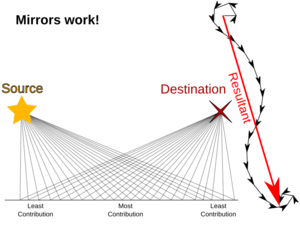
- Mirror experiment
- If all the paths of a source that reflects off a mirror are explored, adding the phasors together creates an s shape with a large resultant amplitude
- The paths that go through the middle of the mirror have a smaller phase difference and therefore are more like a straight line and so therefore contribute more to the quantum amplitude
- The paths on the edge of the mirror have a larger phase difference and so therefore the phasors at the edges curl up and contribute less to the quantum amplitude
- This is all because the trip time at the edges are longer, and the shortest trip times contribute more to the resultant quantum amplitude
- A straight line between source and detector is the shortest trip time
- Convex lens
- A lens works by making the trip times similar to result in a large quantum amplitude so a higher quantum probability so more intensity
- The lens is thicker in the middle to slow down the shortest trip times and thinner at the edges where the trip times are longer
- This results in most the phasors pointing in the same direction producing a huge quantum amplitude so therefore high quantum probability so the light is very intense
- This works because light changes speed through different mediums
Quantum behaviour of electrons
- De broglie wavelength
- λ = h/p p= momentum
- Applies to everything but photons
- or λ = h/mv
- Electron diffraction
- Diffraction occurs when electrons are accelerated through a voltage in a vacuum through a graphite crystal
- f = KE/ h
- Increasing accelerating voltage increases electron speed
- v² = 2KE/m
- KE = ½mv²
- KE = Potential energy (when e- are accelerated through a vacuum)
- Potential energy = eV => 1.6x10^-19 x V
- You only get diffraction if the e- are passed through an object with a similar de broglie wavelength
- De broglie wavelength
Images and files in the map
Information
- Description
- Mind Map on Quantum, created by Fin Carson on 30/04/2018.
- Created by
- Fin Carson
- Views
- 0
- Rating