
Mind map
Calf Diarrhoea Complex
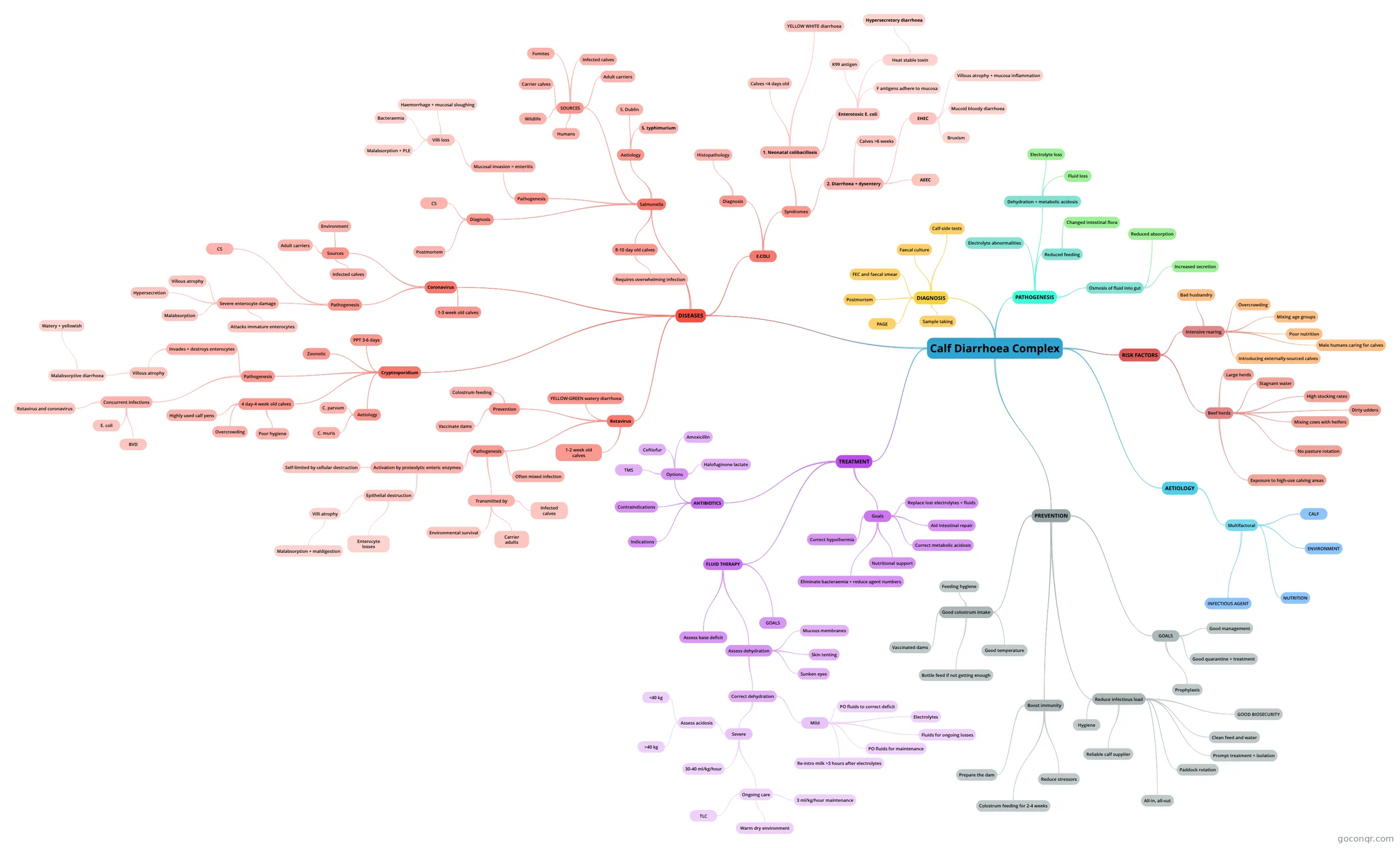
Mind map: Calf diarrhoea complex
Map content
Calf Diarrhoea Complex
AETIOLOGY
- Multifactoral
- CALF
- ENVIRONMENT
- Poor housing/hygiene Overcrowding Mixing age groups Poor management of sick calves
- NUTRITION
- Inadequate colostrum Poor feeding hygiene and routines
- INFECTIOUS AGENT
- Most common: - Salmonella - E. coli - Rotavirus - Coronavirus - Cryptosporidium Often more than 1 agent present
- Multifactoral
RISK FACTORS
- Beef herds
- Large herds
- High stocking rates
- Stagnant water
- Mixing cows with heifers
- Exposure to high-use calving areas
- Dirty udders
- No pasture rotation
- Intensive rearing
- Bad husbandry
- Poor ventilation Moisture accumulation Draughts
- Overcrowding
- Mixing age groups
- Poor nutrition
- Bad milk replacer Variable milk temperature Contaminated milk 1 feed/day
- Introducing externally-sourced calves
- Male humans caring for calves
- Bad husbandry
- Beef herds
PATHOGENESIS
- Osmosis of fluid into gut
- E.coli enterotoxin Salmonella inflammation + damage Viral/protozoal epithelial destruction Hypovolaemic shock
- Increased secretion
- Reduced absorption
- Reduced feeding
- Changed intestinal flora
- Dehydration + metabolic acidosis
- Fluid loss
- Electrolyte loss
- Na Cl K Bicarbonate
- Electrolyte abnormalities
- Hyperkalaemia (moving extracellular) Hypoglycaemia
- Osmosis of fluid into gut
DIAGNOSIS
- Faecal culture
- Salmonella E.coli
- FEC and faecal smear
- Cryptosporidium
- PAGE
- Polyacrylamide gel electrophoresis Rotavirus
- Calf-side tests
- Rotavirus E.coli Cryptosporidium
- Sample taking
- Multiple calves Faeces
- Postmortem
- Emaciation Non-specific signs of diarrhoea + dehydration Haemorrhagic enteritis - Salmonella, coccidia Intestinal swabs Histopathology --> Intestines, liver, spleen, LNs, lungs, joints
- Faecal culture
TREATMENT
- Goals
- Replace lost electrolytes + fluids
- Nutritional support
- Correct metabolic acidosis
- Aid intestinal repair
- Eliminate bacteraemia + reduce agent numbers
- Correct hypothermia
- FLUID THERAPY
- GOALS
- Support kidneys Correct Na/K imbalances Correct metabolic acidosis Provide energy
- Assess dehydration
- <5% = minimal eye recession, 2-4 second skin tent, moist MMs, warm extremities 8-12% = 4-7 mm eye recession, >8 second skin tent, dry MMs, cold extremities
- Skin tenting
- Sunken eyes
- % dehydration = 1.7 x recession depth (mm)
- Mucous membranes
- Correct dehydration
- Mild
- PO fluids to correct deficit
- E.g. 4% dehydrated in 45 kg calf = 45 x 0.05 = 2.25 L fluid
- PO fluids for maintenance
- 10% of bodyweight at 3 ml/kg/hour if IV E.g. 45 kg calf = 4.5 L
- Electrolytes
- Sodium, glucose, bicarbonate, acetate/proprionate
- Re-intro milk >3 hours after electrolytes
- Give 2-4 L extra, 2+ feeds/day
- Fluids for ongoing losses
- PO fluids to correct deficit
- Severe
- Assess acidosis
- How much bicarb needed (1.3% solution - 13 ml/L
- <40 kg
- <8 days + recumbent = 2 L >8 days + sternal = 2 L >8 days + lateral = 3 L
- >40 kg
- <8 days + recumbent = 3 L >8 days + sternal = 3 L >8 days + lateral = 4 L
- 30-40 ml/kg/hour
- BW x % dehydration Add 50 ml dextrose/litre Signs of improvement --> urination, reduced dehydration, improved mentation, suckling reflex
- Ongoing care
- 3 ml/kg/hour maintenance
- Warm dry environment
- TLC
- Assess acidosis
- Mild
- Assess base deficit
- 5 mmol/L = BAR, strong suckle reflex, warm mouth 10 mmol/L = quiet, moves if disturbed, weak suckle, slight cold mouth 15 mmol/L = depressed, unable to stand, no suckle, cold mouth 20 mmol/L = collapsed, lateral recumbency, no suckle, cold-mouth, moribund
- GOALS
- ANTIBIOTICS
- Indications
- Severe diarrhoea + dehydration True bacterial enteritis + septicaemia 2ndry infections in viral diarrhoea
- Contraindications
- Mild/moderate diarrhoea PER OS ADMIN
- Options
- TMS
- Ceftiofur
- Amoxicillin
- Halofuginone lactate
- Cryptosporidium prophylaxis + treatment
- Indications
- Goals
PREVENTION
- GOALS
- Good management
- Hygiene Stocking density Pasture/pen rotation + spelling No mixing of age groups
- Good quarantine + treatment
- Prophylaxis
- Good management
- Good colostrum intake
- Vaccinated dams
- Good temperature
- Feeding hygiene
- Bottle feed if not getting enough
- Boost immunity
- Prepare the dam
- Vaccination - rotavirus, ETEC, coronavirus Transitional feeding Supplementation
- Colostrum feeding for 2-4 weeks
- Reduce stressors
- Dystocia navel ill Poor environment Mixing of age groups Overcrowding Poor nutrition
- Prepare the dam
- Reduce infectious load
- GOOD BIOSECURITY
- Hygiene
- All-in, all-out
- Paddock rotation
- Prompt treatment + isolation
- Reliable calf supplier
- Clean feed and water
- GOALS
DISEASES
- E.COLI
- Syndromes
- 1. Neonatal colibacillosis
- Calves <4 days old
- YELLOW WHITE diarrhoea
- Enterotoxic E. coli
- K99 antigen
- F antigens adhere to mucosa
- Heat stable toxin
- Hypersecretory diarrhoea
- 2. Diarrhoea + dysentery
- Calves >6 weeks
- EHEC
- Villous atrophy + mucosa inflammation
- Mucoid bloody diarrhoea
- Bruxism
- AEEC
- Attaching and effacing E. coli
- 1. Neonatal colibacillosis
- Diagnosis
- Histopathology
- Intestines
- Histopathology
- Syndromes
- Salmonella
- Aetiology
- S. typhimurium
- S. Dublin
- SOURCES
- Infected calves
- Adult carriers
- Shed when stressed
- Fomites
- Carrier calves
- Humans
- Wildlife
- 8-10 day old calves
- Requires overwhelming infection
- Pathogenesis
- Mucosal invasion = enteritis
- Villi loss
- Malabsorption + PLE
- Bacteraemia
- Haemorrhage + mucosal sloughing
- Villi loss
- Mucosal invasion = enteritis
- Diagnosis
- CS
- Dysentery - mucoid + malodorous + mucosal shreds Abdominal pain
- Postmortem
- Haemorrhagic/catarrhal enteritis Mesenteric LN enlargment +/- cranial bronchopneumonia, liver pathology
- CS
- Aetiology
- Rotavirus
- 1-2 week old calves
- Reduced colostrum immunity Most common cause of calf diarrhoea
- Pathogenesis
- Often mixed infection
- Cryptosporidium Salmonella E.coli
- Transmitted by
- Infected calves
- Shed for up to 3 weeks
- Carrier adults
- Environmental survival
- Infected calves
- Activation by proteolytic enteric enzymes
- Epithelial destruction
- Upper intestines, then lower as progresses
- Enterocyte losses
- Villi atrophy
- Malabsorption + maldigestion
- Self-limited by cellular destruction
- Epithelial destruction
- Often mixed infection
- YELLOW-GREEN watery diarrhoea
- Prevention
- Vaccinate dams
- Colostrum feeding
- 1-2 week old calves
- Cryptosporidium
- Aetiology
- C. parvum
- Small intestine
- C. muris
- Abomasum
- C. parvum
- PPT 3-6 days
- Pathogenesis
- Invades + destroys enterocytes
- Villous atrophy
- Malabsorptive diarrhoea
- Watery + yellowish
- Malabsorptive diarrhoea
- Villous atrophy
- Concurrent infections
- E. coli
- BVD
- Rotavirus and coronavirus
- Invades + destroys enterocytes
- Zoonotic
- 4 day-4 week old calves
- Age resistance
- Overcrowding
- Poor hygiene
- Highly used calf pens
- Environmental resistance
- Aetiology
- Coronavirus
- 1-3 week old calves
- Sources
- Environment
- Infected calves
- Adult carriers
- Pathogenesis
- CS
- Profuse watery diarrhoea --> Turns mucoid and contains undigested milk + blood
- Severe enterocyte damage
- Villous atrophy
- Malabsorption
- Hypersecretion
- Attacks immature enterocytes
- Prolonged recovery
- CS
- E.COLI
Information
- Description
- Mind Map on Calf Diarrhoea Complex, created by Alinta Kalns on 09/06/2018.
- Created by
- Alinta Kalns
- Views
- 0
- Rating