
Mind map
2. Risk Modeling and Aggregation of Risks
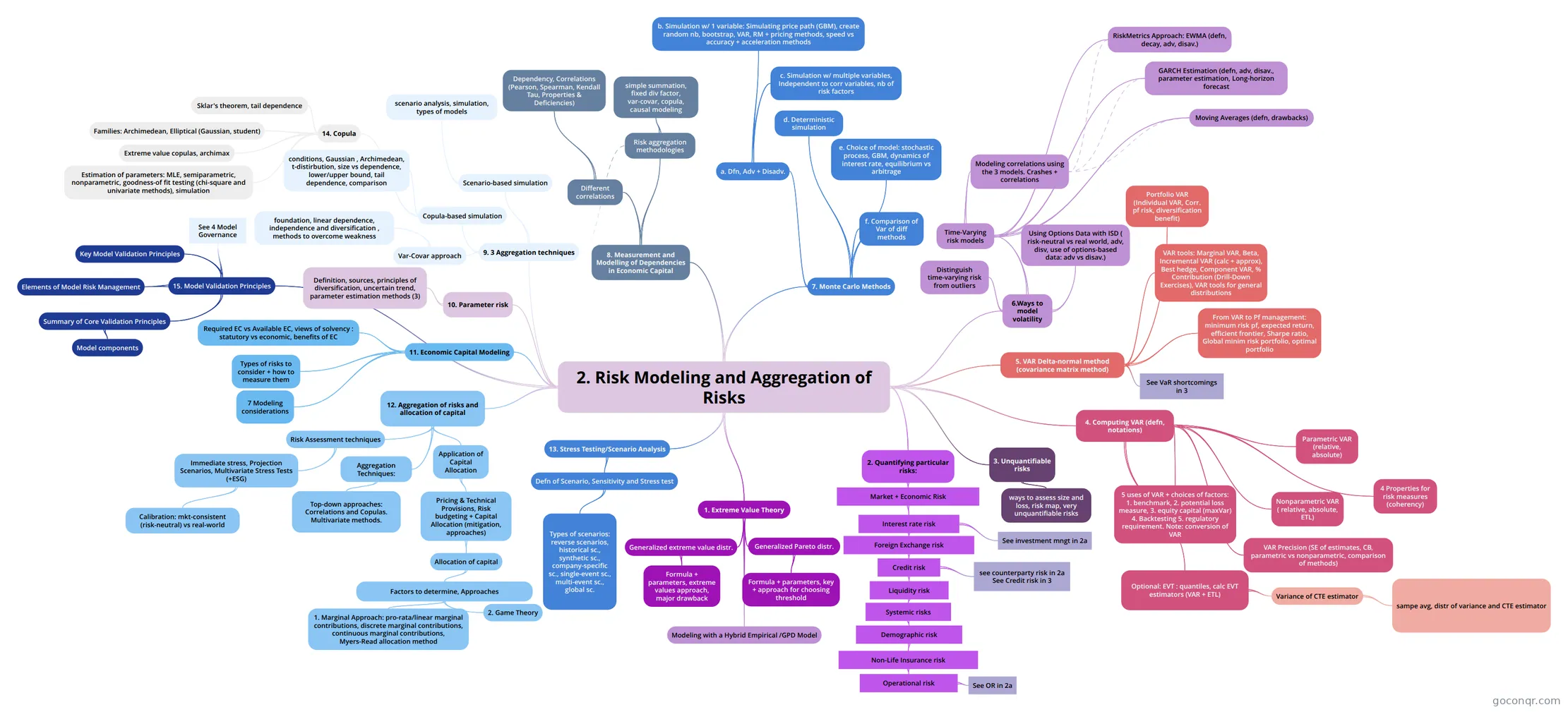
Mind map: Risk modeling and aggregation of risks
Map content
2. Risk Modeling and Aggregation of Risks
1. Extreme Value Theory
- Generalized extreme value distr.
- Formula + parameters, extreme values approach, major drawback
- Generalized Pareto distr.
- Formula + parameters, key + approach for choosing threshold
- Modeling with a Hybrid Empirical /GPD Model
- Generalized extreme value distr.
2. Quantifying particular risks:
- Market + Economic Risk
- Interest rate risk
- Foreign Exchange risk
- Credit risk
- Liquidity risk
- Systemic risks
- Demographic risk
- Non-Life Insurance risk
- Operational risk
- See OR in 2a
- Operational risk
- Non-Life Insurance risk
- Demographic risk
- Systemic risks
- see counterparty risk in 2a See Credit risk in 3
- Liquidity risk
- Credit risk
- See investment mngt in 2a
- Foreign Exchange risk
- Interest rate risk
- Market + Economic Risk
3. Unquantifiable risks
- ways to assess size and loss, risk map, very unquantifiable risks
4. Computing VAR (defn, notations)
- Nonparametric VAR ( relative, absolute, ETL)
- Parametric VAR (relative, absolute)
- 4 Properties for risk measures (coherency)
- 5 uses of VAR + choices of factors: 1. benchmark, 2. potential loss measure, 3. equity capital (maxVar) 4. Backtesting 5. regulatory requirement. Note: conversion of VAR
- VAR Precision (SE of estimates, CB, parametric vs nonparametric, comparison of methods)
- Optional: EVT : quantiles, calc EVT estimators (VAR + ETL)
- Variance of CTE estimator
- sampe avg, distr of variance and CTE estimator
- Variance of CTE estimator
5. VAR Delta-normal method (covariance matrix method)
- Portfolio VAR (Individual VAR, Corr. pf risk, diversification benefit)
- VAR tools: Marginal VAR, Beta, Incremental VAR (calc + approx), Best hedge, Component VAR, % Contribution (Drill-Down Exercises), VAR tools for general distributions
- From VAR to Pf management: minimum risk pf, expected return, efficient frontier, Sharpe ratio, Global minim risk portfolio, optimal portfolio
- See VaR shortcomings in 3
6.Ways to model volatility
- Distinguish time-varying risk from outliers
- Time-Varying risk models
- Moving Averages (defn, drawbacks)
- GARCH Estimation (defn, adv, disav., parameter estimation, Long-horizon forecast
- RiskMetrics Approach: EWMA (defn, decay, adv, disav.)
- Modeling correlations using the 3 models. Crashes + correlations
- Using Options Data with ISD ( risk-neutral vs real world, adv, disv, use of options-based data: adv vs disav.)
7. Monte Carlo Methods
- a. Dfn, Adv + Disadv.
- b. Simulation w/ 1 variable: Simulating price path (GBM), create random nb, bootstrap, VAR, RM + pricing methods, speed vs accuracy + acceleration methods
- c. Simulation w/ multiple variables, Independent to corr variables, nb of risk factors
- d. Deterministic simulation
- e. Choice of model: stochastic process, GBM, dynamics of interest rate, equilibrium vs arbitrage
- f. Comparison of Var of diff methods
- a. Dfn, Adv + Disadv.
8. Measurement and Modelling of Dependencies in Economic Capital
- Different correlations
- Dependency, Correlations (Pearson, Spearman, Kendall Tau, Properties & Deficiencies)
- Risk aggregation methodologies
- simple summation, fixed div factor, var-covar, copula, causal modeling
- Different correlations
9. 3 Aggregation techniques
- Var-Covar approach
- foundation, linear dependence, independence and diversification , methods to overcome weakness
- Copula-based simulation
- conditions, Gaussian , Archimedean, t-distirbution, size vs dependence, lower/upper bound, tail dependence, comparison
- 14. Copula
- Sklar's theorem, tail dependence
- Families: Archimedean, Elliptical (Gaussian, student)
- Extreme value copulas, archimax
- Estimation of parameters: MLE, semiparametric, nonparametric, goodness-of fit testing (chi-square and univariate methods), simulation
- Scenario-based simulation
- scenario analysis, simulation, types of models
- Var-Covar approach
10. Parameter risk
- Definition, sources, principles of diversification, uncertain trend, parameter estimation methods (3)
11. Economic Capital Modeling
- Required EC vs Available EC, views of solvency : statutory vs economic, benefits of EC
- Types of risks to consider + how to measure them
- 7 Modeling considerations
12. Aggregation of risks and allocation of capital
- Risk Assessment techniques
- Immediate stress, Projection Scenarios, Multivariate Stress Tests (+ESG)
- Calibration: mkt-consistent (risk-neutral) vs real-world
- Immediate stress, Projection Scenarios, Multivariate Stress Tests (+ESG)
- Aggregation Techniques:
- Top-down approaches: Correlations and Copulas. Multivariate methods.
- Application of Capital Allocation
- Pricing & Technical Provisions, Risk budgeting + Capital Allocation (mitigation, approaches)
- Allocation of capital
- Factors to determine, Approaches
- 1. Marginal Approach: pro-rata/linear marginal contributions, discrete marginal contributions, continuous marginal contributions, Myers-Read allocation method
- 2. Game Theory
- Factors to determine, Approaches
- Allocation of capital
- Pricing & Technical Provisions, Risk budgeting + Capital Allocation (mitigation, approaches)
- Risk Assessment techniques
13. Stress Testing/Scenario Analysis
- Defn of Scenario, Sensitivity and Stress test
- Types of scenarios: reverse scenarios, historical sc., synthetic sc., company-specific sc., single-event sc., multi-event sc., global sc.
- Defn of Scenario, Sensitivity and Stress test
15. Model Validation Principles
- Key Model Validation Principles
- Elements of Model Risk Management
- Summary of Core Validation Principles
- Model components
- See 4 Model Governance
Information
- Description
- ERM Mind Map on 2. Risk Modeling and Aggregation of Risks, created by Nadège A. on 15/01/2019.
- Created by
- Nadège A.
- Views
- 7
- Rating