
Mind map
Unit 5: Pressure
Map content
Unit 5: Pressure
Recall that pressure is force per unit area and that a larger area for a given force reduces the pressure
- Pressure is caused when objects exert forces on each other. The pressure caused by any force depends on the area of contact where the force acts, as well as on the size of the force
- the unit of pressure is the pascal (Pa) which is equal to 1N/m2 (squared)
Explain applications where the area is an important design consideration
- Caterpillar tracks fitted to vehicles
- the large contact area of the tracks on the ground reduce the pressure of the vehicle on the ground. It weight is spread over a much larger contact area.
- A sharp surgical knife used in operating theatres in hospitals
- it has a small area of contact when used. So the pressure is greater than the pressure of a blunt knife.
- Caterpillar tracks fitted to vehicles
Describe how a hydraulic system works
- A hydraulic system uses the pressure in a fluid to exert a force
Recall that the force exerted by a hydraulic system depends on the pressure and the area of the cylinder that exerts the force
- the force exerted by a hydraulic system depends on the pressure and the area of the cylinder that exerts the force
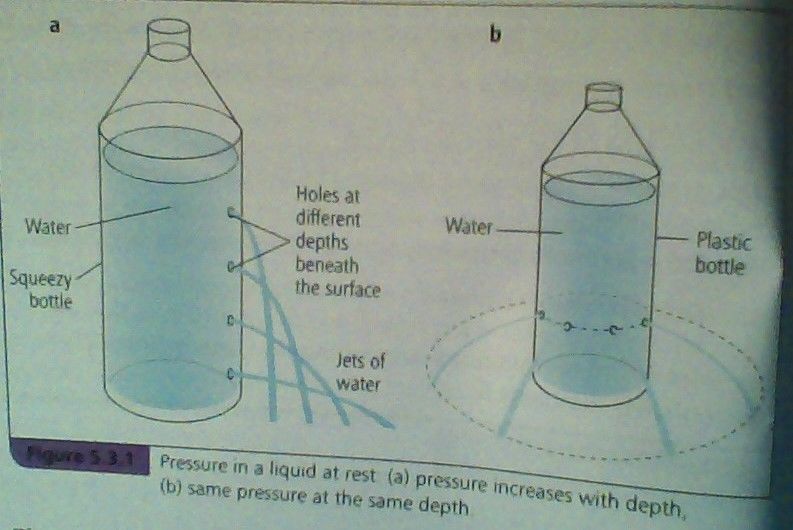
Recall that the pressure in a liquid increases with depth and depends on the density of the liquid
Recall and use the equations pressure = force / area and pressure = height* density* gravity
Describe and use a U-tube manometer and a mercury barometer
- U-tube manometer
- used to measure gas pressure
- the pressure of the gas forces the liquid to in the manometer up the open side of the U-tube until it is at rest
- the height difference, between the two levels (see picture), is a measure of the gas pressure
- mercury barometer
- used to measure atmospheric pressure
- it consists of an inverted glass tube containing mercury with its lower end under the surface of mercury in a container open to the atmosphere. The space above the mercury in the tube is a vacuum
- atmospheric pressure balances the pressure due to the column of mercury in the tube
- the height of the mercury column in the barometer is a measure of the atmospheric pressure, because:
- an increase of atmospheric pressure causes the mercury to rise in the tube
- a decrease of atmospheric pressure causes the mercury to fall
- U-tube manometer
Calculate gas pressure and atmospheric pressure respectively from manometer and barometer readings
- gas pressure from manometer readings
- ex. gravity = 10N/kg density = 950kg/m3 (cubed) height = 0.26m
- pressure = height*density*gravity
- pressure = 0.26*950*10 = 2500
- pressure = 2500 Pa
- pressure = 0.26*950*10 = 2500
- pressure = height*density*gravity
- ex. gravity = 10N/kg density = 950kg/m3 (cubed) height = 0.26m
- atmospheric pressure from barometer readings
- ex. gravity = 10N/kg height = 760mm density of mercury = 13,600 kg/m3 (cubed)
- pressure = 760*13,600*10 = 1.03 x 10 to the power of 5
- pressure 1.03 x 10 to the power of 5 Pa
- pressure = 760*13,600*10 = 1.03 x 10 to the power of 5
- ex. gravity = 10N/kg height = 760mm density of mercury = 13,600 kg/m3 (cubed)
- gas pressure from manometer readings
Describe the characteristic properties of a solid, a liquid and a gas and the arrangement of particles in each state
- solid
- doesn't flow, fixed shape, fixed volume
- the molecules in a solid hold each other together in fixed positions to form a rigid structure with its own shape
- doesn't flow, fixed shape, fixed volume
- liquid
- flows, fits container shape, fixed volume
- the molecules in a liquid move about in contact with each other but they don't stay in fixed positions. This is why a liquid doesn't have it own shape and can flow
- flows, fits container shape, fixed volume
- gas
- flows, fills container, volume can be changed
- the molecules in a gas are far apart compared with molecules in a liquid or solid. This is why the density of a gas is much less than that of a solid or liquid. They move very rapidly throughout their container and only make contact when they collide.
- flows, fills container, volume can be changed
- solid
Recall how the temperature of a gas affects the average speed of its molecules
- Increasing the temperature of a gas causes its molecules to gain more kinetic energy. Therefore, the average speed of the gas molecules increases.
Explain in terms of molecules why a gas exerts pressure
- The pressure of the gas on a surface is caused by its molcules repeatedly hitting the surface and colliding with each other.
Describe how the temperature of a gas in a sealed container affects its pressure
- Increasing the temperature of any sealed container increases the pressure of the gas inside it. This is because:
- the gas molecules move about very fast in random directions - the pressure of the gas is due to the impacts of the gas molcules with the container surface
- the heat energy supplied to the gas to raise its temperature is supplied to the gas molecules as kinetic energy
- Increasing the temperature of any sealed container increases the pressure of the gas inside it. This is because:
Explain why the temperature of a gas in a sealed container affects its pressure
- the average kinetic energy of the gas molecules increases when the gas is heated. So the average speed of the molecules therefore increases.
- this increased speed of the gas molecules causes them to move about faster inside the sealed container. They hit the surfaces harder and more often, which increases the pressure.
- the average kinetic energy of the gas molecules increases when the gas is heated. So the average speed of the molecules therefore increases.
Describe evidence that proves that gas molecules move about at random
- Brownian motion = the erratic/ random motion of particles due to collisions with individual molecules.
Explain the difference between an unsaturated vapour and a saturated vapour
- unsaturated vapour
- vapour in air that can hold more vapour
- saturated vapour
- vapour in air that can hold no more vapour
- unsaturated vapour
Explain cooling by evaporation of a liquid
- weak attractive forces exist between the molecules in the liquid
- molecules with sufficient kinetic energy break away from the attraction of the other molecules and escape from the liquid
- after they escape the average kinetic energy of the remaining molecules in the liquid decreases so the liquid becomes cooler
Recall the factors that can increase evaporation from a liquid
- increasing the surface area of the liquid
- increasing the temperature of the liquid
- creating a draught of air across the liquid surface
Recall and use the equation pressure*volume = constant
- also known as Boyle's Law
Explain the characteristic properties of a solid, a liquid and a gas and the arrangement of particles in each state
- solid
- strong forces of attraction between molecules
- each molecule vibrates about a fixed point
- when a solid is heated, the molcules gain energy and vibrate more. When a solid melts/ sublimes, the molecules have gained enough energy to break away from the structure
- liquid
- there are still forces of attraction between molecules, but they are not strong enough to hold molecules in a rigid structure. Therefore a liquid can flow but has no fixed shape
- when a liquid is heated, some of the molecules gain enough energy to break away from the other molecules. The molecules that escape from the liquid become a gas
- gas
- the forces of attraction between the molcules are negligible. Therefore a gas can flow but has no fixed shape or volume
- when a gas is heated, the molecules gain kinetic energy and move faster. This causes the pressure of the gas to increase because the molcules collide with the container surface with more force
- solid
Describe how and explain why the pressure of a gas at constant temperature affects its volume
- if the volume decreases, the pressure increases. if the volume increases, the pressure decreases
- when the volume decreases and the pressure increases: the space the molecules move in is smaller so they do not travel as far between successive impacts on the surface. The molecules hit the surface more often, so the average force of impact (i.e. pressure) increases.
Images and files in the map


Information
- Description
- GCSE Physics (Unit 5: Pressure) Mind Map on Unit 5: Pressure, created by cmharrisuk on 19/11/2014.
- Created by
- cmharrisuk
- Views
- 11
- Rating