
Mind map
IT Laws & Legislation
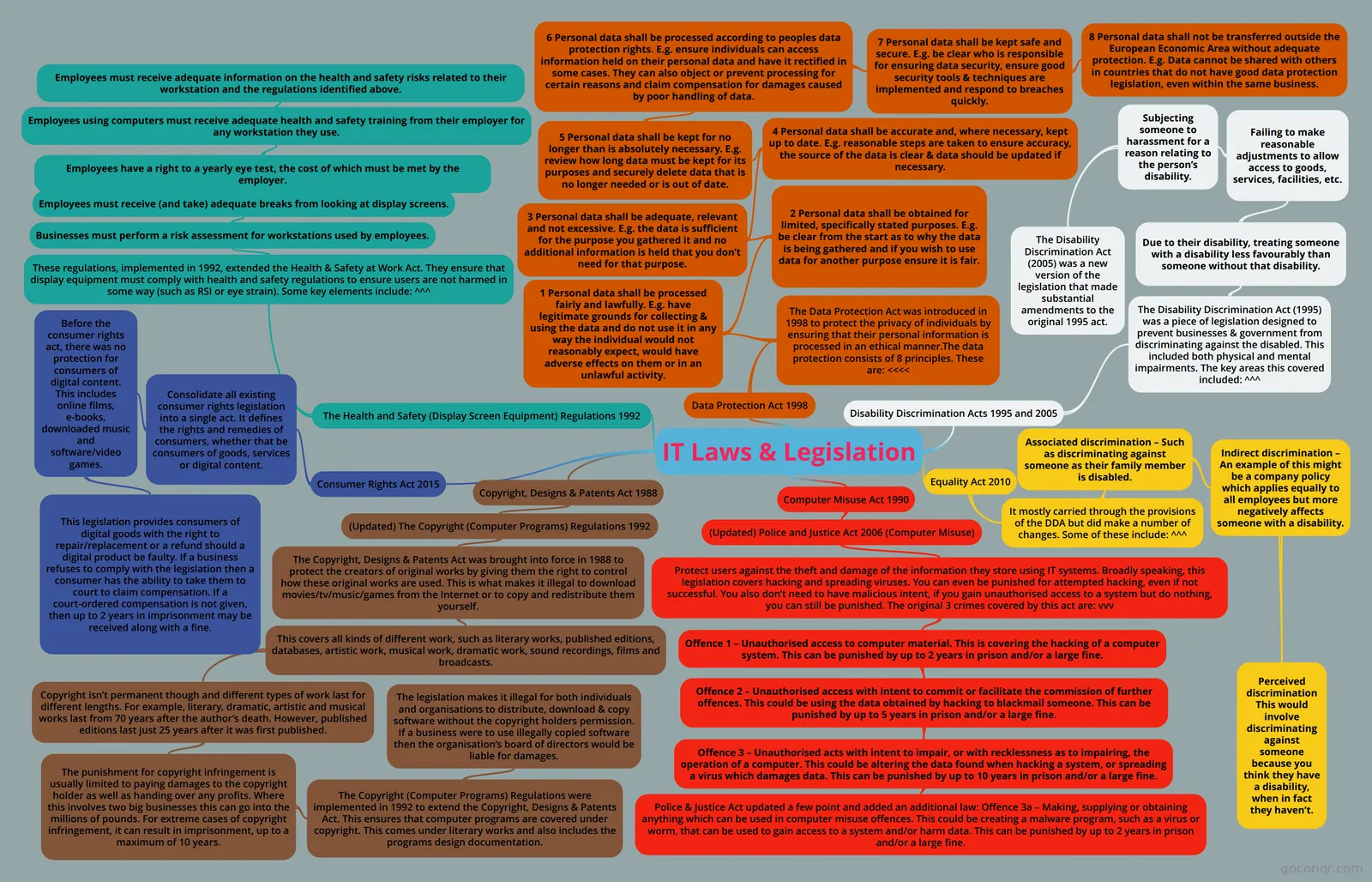
Mind map: IT laws and legislation
Map content
IT Laws & Legislation
Computer Misuse Act 1990
- (Updated) Police and Justice Act 2006 (Computer Misuse)
- Protect users against the theft and damage of the information they store using IT systems. Broadly speaking, this legislation covers hacking and spreading viruses. You can even be punished for attempted hacking, even if not successful. You also don’t need to have malicious intent, if you gain unauthorised access to a system but do nothing, you can still be punished. The original 3 crimes covered by this act are: vvv
- Offence 1 – Unauthorised access to computer material. This is covering the hacking of a computer system. This can be punished by up to 2 years in prison and/or a large fine.
- Offence 2 – Unauthorised access with intent to commit or facilitate the commission of further offences. This could be using the data obtained by hacking to blackmail someone. This can be punished by up to 5 years in prison and/or a large fine.
- Offence 3 – Unauthorised acts with intent to impair, or with recklessness as to impairing, the operation of a computer. This could be altering the data found when hacking a system, or spreading a virus which damages data. This can be punished by up to 10 years in prison and/or a large fine.
- Police & Justice Act updated a few point and added an additional law: Offence 3a – Making, supplying or obtaining anything which can be used in computer misuse offences. This could be creating a malware program, such as a virus or worm, that can be used to gain access to a system and/or harm data. This can be punished by up to 2 years in prison and/or a large fine.
- Offence 3 – Unauthorised acts with intent to impair, or with recklessness as to impairing, the operation of a computer. This could be altering the data found when hacking a system, or spreading a virus which damages data. This can be punished by up to 10 years in prison and/or a large fine.
- Offence 2 – Unauthorised access with intent to commit or facilitate the commission of further offences. This could be using the data obtained by hacking to blackmail someone. This can be punished by up to 5 years in prison and/or a large fine.
- Offence 1 – Unauthorised access to computer material. This is covering the hacking of a computer system. This can be punished by up to 2 years in prison and/or a large fine.
- Protect users against the theft and damage of the information they store using IT systems. Broadly speaking, this legislation covers hacking and spreading viruses. You can even be punished for attempted hacking, even if not successful. You also don’t need to have malicious intent, if you gain unauthorised access to a system but do nothing, you can still be punished. The original 3 crimes covered by this act are: vvv
- (Updated) Police and Justice Act 2006 (Computer Misuse)
Copyright, Designs & Patents Act 1988
- (Updated) The Copyright (Computer Programs) Regulations 1992
- The Copyright, Designs & Patents Act was brought into force in 1988 to protect the creators of original works by giving them the right to control how these original works are used. This is what makes it illegal to download movies/tv/music/games from the Internet or to copy and redistribute them yourself.
- This covers all kinds of different work, such as literary works, published editions, databases, artistic work, musical work, dramatic work, sound recordings, films and broadcasts.
- Copyright isn’t permanent though and different types of work last for different lengths. For example, literary, dramatic, artistic and musical works last from 70 years after the author’s death. However, published editions last just 25 years after it was first published.
- The punishment for copyright infringement is usually limited to paying damages to the copyright holder as well as handing over any profits. Where this involves two big businesses this can go into the millions of pounds. For extreme cases of copyright infringement, it can result in imprisonment, up to a maximum of 10 years.
- The Copyright (Computer Programs) Regulations were implemented in 1992 to extend the Copyright, Designs & Patents Act. This ensures that computer programs are covered under copyright. This comes under literary works and also includes the programs design documentation.
- The legislation makes it illegal for both individuals and organisations to distribute, download & copy software without the copyright holders permission. If a business were to use illegally copied software then the organisation’s board of directors would be liable for damages.
- The Copyright (Computer Programs) Regulations were implemented in 1992 to extend the Copyright, Designs & Patents Act. This ensures that computer programs are covered under copyright. This comes under literary works and also includes the programs design documentation.
- The punishment for copyright infringement is usually limited to paying damages to the copyright holder as well as handing over any profits. Where this involves two big businesses this can go into the millions of pounds. For extreme cases of copyright infringement, it can result in imprisonment, up to a maximum of 10 years.
- Copyright isn’t permanent though and different types of work last for different lengths. For example, literary, dramatic, artistic and musical works last from 70 years after the author’s death. However, published editions last just 25 years after it was first published.
- This covers all kinds of different work, such as literary works, published editions, databases, artistic work, musical work, dramatic work, sound recordings, films and broadcasts.
- The Copyright, Designs & Patents Act was brought into force in 1988 to protect the creators of original works by giving them the right to control how these original works are used. This is what makes it illegal to download movies/tv/music/games from the Internet or to copy and redistribute them yourself.
- (Updated) The Copyright (Computer Programs) Regulations 1992
The Health and Safety (Display Screen Equipment) Regulations 1992
- These regulations, implemented in 1992, extended the Health & Safety at Work Act. They ensure that display equipment must comply with health and safety regulations to ensure users are not harmed in some way (such as RSI or eye strain). Some key elements include: ^^^
- Businesses must perform a risk assessment for workstations used by employees.
- Employees must receive (and take) adequate breaks from looking at display screens.
- Employees have a right to a yearly eye test, the cost of which must be met by the employer.
- Employees using computers must receive adequate health and safety training from their employer for any workstation they use.
- Employees must receive adequate information on the health and safety risks related to their workstation and the regulations identified above.
- Employees using computers must receive adequate health and safety training from their employer for any workstation they use.
- Employees have a right to a yearly eye test, the cost of which must be met by the employer.
- Employees must receive (and take) adequate breaks from looking at display screens.
- Businesses must perform a risk assessment for workstations used by employees.
- These regulations, implemented in 1992, extended the Health & Safety at Work Act. They ensure that display equipment must comply with health and safety regulations to ensure users are not harmed in some way (such as RSI or eye strain). Some key elements include: ^^^
Data Protection Act 1998
- The Data Protection Act was introduced in 1998 to protect the privacy of individuals by ensuring that their personal information is processed in an ethical manner.The data protection consists of 8 principles. These are: <<<<
- 1 Personal data shall be processed fairly and lawfully. E.g. have legitimate grounds for collecting & using the data and do not use it in any way the individual would not reasonably expect, would have adverse effects on them or in an unlawful activity.
- 2 Personal data shall be obtained for limited, specifically stated purposes. E.g. be clear from the start as to why the data is being gathered and if you wish to use data for another purpose ensure it is fair.
- 3 Personal data shall be adequate, relevant and not excessive. E.g. the data is sufficient for the purpose you gathered it and no additional information is held that you don’t need for that purpose.
- 4 Personal data shall be accurate and, where necessary, kept up to date. E.g. reasonable steps are taken to ensure accuracy, the source of the data is clear & data should be updated if necessary.
- 5 Personal data shall be kept for no longer than is absolutely necessary. E.g. review how long data must be kept for its purposes and securely delete data that is no longer needed or is out of date.
- 6 Personal data shall be processed according to peoples data protection rights. E.g. ensure individuals can access information held on their personal data and have it rectified in some cases. They can also object or prevent processing for certain reasons and claim compensation for damages caused by poor handling of data.
- 7 Personal data shall be kept safe and secure. E.g. be clear who is responsible for ensuring data security, ensure good security tools & techniques are implemented and respond to breaches quickly.
- 8 Personal data shall not be transferred outside the European Economic Area without adequate protection. E.g. Data cannot be shared with others in countries that do not have good data protection legislation, even within the same business.
- 7 Personal data shall be kept safe and secure. E.g. be clear who is responsible for ensuring data security, ensure good security tools & techniques are implemented and respond to breaches quickly.
- 6 Personal data shall be processed according to peoples data protection rights. E.g. ensure individuals can access information held on their personal data and have it rectified in some cases. They can also object or prevent processing for certain reasons and claim compensation for damages caused by poor handling of data.
- 5 Personal data shall be kept for no longer than is absolutely necessary. E.g. review how long data must be kept for its purposes and securely delete data that is no longer needed or is out of date.
- 4 Personal data shall be accurate and, where necessary, kept up to date. E.g. reasonable steps are taken to ensure accuracy, the source of the data is clear & data should be updated if necessary.
- 3 Personal data shall be adequate, relevant and not excessive. E.g. the data is sufficient for the purpose you gathered it and no additional information is held that you don’t need for that purpose.
- 2 Personal data shall be obtained for limited, specifically stated purposes. E.g. be clear from the start as to why the data is being gathered and if you wish to use data for another purpose ensure it is fair.
- 1 Personal data shall be processed fairly and lawfully. E.g. have legitimate grounds for collecting & using the data and do not use it in any way the individual would not reasonably expect, would have adverse effects on them or in an unlawful activity.
- The Data Protection Act was introduced in 1998 to protect the privacy of individuals by ensuring that their personal information is processed in an ethical manner.The data protection consists of 8 principles. These are: <<<<
Consumer Rights Act 2015
- Consolidate all existing consumer rights legislation into a single act. It defines the rights and remedies of consumers, whether that be consumers of goods, services or digital content.
- Before the consumer rights act, there was no protection for consumers of digital content. This includes online films, e-books, downloaded music and software/video games.
- This legislation provides consumers of digital goods with the right to repair/replacement or a refund should a digital product be faulty. If a business refuses to comply with the legislation then a consumer has the ability to take them to court to claim compensation. If a court-ordered compensation is not given, then up to 2 years in imprisonment may be received along with a fine.
- Before the consumer rights act, there was no protection for consumers of digital content. This includes online films, e-books, downloaded music and software/video games.
- Consolidate all existing consumer rights legislation into a single act. It defines the rights and remedies of consumers, whether that be consumers of goods, services or digital content.
Disability Discrimination Acts 1995 and 2005
- The Disability Discrimination Act (1995) was a piece of legislation designed to prevent businesses & government from discriminating against the disabled. This included both physical and mental impairments. The key areas this covered included: ^^^
- Due to their disability, treating someone with a disability less favourably than someone without that disability.
- Failing to make reasonable adjustments to allow access to goods, services, facilities, etc.
- Subjecting someone to harassment for a reason relating to the person’s disability.
- The Disability Discrimination Act (2005) was a new version of the legislation that made substantial amendments to the original 1995 act.
- Subjecting someone to harassment for a reason relating to the person’s disability.
- Failing to make reasonable adjustments to allow access to goods, services, facilities, etc.
- Due to their disability, treating someone with a disability less favourably than someone without that disability.
- The Disability Discrimination Act (1995) was a piece of legislation designed to prevent businesses & government from discriminating against the disabled. This included both physical and mental impairments. The key areas this covered included: ^^^
Equality Act 2010
- It mostly carried through the provisions of the DDA but did make a number of changes. Some of these include: ^^^
- Associated discrimination – Such as discriminating against someone as their family member is disabled.
- Indirect discrimination – An example of this might be a company policy which applies equally to all employees but more negatively affects someone with a disability.
- Perceived discrimination This would involve discriminating against someone because you think they have a disability, when in fact they haven’t.
- Indirect discrimination – An example of this might be a company policy which applies equally to all employees but more negatively affects someone with a disability.
- Associated discrimination – Such as discriminating against someone as their family member is disabled.
- It mostly carried through the provisions of the DDA but did make a number of changes. Some of these include: ^^^
Information
- Description
- Mind Map on IT Laws & Legislation, created by Liam Smith on 01/04/2019.
- Created by
- Liam Smith
- Views
- 2
- Rating