
Mind map
MOOCs
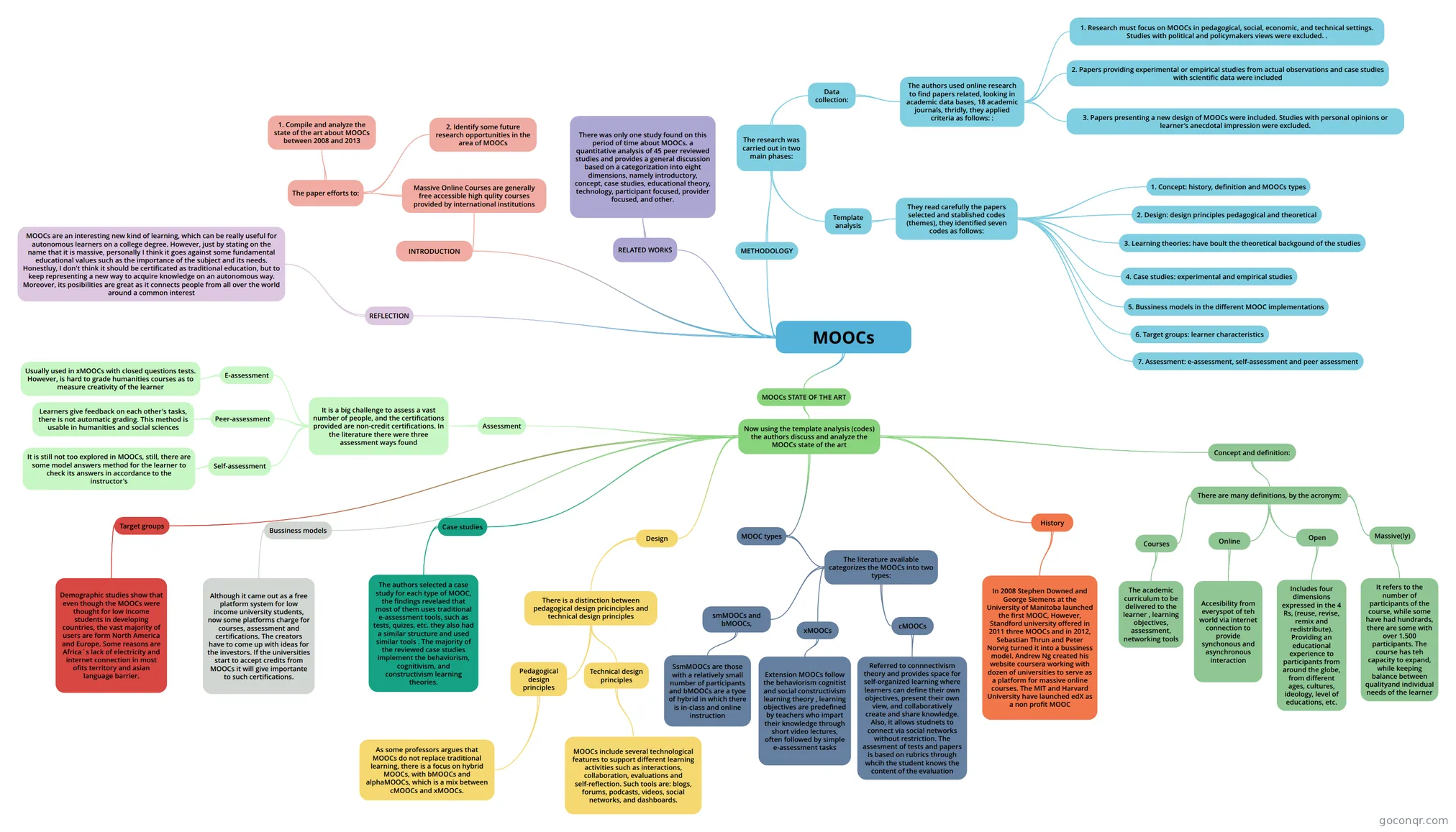
Mind map: MOOCs
Map content
MOOCs
INTRODUCTION
- Massive Online Courses are generally free accessible high qulity courses provided by international institutions
- The paper efforts to:
- 1. Compile and analyze the state of the art about MOOCs between 2008 and 2013
- 2. Identify some future research opportunities in the area of MOOCs
- The paper efforts to:
- Massive Online Courses are generally free accessible high qulity courses provided by international institutions
RELATED WORKS
- There was only one study found on this period of time about MOOCs. a quantitative analysis of 45 peer reviewed studies and provides a general discussion based on a categorization into eight dimensions, namely introductory, concept, case studies, educational theory, technology, participant focused, provider focused, and other.
METHODOLOGY
- The research was carried out in two main phases:
- Data collection:
- The authors used online research to find papers related, looking in academic data bases, 18 academic journals, thridly, they applied criteria as follows: :
- 1. Research must focus on MOOCs in pedagogical, social, economic, and technical settings. Studies with political and policymakers views were excluded. .
- 2. Papers providing experimental or empirical studies from actual observations and case studies with scientific data were included
- 3. Papers presenting a new design of MOOCs were included. Studies with personal opinions or learner’s anecdotal impression were excluded.
- The authors used online research to find papers related, looking in academic data bases, 18 academic journals, thridly, they applied criteria as follows: :
- Template analysis
- They read carefully the papers selected and stablished codes (themes), they identified seven codes as follows:
- 1. Concept: history, definition and MOOCs types
- 2. Design: design principles pedagogical and theoretical
- 3. Learning theories: have boult the theoretical backgound of the studies
- 4. Case studies: experimental and empirical studies
- 5. Bussiness models in the different MOOC implementations
- 6. Target groups: learner characteristics
- 7. Assessment: e-assessment, self-assessment and peer assessment
- They read carefully the papers selected and stablished codes (themes), they identified seven codes as follows:
- Data collection:
- The research was carried out in two main phases:
MOOCs STATE OF THE ART
- Now using the template analysis (codes) the authors discuss and analyze the MOOCs state of the art
- Concept and definition:
- There are many definitions, by the acronym:
- Massive(ly)
- It refers to the number of participants of the course, while some have had hundrards, there are some with over 1.500 participants. The course has teh capacity to expand, while keeping balance between qualityand individual needs of the learner
- Open
- Includes four dimensions expressed in the 4 Rs, (reuse, revise, remix and redistribute). Providing an educational experience to participants from around the globe, from different ages, cultures, ideology, level of educations, etc.
- Online
- Accesibility from everyspot of teh world via internet connection to provide synchonous and asynchronous interaction
- Courses
- The academic curriculum to be delivered to the learner , learning objectives, assessment, networking tools
- Massive(ly)
- There are many definitions, by the acronym:
- History
- In 2008 Stephen Downed and George Siemens at the University of Manitoba launched the first MOOC, However, Standford university offered in 2011 three MOOCs and in 2012, Sebastian Thrun and Peter Norvig turned it into a bussiness model. Andrew Ng created his website coursera working with dozen of universities to serve as a platform for massive online courses. The MIT and Harvard University have launched edX as a non profit MOOC
- MOOC types
- The literature available categorizes the MOOCs into two types:
- cMOOCs
- Referred to connnectivism theory and provides space for self-organized learning where learners can define their own objectives, present their own view, and collaboratively create and share knowledge. Also, it allows studnets to connect via social networks without restriction. The assesment of tests and papers is based on rubrics through whcih the student knows the content of the evaluation
- xMOOCs
- Extension MOOCs follow the behaviorism cognitist and social constructivism learning theory , learning objectives are predefined by teachers who impart their knowledge through short video lectures, often followed by simple e-assessment tasks
- smMOOCs and bMOOCs,
- SsmMOOCs are those with a relatively small number of participants and bMOOCs are a tyoe of hybrid in which there is in-class and online instruction
- cMOOCs
- The literature available categorizes the MOOCs into two types:
- Design
- There is a distinction between pedagogical design pricinciples and technical design principles
- Pedagogical design principles
- As some professors argues that MOOCs do not replace traditional learning, there is a focus on hybrid MOOCs, with bMOOCs and alphaMOOCs, which is a mix between cMOOCs and xMOOCs.
- Technical design principles
- MOOCs include several technological features to support different learning activities such as interactions, collaboration, evaluations and self-reflection. Such tools are: blogs, forums, podcasts, videos, social networks, and dashboards.
- Pedagogical design principles
- There is a distinction between pedagogical design pricinciples and technical design principles
- Case studies
- The authors selected a case study for each type of MOOC, the findings revelaed that most of them uses traditional e-assessment tools, such as tests, quizes, etc. they also had a similar structure and used similar tools . The majority of the reviewed case studies implement the behaviorism, cognitivism, and constructivism learning theories.
- Bussiness models
- Although it came out as a free platform system for low income university students, now some platforms charge for courses, assessment and certifications. The creators have to come up with ideas for the investors. If the universities start to accept credits from MOOCs it will give importante to such certifications.
- Target groups
- Demographic studies show that even though the MOOCs were thought for low income students in developing countries, the vast majority of users are form North America and Europe. Some reasons are Africa´s lack of electricity and internet connection in most ofits territory and asian language barrier.
- Assessment
- It is a big challenge to assess a vast number of people, and the certifications provided are non-credit certifications. In the literature there were three assessment ways found
- E-assessment
- Usually used in xMOOCs with closed questions tests. However, is hard to grade humanities courses as to measure creativity of the learner
- Peer-assessment
- Learners give feedback on each other's tasks, there is not automatic grading. This method is usable in humanities and social sciences
- Self-assessment
- It is still not too explored in MOOCs, still, there are some model answers method for the learner to check its answers in accordance to the instructor's
- E-assessment
- It is a big challenge to assess a vast number of people, and the certifications provided are non-credit certifications. In the literature there were three assessment ways found
- Concept and definition:
- Now using the template analysis (codes) the authors discuss and analyze the MOOCs state of the art
REFLECTION
- MOOCs are an interesting new kind of learning, which can be really useful for autonomous learners on a college degree. However, just by stating on the name that it is massive, personally I think it goes against some fundamental educational values such as the importance of the subject and its needs. Honestluy, I don't think it should be certificated as traditional education, but to keep representing a new way to acquire knowledge on an autonomous way. Moreover, its posibilities are great as it connects people from all over the world around a common interest
Information
- Description
- TICs Mind Map on MOOCs, created by Sergio Marquez on 21/10/2019.
- Created by
- Sergio Marquez
- Views
- 1
- Rating