
Mind map
Self-Concept Under Attack
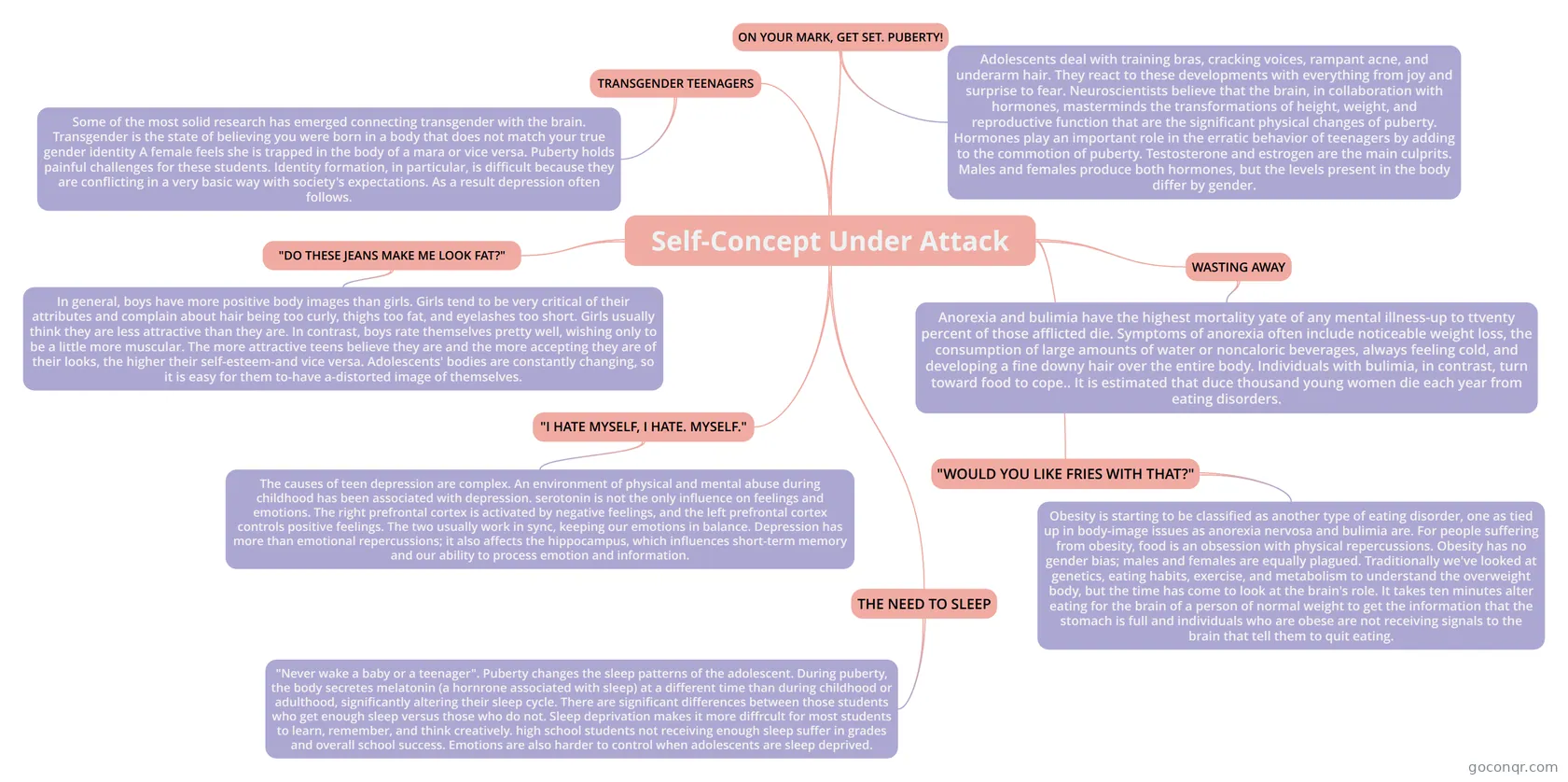
Mind map: self-concept under attack
Map content
Self-Concept Under Attack
ON YOUR MARK, GET SET. PUBERTY!
- Adolescents deal with training bras, cracking voices, rampant acne, and underarm hair. They react to these developments with everything from joy and surprise to fear. Neuroscientists believe that the brain, in collaboration with hormones, masterminds the transformations of height, weight, and reproductive function that are the significant physical changes of puberty. Hormones play an important role in the erratic behavior of teenagers by adding to the commotion of puberty. Testosterone and estrogen are the main culprits. Males and females produce both hormones, but the levels present in the body differ by gender.
TRANSGENDER TEENAGERS
- Some of the most solid research has emerged connecting transgender with the brain. Transgender is the state of believing you were born in a body that does not match your true gender identity A female feels she is trapped in the body of a mara or vice versa. Puberty holds painful challenges for these students. Identity formation, in particular, is difficult because they are conflicting in a very basic way with society's expectations. As a result depression often follows.
"DO THESE JEANS MAKE ME LOOK FAT?"
- In general, boys have more positive body images than girls. Girls tend to be very critical of their attributes and complain about hair being too curly, thighs too fat, and eyelashes too short. Girls usually think they are less attractive than they are. In contrast, boys rate themselves pretty well, wishing only to be a little more muscular. The more attractive teens believe they are and the more accepting they are of their looks, the higher their self-esteem-and vice versa. Adolescents' bodies are constantly changing, so it is easy for them to-have a-distorted image of themselves.
"I HATE MYSELF, I HATE. MYSELF."
- The causes of teen depression are complex. An environment of physical and mental abuse during childhood has been associated with depression. serotonin is not the only influence on feelings and emotions. The right prefrontal cortex is activated by negative feelings, and the left prefrontal cortex controls positive feelings. The two usually work in sync, keeping our emotions in balance. Depression has more than emotional repercussions; it also affects the hippocampus, which influences short-term memory and our ability to process emotion and information.
WASTING AWAY
- Anorexia and bulimia have the highest mortality yate of any mental illness-up to ttventy percent of those afflicted die. Symptoms of anorexia often include noticeable weight loss, the consumption of large amounts of water or noncaloric beverages, always feeling cold, and developing a fine downy hair over the entire body. Individuals with bulimia, in contrast, turn toward food to cope.. It is estimated that duce thousand young women die each year from eating disorders.
"WOULD YOU LIKE FRIES WITH THAT?"
- Obesity is starting to be classified as another type of eating disorder, one as tied up in body-image issues as anorexia nervosa and bulimia are. For people suffering from obesity, food is an obsession with physical repercussions. Obesity has no gender bias; males and females are equally plagued. Traditionally we've looked at genetics, eating habits, exercise, and metabolism to understand the overweight body, but the time has come to look at the brain's role. It takes ten minutes alter eating for the brain of a person of normal weight to get the information that the stomach is full and individuals who are obese are not receiving signals to the brain that tell them to quit eating.
THE NEED TO SLEEP
- "Never wake a baby or a teenager". Puberty changes the sleep patterns of the adolescent. During puberty, the body secretes melatonin (a hornrone associated with sleep) at a different time than during childhood or adulthood, significantly altering their sleep cycle. There are significant differences between those students who get enough sleep versus those who do not. Sleep deprivation makes it more diffrcult for most students to learn, remember, and think creatively. high school students not receiving enough sleep suffer in grades and overall school success. Emotions are also harder to control when adolescents are sleep deprived.
Information
- Description
- Mind Map on Self-Concept Under Attack, created by Joseline Rodriguez on 08/03/2020.
- Created by
- Joseline Rodriguez
- Views
- 0
- Rating