
Mind map
Enter text here
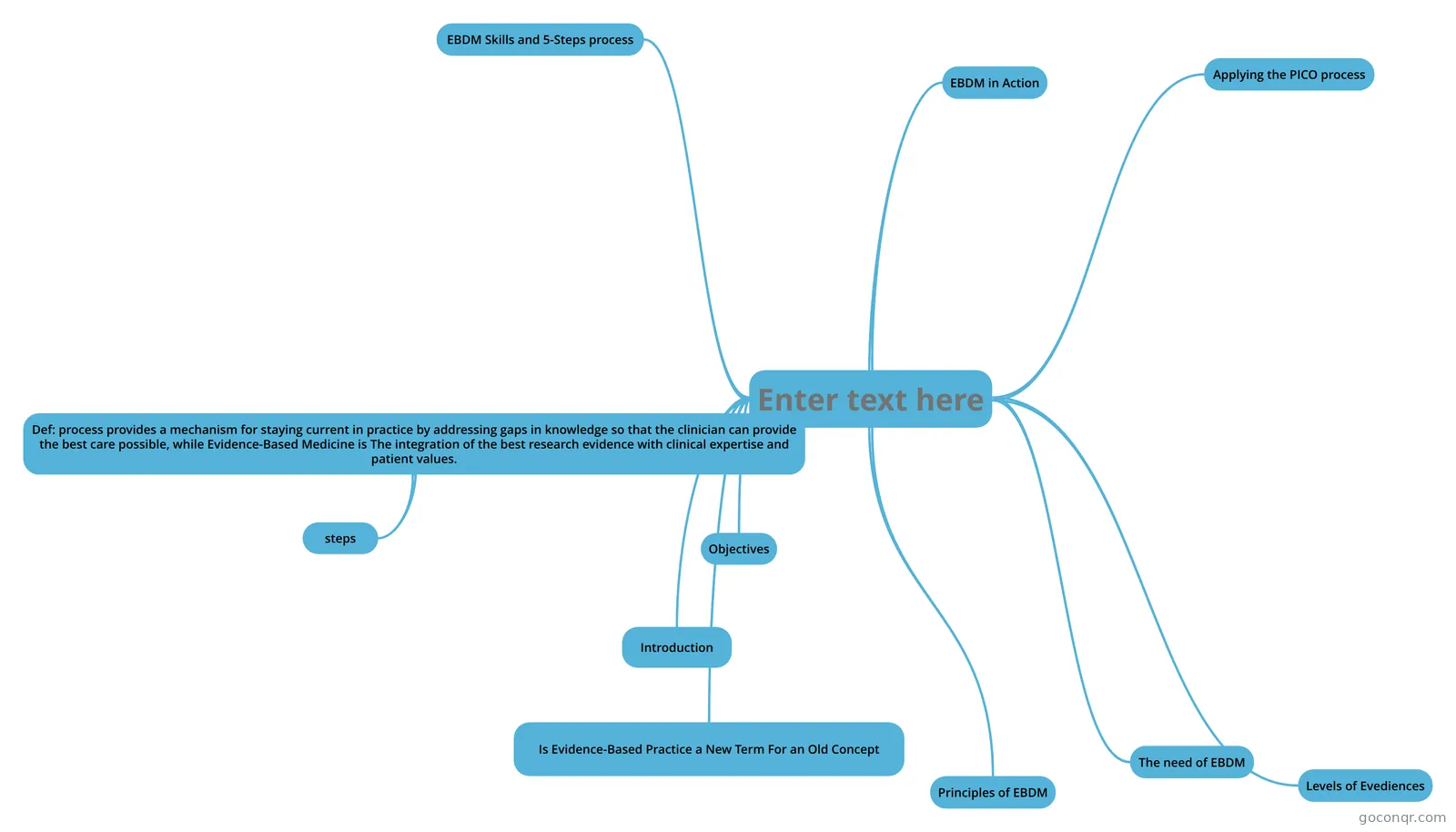
Mind map: Evidence-Based Dentistry (EBDM)
Map content
Enter text here
overview
- Def: process provides a mechanism for staying current in practice by addressing gaps in knowledge so that the clinician can provide the best care possible, while Evidence-Based Medicine is The integration of the best research evidence with clinical expertise and patient values.
- The formalized process of using the skills for identifying, searching for and interpreting the results of the best scientific evidence, which is considered in conjunction with the clinician's experience and judgment, the patient's preferences and values, and the clinical/patient circumstances when making patient care decisions.
- steps
- - how to ask an answerable question -This question provides the basis for identifying the key terms for conducting an efficient search -Critically appraising the evidence, applying the results in clinical practice, and evaluating the outcome.
- Def: process provides a mechanism for staying current in practice by addressing gaps in knowledge so that the clinician can provide the best care possible, while Evidence-Based Medicine is The integration of the best research evidence with clinical expertise and patient values.
Objectives
- -Define Evidence-Based Medicine/Practice. -Define Evidence-based Decision Making and its purpose. -Explain why evidence-based practice is not just a new term for an old concept. -Identify two principles of EBDM. -Discuss the need for EBDM.Identify the levels of evidence and premise upon which they are based. -Describe the 5 steps and skills necessary for EBDM. -Formulate a good question using the PICO process. -Discuss the benefits of EBDM..
Introduction
- The old clinical problem-solving model based on individual experience or the use of information gained by consulting authorities (colleagues or text books) gave way to a new methodology for practice and restructured the way in which more effective clinical problem-solving should be conducted. This new methodology was termed Evidence-Based Medicine (EBM)
Is Evidence-Based Practice a New Term For an Old Concept
- The use of evidence in practice is not new. What is new is the nature of the clinical evidence itself in terms of the methods for gathering it [randomized controlled trials and other well-designed methods], the statistical tools for synthesising and analysing it [systematic reviews and meta-analysis], and the ways for ways for accessing [electronic databases] and applying it [evidence-based decision-making and practice guidelines]
- In other words, evidence-based practice is not just a new term for an old concept and as a result of advances, practitioners need: more efficient and effective online searching skills to find relevant evidence, andcritical appraisal skills to rapidly evaluate and sort out what is valid and useful, and what is not.10 EBDM is the formalised process and structure for learning these skills with the purpose of closing the gap between what is known and what is practiced in order to improve patient care based on informed decision-making.
Principles of EBDM
- Evidence-based decision-making is about solving clinical problems and involves two fundamental principles:
- Evidence alone is never sufficient to make a clinical decision. Initially, the focus of EBM emphasized using randomized clinical trials and other quantifiable methods. However, as EBM has evolved, so has the realisation that the evidence from clinical research is only one key component of the decision making process and does not tell a practitioner what to do.
- A hierarchy of evidence exists to guide clinical decision-making.9 EBDM is a structured process which incorporates a formal set of rules for interpreting the results of clinical research and places a lower value on authority or custom. In contrast to EBDM, traditional decision-making, relies more on intuition, unsystematic clinical experience and pathophysiologic rationale.
The need of EBDM
- An evidence-based approach emerged in response to the need for improving the quality of health care, keeping up with the evidence as it changes with new research, and demonstrating the best use of limited resources.
- Forces driving the need to improve the quality of care include: variations in practice,slow translation and assimilation of the scientific evidence into practice,managing the information overload, andchanging educational competencies that require students to have the skills for lifelong learning.
Levels of Evediences
EBDM Skills and 5-Steps process
EBDM in Action
Applying the PICO process
Information
- Description
- Mind Map on Enter text here, created by Khaled K.mohammed on 29/03/2020.
- Created by
- Khaled K.mohammed
- Views
- 1
- Rating
More on Evidence-Based Decision Making