
Mind map
ORTHOGRAPHY
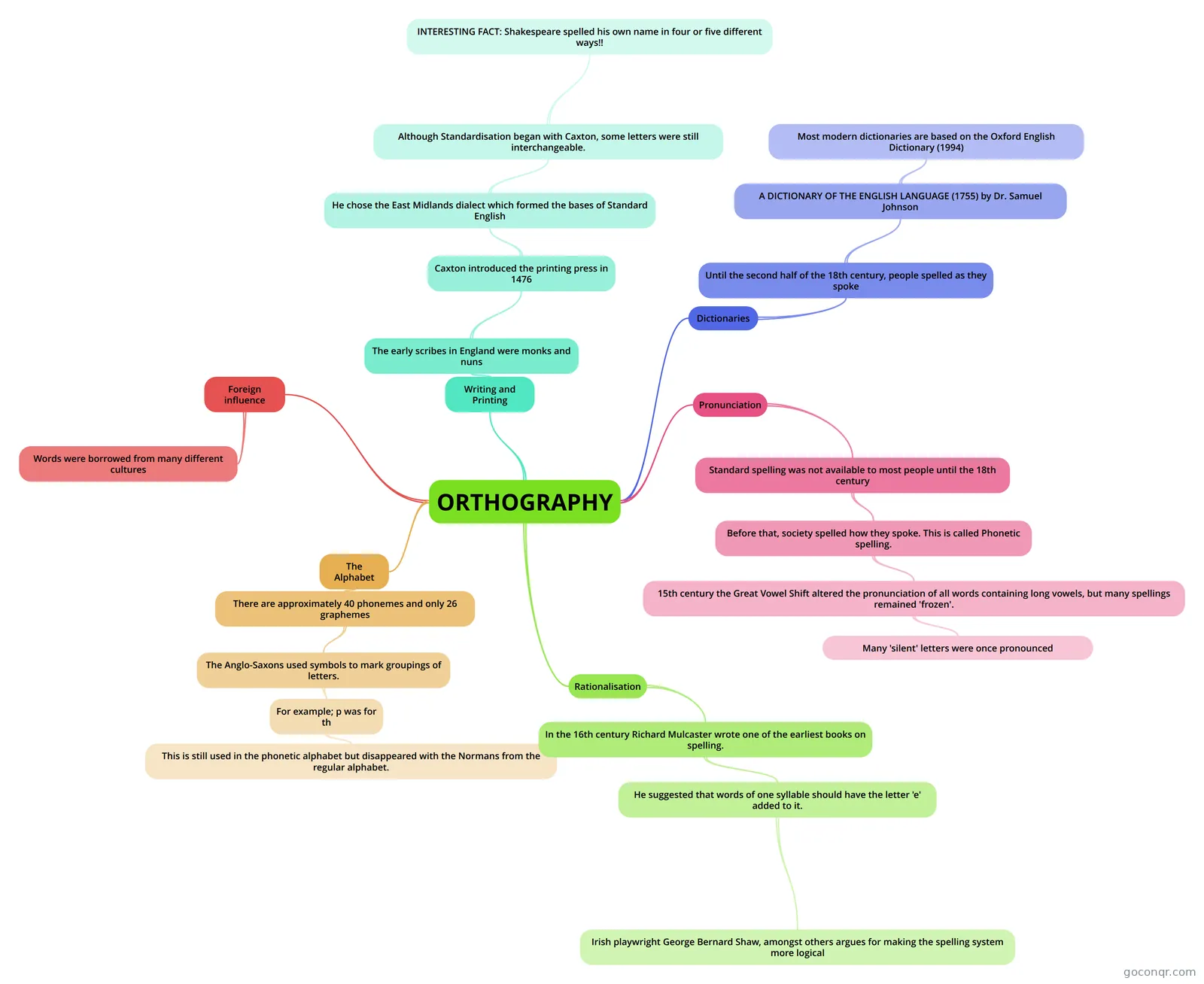
Mind map: English orthography
Map content
ORTHOGRAPHY
The Alphabet
- There are approximately 40 phonemes and only 26 graphemes
- The Anglo-Saxons used symbols to mark groupings of letters.
- For example; p was for th
- This is still used in the phonetic alphabet but disappeared with the Normans from the regular alphabet.
- For example; p was for th
- The Anglo-Saxons used symbols to mark groupings of letters.
- There are approximately 40 phonemes and only 26 graphemes
Pronunciation
- Standard spelling was not available to most people until the 18th century
- Before that, society spelled how they spoke. This is called Phonetic spelling.
- 15th century the Great Vowel Shift altered the pronunciation of all words containing long vowels, but many spellings remained 'frozen'.
- Many 'silent' letters were once pronounced
- 15th century the Great Vowel Shift altered the pronunciation of all words containing long vowels, but many spellings remained 'frozen'.
- Before that, society spelled how they spoke. This is called Phonetic spelling.
- Standard spelling was not available to most people until the 18th century
Writing and Printing
- The early scribes in England were monks and nuns
- Caxton introduced the printing press in 1476
- He chose the East Midlands dialect which formed the bases of Standard English
- Although Standardisation began with Caxton, some letters were still interchangeable.
- For example; y/i j/i u/v
- INTERESTING FACT: Shakespeare spelled his own name in four or five different ways!!
- Although Standardisation began with Caxton, some letters were still interchangeable.
- He chose the East Midlands dialect which formed the bases of Standard English
- Caxton introduced the printing press in 1476
- The early scribes in England were monks and nuns
Foreign influence
- Words were borrowed from many different cultures
- In the 15th and 16th centuries, European scholars became interested in the ideas of the ancient Greeks and Romans that so many new words came into English.
- Words were borrowed from many different cultures
Dictionaries
- Until the second half of the 18th century, people spelled as they spoke
- A DICTIONARY OF THE ENGLISH LANGUAGE (1755) by Dr. Samuel Johnson
- Did you know that it took Dr. Johnson seven years to complete the two volumes of his dictionary?
- Most modern dictionaries are based on the Oxford English Dictionary (1994)
- Now, looking a word up in the dictionary to check the spelling is a valued skill
- A DICTIONARY OF THE ENGLISH LANGUAGE (1755) by Dr. Samuel Johnson
- Until the second half of the 18th century, people spelled as they spoke
Rationalisation
- In the 16th century Richard Mulcaster wrote one of the earliest books on spelling.
- He suggested that words of one syllable should have the letter 'e' added to it.
- For example; Pin- Pine Pet- Pete Cod- Code Cut- Cute
- Irish playwright George Bernard Shaw, amongst others argues for making the spelling system more logical
- He suggested that words of one syllable should have the letter 'e' added to it.
- In the 16th century Richard Mulcaster wrote one of the earliest books on spelling.
Information
- Description
- Mind Map on ORTHOGRAPHY, created by Ashleigh Edwards on 04/10/2013.
- Created by
- Ashleigh Edwards
- Views
- 74
- Rating