
Mind map
Digital Business Models
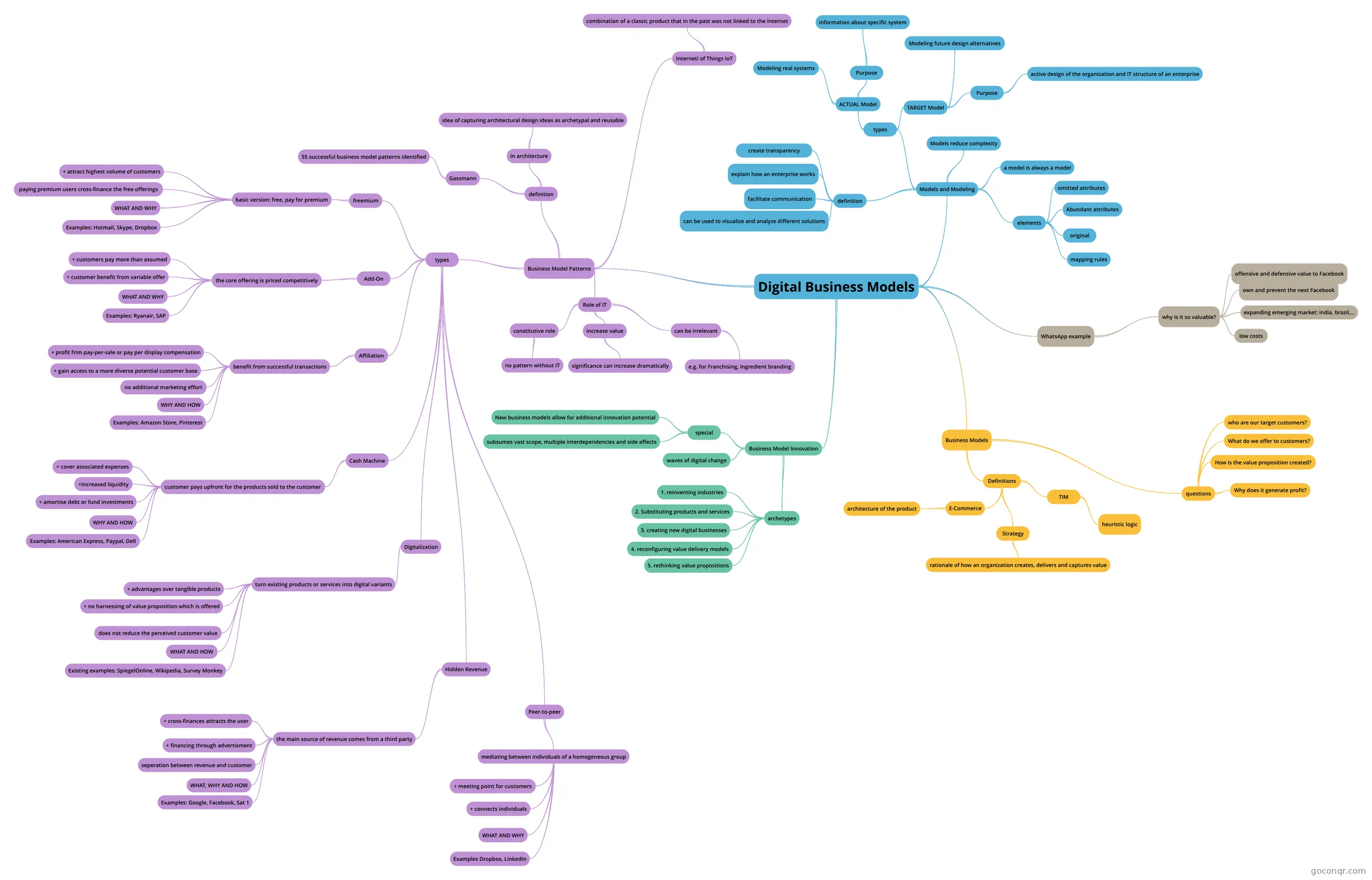
Mind map: Digital business models
Map content
Digital Business Models
Models and Modeling
- Models reduce complexity
- a model is always a model
- elements
- omitted attributes
- Abundant attributes
- original
- mapping rules
- types
- ACTUAL Model
- Modeling real systems
- Purpose
- information about specific system
- TARGET Model
- Modeling future design alternatives
- Purpose
- active design of the organization and IT structure of an enterprise
- ACTUAL Model
- definition
- create transparency
- explain how an enterprise works
- facilitate communication
- can be used to visualize and analyze different solutions
Business Models
- Definitions
- E-Commerce
- architecture of the product
- Strategy
- rationale of how an organization creates, delivers and captures value
- TIM
- heuristic logic
- E-Commerce
- questions
- who are our target customers?
- What do we offer to customers?
- How is the value proposition created?
- Why does it generate profit?
- Definitions
Business Model Innovation
- special
- New business models allow for additional innovation potential
- subsumes vast scope, multiple interdependencies and side effects
- waves of digital change
- archetypes
- 1. reinventing industries
- 2. Substituting products and services
- 3. creating new digital businesses
- 4. reconfiguring value delivery models
- 5. rethinking value propositions
- special
Business Model Patterns
- definition
- in architecture
- idea of capturing architectural design ideas as archetypal and reusable
- Gassmann
- 55 successful business model patterns identified
- in architecture
- types
- freemium
- basic version: free, pay for premium
- + attract highest volume of customers
- paying premium users cross-finance the free offerings
- WHAT AND WHY
- Examples: Hotmail, Skype, Dropbox
- basic version: free, pay for premium
- Add-On
- the core offering is priced competitively
- + customers pay more than assumed
- + customer benefit from variable offer
- WHAT AND WHY
- Examples: Ryanair, SAP
- the core offering is priced competitively
- Affiliation
- benefit from successful transactions
- + profit frim pay-per-sale or pay per display compensation
- + gain access to a more diverse potential customer base
- no additional marketing effort
- WHY AND HOW
- Examples: Amazon Store, Pinterest
- benefit from successful transactions
- Cash Machine
- customer pays upfront for the products sold to the customer
- + cover associated expenses
- +increased liquidity
- + amortise debt or fund investments
- WHY AND HOW
- Examples: American Express, Paypal, Dell
- customer pays upfront for the products sold to the customer
- Digitalization
- turn existing products or services into digital variants
- + advantages over tangible products
- + no harnessing of value proposition which is offered
- does not reduce the perceived customer value
- WHAT AND HOW
- Existing examples: SpiegelOnline, Wikipedia, Survey Monkey
- turn existing products or services into digital variants
- Hidden Revenue
- the main source of revenue comes from a third party
- + cross-finances attracts the user
- + financing through advertisment
- seperation between revenue and customer
- WHAT, WHY AND HOW
- Examples: Google, Facebook, Sat 1
- the main source of revenue comes from a third party
- Peer-to-peer
- mediating between individuals of a homogeneous group
- + meeting point for customers
- + connects individuals
- WHAT AND WHY
- Examples Dropbox, LinkedIn
- mediating between individuals of a homogeneous group
- freemium
- Role of IT
- constitutive role
- no pattern without IT
- increase value
- significance can increase dramatically
- can be irrelevant
- e.g. for Franchising, Ingredient branding
- constitutive role
- Interneti of Things IoT
- combination of a classic product that in the past was not linked to the Internet
- definition
WhatsApp example
- why is it so valuable?
- offensive and defensive value to Facebook
- own and prevent the next Facebook
- expanding emerging market: india, brazil,...
- low costs
- why is it so valuable?
Information
- Description
- KLAUSUR&NOTENBONUS INFORMATION MANAGEMENT Mind Map on Digital Business Models, created by Luis Vering on 25/04/2021.
- Created by
- Luis Vering
- Views
- 2
- Rating
More on Digital Business Models and Platforms