
Mind map
Java Language Fundamentals
Map content
Java Language Fundamentals
Encoding Sets
- Java supports the Unicode character set, which allows for text to be written using characters from any language
- Since Unicode stores so many characters, transmitting Unicode text is not efficient
- Solution: Character encoding! (a.k.a data compression)
- UTF-8 Encoding
- UTF-8 translates any character into a binary string. The string can be 1-4 bytes, and the first 256 most commonly used ASCII characters are all stored in one byte
- By using less space to store more common characters, UTF-8 reduces file size and allows for a large number of less-common characters
- UTF-8 translates any character into a binary string. The string can be 1-4 bytes, and the first 256 most commonly used ASCII characters are all stored in one byte
- UTF-8 Encoding
- Solution: Character encoding! (a.k.a data compression)
- Since Unicode stores so many characters, transmitting Unicode text is not efficient
- Java supports the Unicode character set, which allows for text to be written using characters from any language
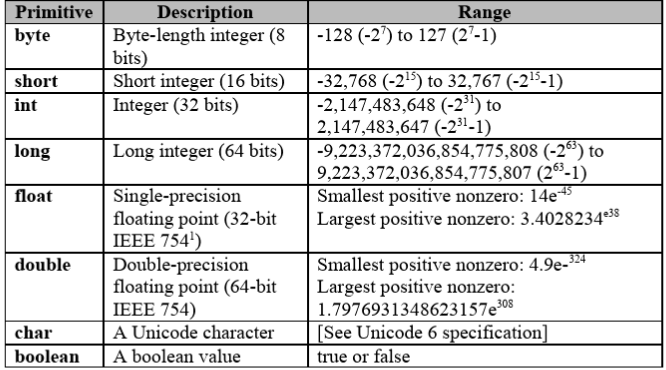
Primitives
- Simple, non-object programming elements, represent numbers and boolean values (t/f)
Variables
- Data placeholders whose contents can change
- Each variable has a type and a name/identifier
- Syntax: type name;
- Each variable has a type and a name/identifier
- Data placeholders whose contents can change
Constants
- Variables whose values cannot be changed after initial assignment
- To Declare: Use keyword 'final'. Also, the name of a constant is usually fully capitalized, with words separated by underscores
- Variables whose values cannot be changed after initial assignment
Literals
- Representation of data values understood by the Java compiler
- Literals of Type Primative
- Integer Literals
- Used to assign values of variable type byte, short, int, long
- To assign a value to a long, suffix the number with 'L'. Otherwise, the value will be considered an int.
- Other literal assignment tips:
- To express a literal in binary, prefix the binary number with 0B
- To make a long integer literal easier to read, utilize underscores
- Used to assign values of variable type byte, short, int, long
- Floating-Point Literals
- A floating point number consists of four parts: whole number, decimal, fractional, and an optional exponent
- There are two types of floating-point numbers: floats and doubles
- To assign a literal as a float, suffix the number with f_or_F
- There are two types of floating-point numbers: floats and doubles
- A floating point number consists of four parts: whole number, decimal, fractional, and an optional exponent
- Character Literals
- Unicode character or escape sequence enclosed in singular quotes (ex. 'a')
- Escape Sequences- need to write character representation (ex. '\t')
- Unicode character or escape sequence enclosed in singular quotes (ex. 'a')
- Boolean Literals
- two possible values: true or false
- Integer Literals
- Literals of Type Primative
- Representation of data values understood by the Java compiler
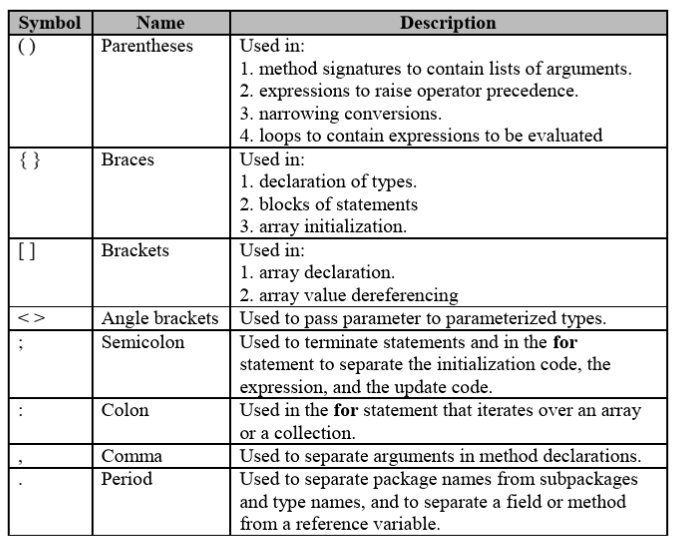
Common Separators
Images and files in the map
Information
- Description
- Mind Map on Java Language Fundamentals, created by Marissa Farmer on 18/06/2021.
- Created by
- Marissa Farmer
- Views
- 0
- Rating