
Mind map
IMPLICATIONAL LAWS
Map content
IMPLICATIONAL LAWS
Implicational laws thus identify the linguistic precursors to more complex phonological properties.
- Recurring Phonological Patterns
- Human languages use a wide variety of sounds but, despite this variety, some sounds are much more common than others.
- It is true that almost all human languages use stop consonants like [p] and [t] and the vowel [a] but, relatively few languages use pharynx fricatives, voiceless vowels, and clicks.
- So [p], [t] and [a] are more common in languages, while pharyngeal fricatives, voiceless vowels, and clicks are the least common speech sounds.
- Sound Inventories
- if a language uses a less common sound, it is generally the case that one of its more common counterparts will also be used.
- When we refer to a language uses a particular sound, we mean that the sound is in the inventory of phonemes of the language. In other words, that sound is contrastive in relation to other sounds of the language.
- The phrase "one of its more common counterparts" refers to the fact that for each less common sound in the inventory tends to have a more common sound in the same inventory that is very similar to the less common sound since they differ by only one or two phonetic characteristics.
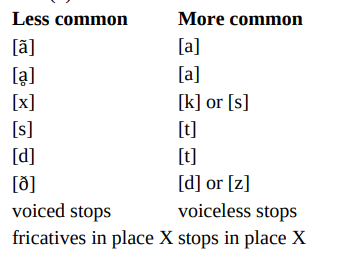
- For example, this image ilustrates the fact that using the terms “most common” and “less common” to designate sounds in an implicative relationship, they do not refer to an absolute standard. Rather, “most common” and “least common” are used relatively. In other words, [s] is less common than [t], but more common than [x].
- This means that any language that uses [ã] will also use [a], any language that uses [ḁ] will also use use [a], any language that uses [d] will also use [t], and so on.
- This type of observation is called an implicational law because the presence of the minor common sound implies that the most common sound will also be used in the language. Of course, the implication cannot be reversed.
- This means that any language that uses [ã] will also use [a], any language that uses [ḁ] will also use use [a], any language that uses [d] will also use [t], and so on.
- For example, this image ilustrates the fact that using the terms “most common” and “less common” to designate sounds in an implicative relationship, they do not refer to an absolute standard. Rather, “most common” and “least common” are used relatively. In other words, [s] is less common than [t], but more common than [x].
- if a language uses a less common sound, it is generally the case that one of its more common counterparts will also be used.
- Frequency and Distribution
- This is related to the degree to which sounds will be used in a particular language and to the range of distribution of sounds in the words of the language. It means that the pharyngeal fricative will have a limited use compared to the velar fricative.
- An example in English of the limited use and limited distribution of less common sounds is the phoneme [ð]. The sound [ð] can be classified as less common because it is relatively rare in the world's languages, and wherever [ð] appears in English, [z] can also appear.
- The words containing [ð] are limited to "grammatical" words like this, that, those, they, and them. Also, [ð] appears as the last sound in English words less frequently than [z]. Compared to the number of words. containing [z], it is obvious that [ð] has limited use in English
- An example in English of the limited use and limited distribution of less common sounds is the phoneme [ð]. The sound [ð] can be classified as less common because it is relatively rare in the world's languages, and wherever [ð] appears in English, [z] can also appear.
- This is related to the degree to which sounds will be used in a particular language and to the range of distribution of sounds in the words of the language. It means that the pharyngeal fricative will have a limited use compared to the velar fricative.
- Acquisition of Sounds
- The order of acquisition is related to the most common sounds and the least common sounds of the language.
- When a child is learning a language it is much easier for him to acquire the use of more common sounds than the use of less common sounds. For example, by saying [dɪs wᴧn] for "this one", you are replacing the relatively less common [ð] with [d], a much more common sound.
- As a result of this, implicative laws capture a generalization about language knowing that the acquisition of a relatively less common sound implies that its more common counterpart has already been acquired.
- When a child is learning a language it is much easier for him to acquire the use of more common sounds than the use of less common sounds. For example, by saying [dɪs wᴧn] for "this one", you are replacing the relatively less common [ð] with [d], a much more common sound.
- The order of acquisition is related to the most common sounds and the least common sounds of the language.
- Sound Change
- This implies language change because less common sounds tend to be less stable than the more common ones. Thus, in the course of language change, if any sound is to be missed, it is more likely to be a less common one instead of its more common counterpart.
- For example, in the Old English pronunciation of the word "gentleman" there was a voiceless velar fricative [x] between the vowel and the [t]; the letters <gh> indicate where this consonant used to be. During the development of English, this velar fricative was lost
- English speakers just stopped using velar fricatives altogether and now it's a little harder to learn how to say them when we're trying to learn a word. language like German that does use them.
- This fits with the Implicational laws that say that fricatives are less common than stops. Therefore, the fricative [x] is less stable and more likely to be lost or changed to a more common sound than the corresponding stop consonant [k].
- English speakers just stopped using velar fricatives altogether and now it's a little harder to learn how to say them when we're trying to learn a word. language like German that does use them.
- For example, in the Old English pronunciation of the word "gentleman" there was a voiceless velar fricative [x] between the vowel and the [t]; the letters <gh> indicate where this consonant used to be. During the development of English, this velar fricative was lost
- This implies language change because less common sounds tend to be less stable than the more common ones. Thus, in the course of language change, if any sound is to be missed, it is more likely to be a less common one instead of its more common counterpart.
- Recurring Phonological Patterns
It is important to recognize that when people use language, their goal is to communicate, that is, successfully transmit a message from a speaker to a listener and that makes us ask ourselves what are the most common sounds to be able to transmit the message clearly.
Alveolar fricatives are more common than alveolar fricatives. pharyngeal fricatives because the tip of the tongue is more agile than the back of the tongue; therefore alveolar consonants are easier to produce than the pharyngeals, this is why the ease of production is an explanation of at least some of implicative laws.
Another way to answer the question of which sounds are most useful for conveying a message from speaker to listener focuses on the listener's point of view. It is reasonable to assume that if a sound is mixed with closely surrounding sounds its distinctive qualities may become difficult to discern. hear.
Images and files in the map
Information
- Description
- Language English Linguistics Mind Map on IMPLICATIONAL LAWS, created by Cinthya Martínez on 24/02/2022.
- Created by
- Cinthya Martínez
- Views
- 20
- Rating