
Mind map
LITERARY PERIODS
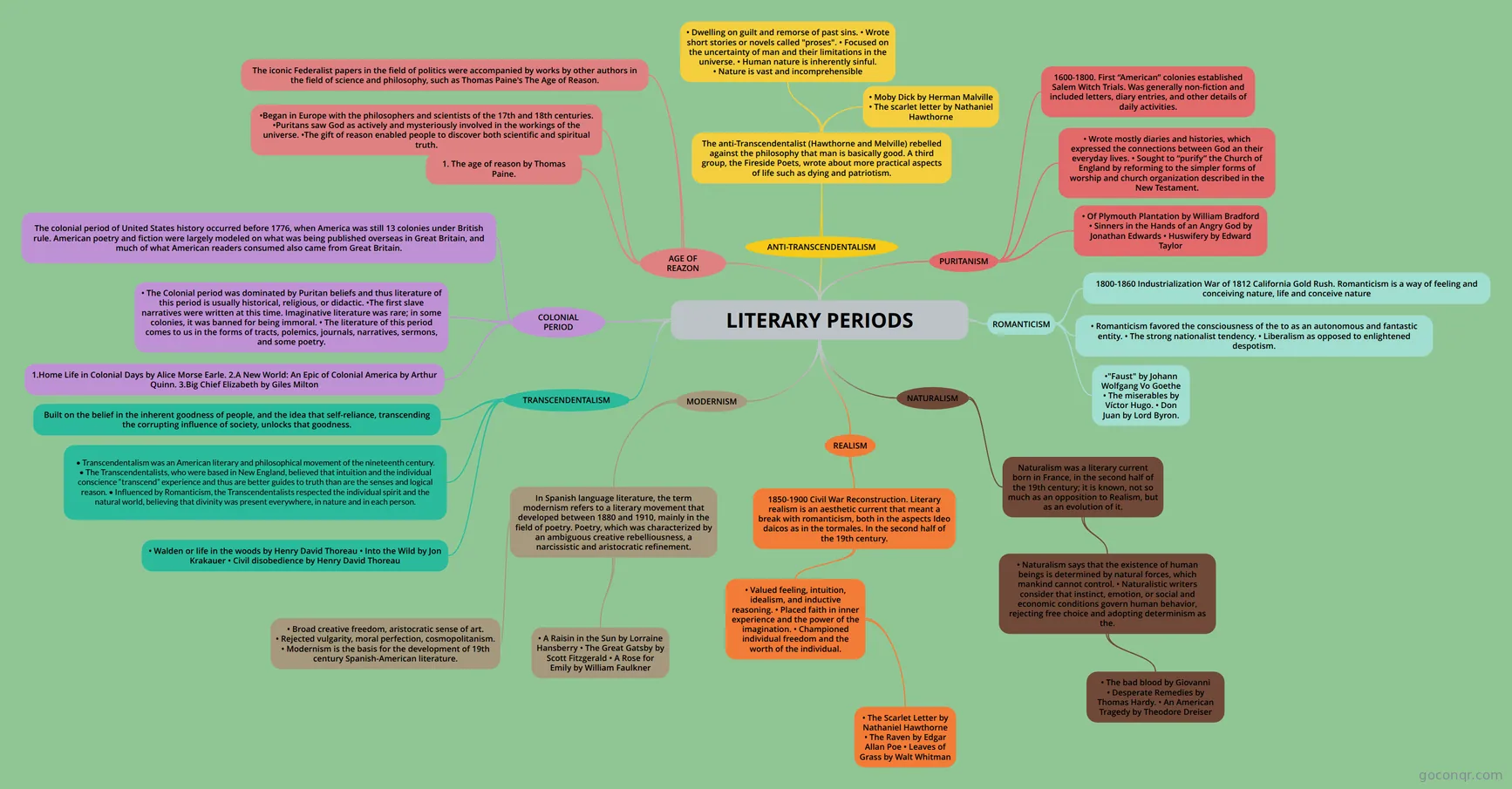
Mind map: literary periods
Map content
LITERARY PERIODS
COLONIAL PERIOD
- The colonial period of United States history occurred before 1776, when America was still 13 colonies under British rule. American poetry and fiction were largely modeled on what was being published overseas in Great Britain, and much of what American readers consumed also came from Great Britain.
- • The Colonial period was dominated by Puritan beliefs and thus literature of this period is usually historical, religious, or didactic. •The first slave narratives were written at this time. Imaginative literature was rare; in some colonies, it was banned for being immoral. • The literature of this period comes to us in the forms of tracts, polemics, journals, narratives, sermons, and some poetry.
- 1.Home Life in Colonial Days by Alice Morse Earle. 2.A New World: An Epic of Colonial America by Arthur Quinn. 3.Big Chief Elizabeth by Giles Milton
AGE OF REAZON
- The iconic Federalist papers in the field of politics were accompanied by works by other authors in the field of science and philosophy, such as Thomas Paine's The Age of Reason.
- •Began in Europe with the philosophers and scientists of the 17th and 18th centuries. •Puritans saw God as actively and mysteriously involved in the workings of the universe. •The gift of reason enabled people to discover both scientific and spiritual truth.
- 1. The age of reason by Thomas Paine.
ROMANTICISM
- 1800-1860 Industrialization War of 1812 California Gold Rush. Romanticism is a way of feeling and conceiving nature, life and conceive nature
- • Romanticism favored the consciousness of the to as an autonomous and fantastic entity. • The strong nationalist tendency. • Liberalism as opposed to enlightened despotism.
- •"Faust" by Johann Wolfgang Vo Goethe • The miserables by Víctor Hugo. • Don Juan by Lord Byron.
TRANSCENDENTALISM
- Built on the belief in the inherent goodness of people, and the idea that self-reliance, transcending the corrupting influence of society, unlocks that goodness.
- • Transcendentalism was an American literary and philosophical movement of the nineteenth century. • The Transcendentalists, who were based in New England, believed that intuition and the individual conscience “transcend” experience and thus are better guides to truth than are the senses and logical reason. • Influenced by Romanticism, the Transcendentalists respected the individual spirit and the natural world, believing that divinity was present everywhere, in nature and in each person.
- • Walden or life in the woods by Henry David Thoreau • Into the Wild by Jon Krakauer • Civil disobedience by Henry David Thoreau
ANTI-TRANSCENDENTALISM
- The anti-Transcendentalist (Hawthorne and Melville) rebelled against the philosophy that man is basically good. A third group, the Fireside Poets, wrote about more practical aspects of life such as dying and patriotism.
- • Dwelling on guilt and remorse of past sins. • Wrote short stories or novels called "proses". • Focused on the uncertainty of man and their limitations in the universe. • Human nature is inherently sinful. • Nature is vast and incomprehensible
- • Moby Dick by Herman Malville • The scarlet letter by Nathaniel Hawthorne
- The anti-Transcendentalist (Hawthorne and Melville) rebelled against the philosophy that man is basically good. A third group, the Fireside Poets, wrote about more practical aspects of life such as dying and patriotism.
PURITANISM
- 1600-1800. First “American” colonies established Salem Witch Trials. Was generally non-fiction and included letters, diary entries, and other details of daily activities.
- • Wrote mostly diaries and histories, which expressed the connections between God an their everyday lives. • Sought to “purify” the Church of England by reforming to the simpler forms of worship and church organization described in the New Testament.
- • Of Plymouth Plantation by William Bradford • Sinners in the Hands of an Angry God by Jonathan Edwards • Huswifery by Edward Taylor
NATURALISM
- Naturalism was a literary current born in France, in the second half of the 19th century; it is known, not so much as an opposition to Realism, but as an evolution of it.
- • Naturalism says that the existence of human beings is determined by natural forces, which mankind cannot control. • Naturalistic writers consider that instinct, emotion, or social and economic conditions govern human behavior, rejecting free choice and adopting determinism as the.
- • The bad blood by Giovanni • Desperate Remedies by Thomas Hardy. • An American Tragedy by Theodore Dreiser
- • Naturalism says that the existence of human beings is determined by natural forces, which mankind cannot control. • Naturalistic writers consider that instinct, emotion, or social and economic conditions govern human behavior, rejecting free choice and adopting determinism as the.
- Naturalism was a literary current born in France, in the second half of the 19th century; it is known, not so much as an opposition to Realism, but as an evolution of it.
MODERNISM
- In Spanish language literature, the term modernism refers to a literary movement that developed between 1880 and 1910, mainly in the field of poetry. Poetry, which was characterized by an ambiguous creative rebelliousness, a narcissistic and aristocratic refinement.
- • Broad creative freedom, aristocratic sense of art. • Rejected vulgarity, moral perfection, cosmopolitanism. • Modernism is the basis for the development of 19th century Spanish-American literature.
- • A Raisin in the Sun by Lorraine Hansberry • The Great Gatsby by Scott Fitzgerald • A Rose for Emily by William Faulkner
- In Spanish language literature, the term modernism refers to a literary movement that developed between 1880 and 1910, mainly in the field of poetry. Poetry, which was characterized by an ambiguous creative rebelliousness, a narcissistic and aristocratic refinement.
REALISM
- 1850-1900 Civil War Reconstruction. Literary realism is an aesthetic current that meant a break with romanticism, both in the aspects Ideo daicos as in the tormales. In the second half of the 19th century.
- • Valued feeling, intuition, idealism, and inductive reasoning. • Placed faith in inner experience and the power of the imagination. • Championed individual freedom and the worth of the individual.
- • The Scarlet Letter by Nathaniel Hawthorne • The Raven by Edgar Allan Poe • Leaves of Grass by Walt Whitman
- • Valued feeling, intuition, idealism, and inductive reasoning. • Placed faith in inner experience and the power of the imagination. • Championed individual freedom and the worth of the individual.
- 1850-1900 Civil War Reconstruction. Literary realism is an aesthetic current that meant a break with romanticism, both in the aspects Ideo daicos as in the tormales. In the second half of the 19th century.
Information
- Description
- Mind Map on LITERARY PERIODS, created by GIANNELLY SARAHI CORNEJO VILLANUEVA on 23/05/2022.
- Created by
- GIANNELLY SARAHI CORNEJO VILLANUEVA
- Views
- 28
- Rating