
Mind map
ROBERT WALTON
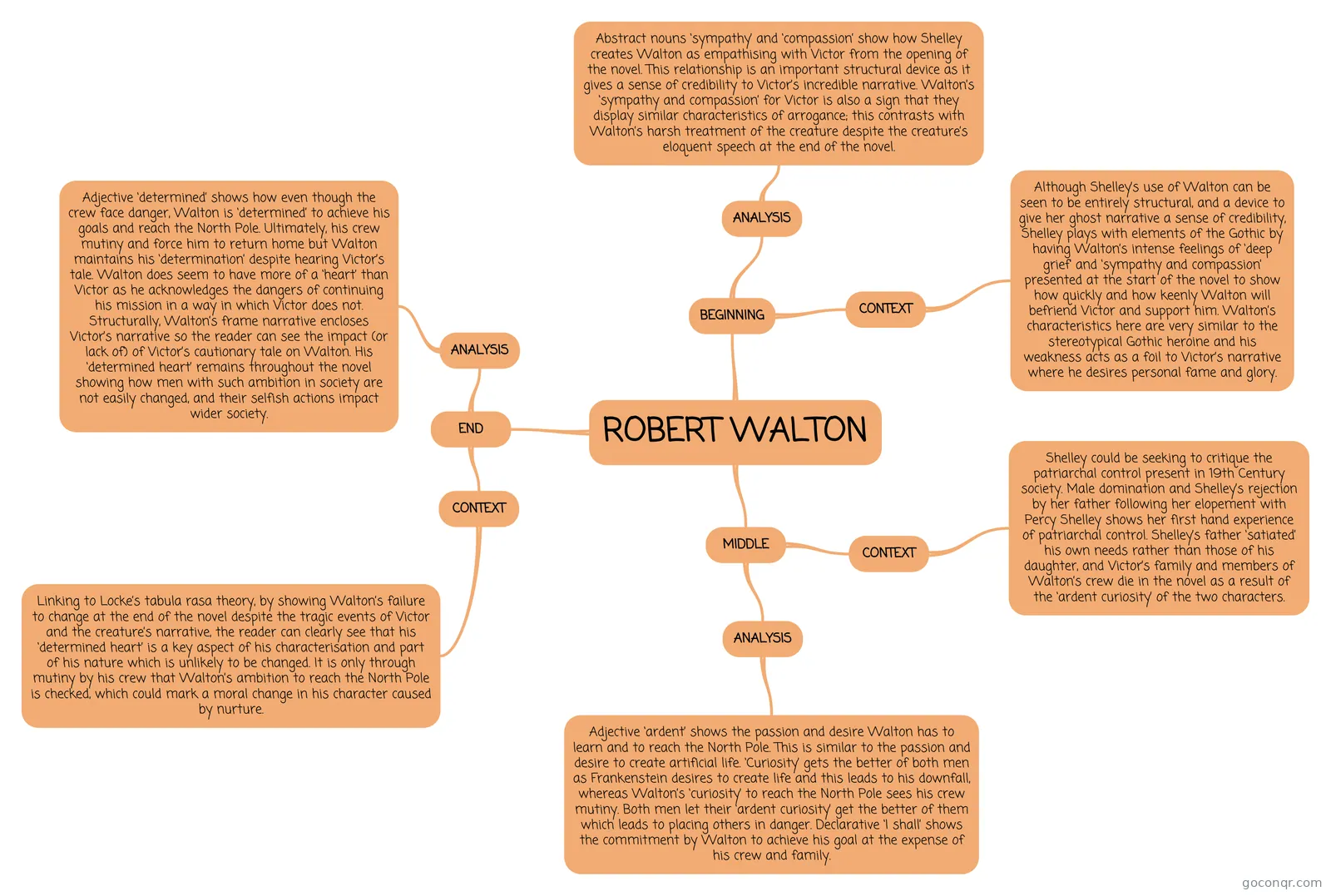
Mind map: Robert Walton
Map content
ROBERT WALTON
BEGINNING
- ANALYSIS
- Abstract nouns ‘sympathy’ and ‘compassion’ show how Shelley creates Walton as empathising with Victor from the opening of the novel. This relationship is an important structural device as it gives a sense of credibility to Victor’s incredible narrative. Walton’s ‘sympathy and compassion’ for Victor is also a sign that they display similar characteristics of arrogance; this contrasts with Walton’s harsh treatment of the creature despite the creature’s eloquent speech at the end of the novel.
- CONTEXT
- Although Shelley’s use of Walton can be seen to be entirely structural, and a device to give her ghost narrative a sense of credibility, Shelley plays with elements of the Gothic by having Walton’s intense feelings of ‘deep grief’ and ‘sympathy and compassion’ presented at the start of the novel to show how quickly and how keenly Walton will befriend Victor and support him. Walton’s characteristics here are very similar to the stereotypical Gothic heroine and his weakness acts as a foil to Victor’s narrative where he desires personal fame and glory.
- ANALYSIS
MIDDLE
- ANALYSIS
- Adjective ‘ardent’ shows the passion and desire Walton has to learn and to reach the North Pole. This is similar to the passion and desire to create artificial life. ‘Curiosity’ gets the better of both men as Frankenstein desires to create life and this leads to his downfall, whereas Walton’s ‘curiosity’ to reach the North Pole sees his crew mutiny. Both men let their ‘ardent curiosity’ get the better of them which leads to placing others in danger. Declarative ‘I shall’ shows the commitment by Walton to achieve his goal at the expense of his crew and family.
- CONTEXT
- Shelley could be seeking to critique the patriarchal control present in 19th Century society. Male domination and Shelley’s rejection by her father following her elopement with Percy Shelley shows her first hand experience of patriarchal control. Shelley’s father ‘satiated’ his own needs rather than those of his daughter, and Victor’s family and members of Walton’s crew die in the novel as a result of the ‘ardent curiosity’ of the two characters.
- ANALYSIS
END
- CONTEXT
- Linking to Locke’s tabula rasa theory, by showing Walton’s failure to change at the end of the novel despite the tragic events of Victor and the creature’s narrative, the reader can clearly see that his ‘determined heart’ is a key aspect of his characterisation and part of his nature which is unlikely to be changed. It is only through mutiny by his crew that Walton’s ambition to reach the North Pole is checked, which could mark a moral change in his character caused by nurture.
- ANALYSIS
- Adjective ‘determined’ shows how even though the crew face danger, Walton is ‘determined’ to achieve his goals and reach the North Pole. Ultimately, his crew mutiny and force him to return home but Walton maintains his ‘determination’ despite hearing Victor’s tale. Walton does seem to have more of a ‘heart’ than Victor as he acknowledges the dangers of continuing his mission in a way in which Victor does not. Structurally, Walton’s frame narrative encloses Victor’s narrative so the reader can see the impact (or lack of) of Victor’s cautionary tale on Walton. His ‘determined heart’ remains throughout the novel showing how men with such ambition in society are not easily changed, and their selfish actions impact wider society.
- CONTEXT
Information
- Description
- Mind Map on ROBERT WALTON, created by Sarah Mawson on 31/05/2022.
- Created by
- Sarah Mawson
- Views
- 0
- Rating