Mind map
12.3 WELCOMING VISITOR
Map content
12.3 WELCOMING VISITOR
POLITE PHRASES
- 1. Qualifiers
- Qualifiers are words used to modify other words and they increase or decrease the quality signified by those words. Here’s a simple example:
- It is very hot.
- a little, a bit, a little bit, slight, slightly, small, one or two.
- We might run slightly over budget
- We are having one or two problems with the new product.
- The marketing campaign is a little bit behind schedule.
- Qualifiers are words used to modify other words and they increase or decrease the quality signified by those words. Here’s a simple example:
- 2. Negative Question Forms
- Another way we can make our English more diplomatic is by using negative questions when we want to make a suggestion.
- Shouldn’t we redesign the company logo?
- Typically, we use shouldn’t, wouldn’t and couldn’t to form this type of question.
- Couldn’t we hire a new advertising agency?
- Wouldn’t it be better to hire a new advertising agency?
- Another way we can make our English more diplomatic is by using negative questions when we want to make a suggestion.
- 3. Using the Past Continuous Tense
- Another way to make a sentence less direct and more diplomatic is to use the past continuous tense:
- I was hoping that we could sign the contract today.
- I was thinking we need to hire more employees.
- I was aiming to finish this project by the end of the month.
- Another way to make a sentence less direct and more diplomatic is to use the past continuous tense:
- 4. The Passive Voice
- Finally, the passive voice is a great way to make your sentences sound more diplomatic:
- My computer has been broken!
- It was understood that you were going to sign the deal today.
- It was agreed that you were going to lower your fees.
- Finally, the passive voice is a great way to make your sentences sound more diplomatic:
- 1. Qualifiers
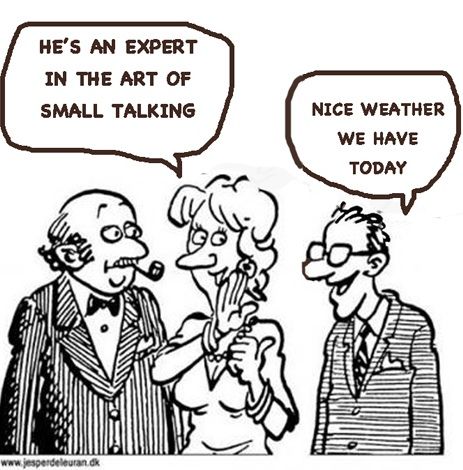
SMALL TALK
- The 10 Big Rules of Small Talk
- 1. Do a Little Homework
- To keep your conversation timely and lively, Carducci suggests scanning newspaper headlines and movie and book reviews.
- 2. Greet People Appropriately
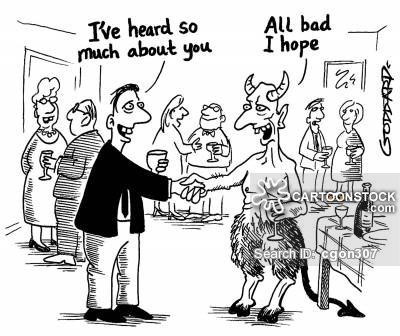
- To kiss or not to kiss? The question is so universal (and, for some, vexing) that Hamlet might have asked it. Generally, a firm handshake is a safe, neutral bet.
- 3. Remember Names
- Introductions tend to pass in a blur, with both parties quickly blurting out names and then taking sips of wine. As a result, no one remembers who anyone is. If you forget a name, discreetly ask a third party for help, or listen for it in conversation.
- 4. Don’t Hold Back
- Begin the conversation by giving the other person something to work with. But don’t put her to work.
- 5. Draw the Other Person Out
- People love to talk about themselves, so be a great listener. The questions don’t have to be that specific
- 6. When in Doubt, Discuss the Setting
- It sounds like a cop-out, but it works. Another fail-safe, setting-specific question is “How do you know the host?”
- 7. Revive a Dying Conversation.
- Don’t panic when there’s a lull in the conversation. Think of silence as a transition. Sometimes silence is appropriate. You don’t want to seem like a babbling idiot
- 8. Make Proper Introductions
- The true hallmark of a skilled and gracious small-talker is the ability to introduce people with ease. In addition to announcing names, offer a piece of information about each person, or a shared interest, thereby facilitating a conversation.
- 9. Defuse Unpleasant Situations
- For every group of lovely people you meet at a party, there’s bound to be a lemon.
- Type 1 is the person who has met you on several occasions but acts as if he’s never seen you before in his life.
- Type 2 invades your personal space.
- Type 3 won’t stop talking about himself and hasn’t asked you a single question
- For every group of lovely people you meet at a party, there’s bound to be a lemon.
- 10. Make a Clean Getaway
- “Use the phrase ‘I need,’” . “I need to get some food; I haven’t eaten all day. I need to talk to a client over there.
- 1. Do a Little Homework
- The 10 Big Rules of Small Talk