
Mind map
K235 - Power & Autonomy
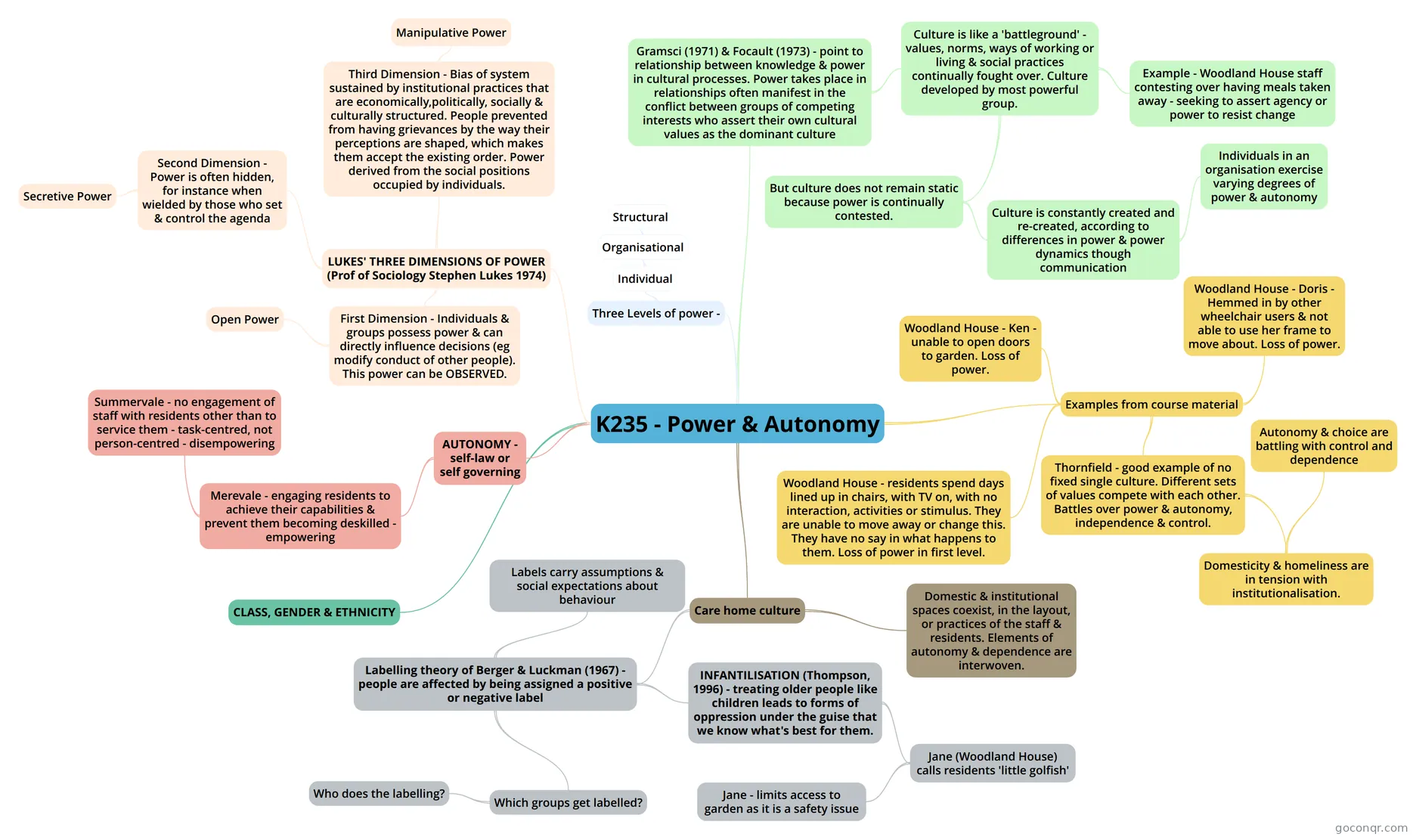
Mind map: Power & autonomy
Map content
K235 - Power & Autonomy
LUKES' THREE DIMENSIONS OF POWER (Prof of Sociology Stephen Lukes 1974)
- First Dimension - Individuals & groups possess power & can directly influence decisions (eg modify conduct of other people). This power can be OBSERVED.
- Open Power
- Second Dimension - Power is often hidden, for instance when wielded by those who set & control the agenda
- Secretive Power
- Third Dimension - Bias of system sustained by institutional practices that are economically,politically, socially & culturally structured. People prevented from having grievances by the way their perceptions are shaped, which makes them accept the existing order. Power derived from the social positions occupied by individuals.
- Manipulative Power
- First Dimension - Individuals & groups possess power & can directly influence decisions (eg modify conduct of other people). This power can be OBSERVED.
Three Levels of power -
- Individual
- Organisational
- Structural
- Organisational
- Individual
Examples from course material
- Woodland House - Doris - Hemmed in by other wheelchair users & not able to use her frame to move about. Loss of power.
- Woodland House - Ken - unable to open doors to garden. Loss of power.
- Woodland House - residents spend days lined up in chairs, with TV on, with no interaction, activities or stimulus. They are unable to move away or change this. They have no say in what happens to them. Loss of power in first level.
- Thornfield - good example of no fixed single culture. Different sets of values compete with each other. Battles over power & autonomy, independence & control.
- Domesticity & homeliness are in tension with institutionalisation.
- Autonomy & choice are battling with control and dependence
- Domesticity & homeliness are in tension with institutionalisation.
AUTONOMY - self-law or self governing
- Merevale - engaging residents to achieve their capabilities & prevent them becoming deskilled - empowering
- Summervale - no engagement of staff with residents other than to service them - task-centred, not person-centred - disempowering
- Merevale - engaging residents to achieve their capabilities & prevent them becoming deskilled - empowering
Care home culture
- Labelling theory of Berger & Luckman (1967) - people are affected by being assigned a positive or negative label
- Which groups get labelled?
- Who does the labelling?
- Labels carry assumptions & social expectations about behaviour
- INFANTILISATION (Thompson, 1996) - treating older people like children leads to forms of oppression under the guise that we know what's best for them.
- Jane (Woodland House) calls residents 'little golfish'
- Jane - limits access to garden as it is a safety issue
- Jane (Woodland House) calls residents 'little golfish'
- Which groups get labelled?
- Domestic & institutional spaces coexist, in the layout, or practices of the staff & residents. Elements of autonomy & dependence are interwoven.
- Labelling theory of Berger & Luckman (1967) - people are affected by being assigned a positive or negative label
Gramsci (1971) & Focault (1973) - point to relationship between knowledge & power in cultural processes. Power takes place in relationships often manifest in the conflict between groups of competing interests who assert their own cultural values as the dominant culture
- Culture is like a 'battleground' - values, norms, ways of working or living & social practices continually fought over. Culture developed by most powerful group.
- But culture does not remain static because power is continually contested.
- Culture is constantly created and re-created, according to differences in power & power dynamics though communication
- Individuals in an organisation exercise varying degrees of power & autonomy
- Culture is constantly created and re-created, according to differences in power & power dynamics though communication
- Example - Woodland House staff contesting over having meals taken away - seeking to assert agency or power to resist change
- But culture does not remain static because power is continually contested.
- Culture is like a 'battleground' - values, norms, ways of working or living & social practices continually fought over. Culture developed by most powerful group.
CLASS, GENDER & ETHNICITY
Information
- Description
- Mind Map on K235 - Power & Autonomy, created by Hazel Mayger on 26/01/2016.
- Created by
- Hazel Mayger
- Views
- 6
- Rating