
Mind map
Res Mat - materials & components
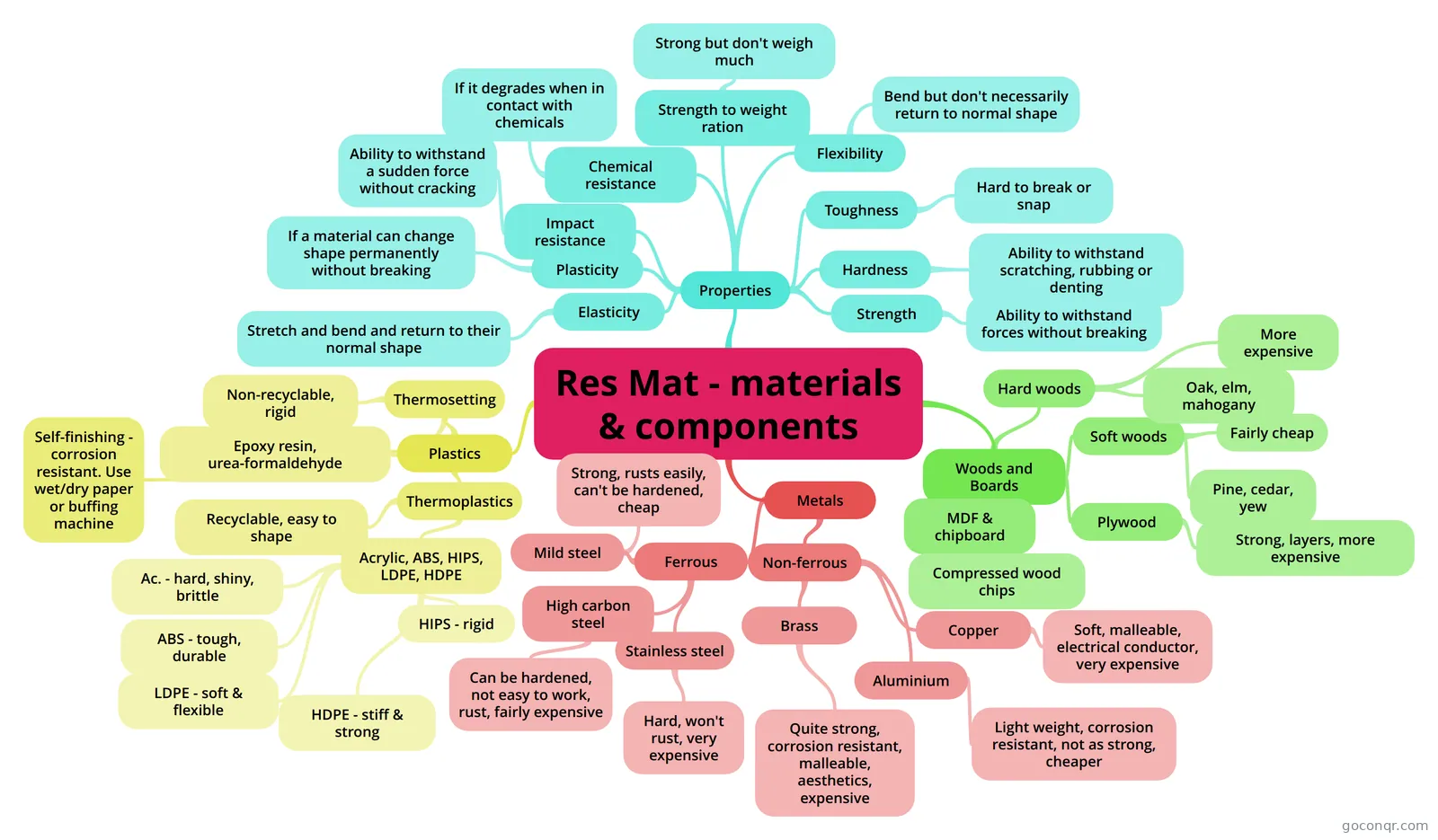
Mind map: Res Mat - materials & components
Map content
Res Mat - materials & components
Properties
- Strength
- Ability to withstand forces without breaking
- Hardness
- Ability to withstand scratching, rubbing or denting
- Toughness
- Hard to break or snap
- Elasticity
- Stretch and bend and return to their normal shape
- Plasticity
- If a material can change shape permanently without breaking
- Impact resistance
- Ability to withstand a sudden force without cracking
- Chemical resistance
- If it degrades when in contact with chemicals
- Flexibility
- Bend but don't necessarily return to normal shape
- Strength to weight ration
- Strong but don't weigh much
- Strength
Woods and Boards
- Soft woods
- Fairly cheap
- Pine, cedar, yew
- Hard woods
- More expensive
- Oak, elm, mahogany
- Plywood
- Strong, layers, more expensive
- MDF & chipboard
- Compressed wood chips
- Soft woods
Metals
- Ferrous
- Mild steel
- Strong, rusts easily, can't be hardened, cheap
- High carbon steel
- Can be hardened, not easy to work, rust, fairly expensive
- Stainless steel
- Hard, won't rust, very expensive
- Mild steel
- Non-ferrous
- Aluminium
- Light weight, corrosion resistant, not as strong, cheaper
- Brass
- Quite strong, corrosion resistant, malleable, aesthetics, expensive
- Copper
- Soft, malleable, electrical conductor, very expensive
- Aluminium
- Ferrous
Plastics
- Thermoplastics
- Recyclable, easy to shape
- Acrylic, ABS, HIPS, LDPE, HDPE
- Ac. - hard, shiny, brittle
- ABS - tough, durable
- HIPS - rigid
- LDPE - soft & flexible
- HDPE - stiff & strong
- Thermosetting
- Non-recyclable, rigid
- Epoxy resin, urea-formaldehyde
- Self-finishing - corrosion resistant. Use wet/dry paper or buffing machine
- Thermoplastics
Information
- Description
- Mind Map on Res Mat - materials & components, created by Keira-Buchanan on 29/12/2013.
- Created by
- Keira-Buchanan
- Views
- 28
- Rating