
Mind map
Othello Quotes
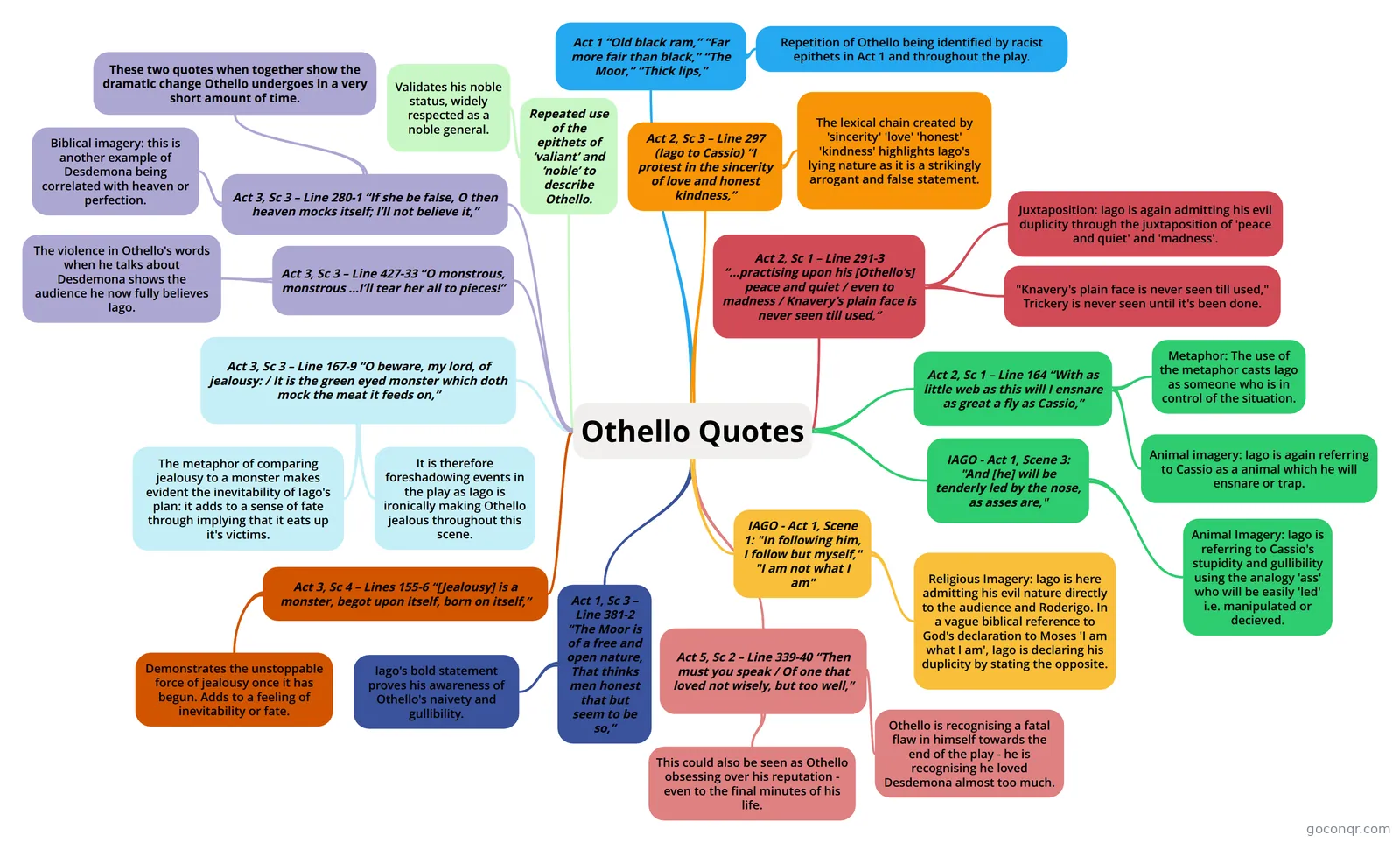
Mind map: Othello quotes
Map content
Othello Quotes
IAGO - Act 1, Scene 1: "In following him, I follow but myself," "I am not what I am"
- Religious Imagery: Iago is here admitting his evil nature directly to the audience and Roderigo. In a vague biblical reference to God's declaration to Moses 'I am what I am', Iago is declaring his duplicity by stating the opposite.
IAGO - Act 1, Scene 3: "And [he] will be tenderly led by the nose, as asses are,"
- Animal Imagery: Iago is referring to Cassio's stupidity and gullibility using the analogy 'ass' who will be easily 'led' i.e. manipulated or decieved.
Act 2, Sc 1 – Line 291-3 “…practising upon his [Othello’s] peace and quiet / even to madness / Knavery’s plain face is never seen till used,”
- Juxtaposition: Iago is again admitting his evil duplicity through the juxtaposition of 'peace and quiet' and 'madness'.
- "Knavery's plain face is never seen till used," Trickery is never seen until it's been done.
Act 2, Sc 1 – Line 164 “With as little web as this will I ensnare as great a fly as Cassio,”
- Animal imagery: Iago is again referring to Cassio as a animal which he will ensnare or trap.
- Metaphor: The use of the metaphor casts Iago as someone who is in control of the situation.
Act 2, Sc 3 – Line 297 (Iago to Cassio) “I protest in the sincerity of love and honest kindness,”
- The lexical chain created by 'sincerity' 'love' 'honest' 'kindness' highlights Iago's lying nature as it is a strikingly arrogant and false statement.
Act 5, Sc 2 – Line 339-40 “Then must you speak / Of one that loved not wisely, but too well,”
- Othello is recognising a fatal flaw in himself towards the end of the play - he is recognising he loved Desdemona almost too much.
- This could also be seen as Othello obsessing over his reputation - even to the final minutes of his life.
Act 3, Sc 3 – Line 280-1 “If she be false, O then heaven mocks itself; I’ll not believe it,”
- Biblical imagery: this is another example of Desdemona being correlated with heaven or perfection.
- These two quotes when together show the dramatic change Othello undergoes in a very short amount of time.
Act 3, Sc 3 – Line 427-33 “O monstrous, monstrous …I’ll tear her all to pieces!”
- The violence in Othello's words when he talks about Desdemona shows the audience he now fully believes Iago.
Act 3, Sc 3 – Line 167-9 “O beware, my lord, of jealousy: / It is the green eyed monster which doth mock the meat it feeds on,”
- The metaphor of comparing jealousy to a monster makes evident the inevitability of Iago's plan: it adds to a sense of fate through implying that it eats up it's victims.
- It is therefore foreshadowing events in the play as Iago is ironically making Othello jealous throughout this scene.
Act 3, Sc 4 – Lines 155-6 “[Jealousy] is a monster, begot upon itself, born on itself,”
- Demonstrates the unstoppable force of jealousy once it has begun. Adds to a feeling of inevitability or fate.
Act 1 “Old black ram,” “Far more fair than black,” “The Moor,” “Thick lips,”
- Repetition of Othello being identified by racist epithets in Act 1 and throughout the play.
Act 1, Sc 3 – Line 381-2 “The Moor is of a free and open nature, That thinks men honest that but seem to be so,”
- Iago's bold statement proves his awareness of Othello's naivety and gullibility.
Repeated use of the epithets of ‘valiant’ and ‘noble’ to describe Othello.
- Validates his noble status, widely respected as a noble general.