
Mind map
3. Dividend Policy Theory
Map content
3. Dividend Policy Theory
Basics
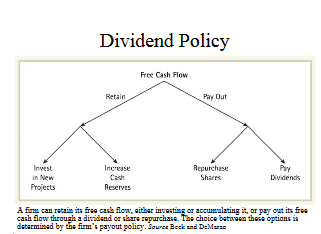
- What is the process of paying dividends?
- Why pay dividend?
- How pay dividends?
- When?
- Where?
- Net profit rule
- Only current or previous earnings
- Capital impairment rule
- No distrbution from capital reserves
- Insolvency rule
- No distribution if firm bankrupt No distribution if debt covenants are breached
- Government regulation
- Loyds case
- As residual
- Dividend = delta earning + delta debt + earnings -investment
- Expectation
- High volatility in dividends
- High growth companies pay small dividends
- Mature companies pay high dividends
- High growth companies pay small dividends
- High volatility in dividends
- Dividends are not volatile
- When?
- 1. Perfect capital markets
- Dividends does not matter
- 2. Signal
- Signal of future prospects Increasing dividends will increase value
- 3. Agency conflicts
- If there are agency conflicts, dividends will increase value, as the money does not get spoiled away. Increase dividends will increase value
- 4. Tax disadvantages
- If tax disadvantage of dividends, then decreasing dividends will increase value.
- Dit = -0.003 + 0.033 EPS it + 0.84 Dit-1 + 0.017 TD - 0.003 TX
- TD = (1-m)/((1-s)(1-z)) m = tax on dividend z = tax in capital gains s = Tax credit TX = Tax exhaustion variable R^2 = 0.863
- 1. Firms long term target dividend payout ratios
- 2. Managers focus more on dividends changes than on absolute levels.
- 3. Dividends follow shifts in long run, sustainable earnings
- 4. Managers are reluctant to make dividend changes that might have to be reversed.
- 3. Dividends follow shifts in long run, sustainable earnings
- 2. Managers focus more on dividends changes than on absolute levels.
- High dividend is costly if not having cash flow to back it up.
- Strong signal
- Empiral evidence
- Strong signal
- Indifferent between dividends and capital gains
- The cash flow does not change
- How pay dividends?
- Announcement data
- Board declares dividend
- Ex-dividend date
- Buyers of stock after this date will not be entitled to dividend
- Record date
- Shareholders recorded by this date receive dividend
- Payment date
- Eligible shareholders receive dividend
- Why pay dividend?
- What is the process of paying dividends?
Images and files in the map
Information
- Description
- Masters ACF Mind Map on 3. Dividend Policy Theory, created by christian.mogste on 07/04/2016.
- Created by
- christian.mogste
- Views
- 11
- Rating