
Mind map
FRG Mindmap
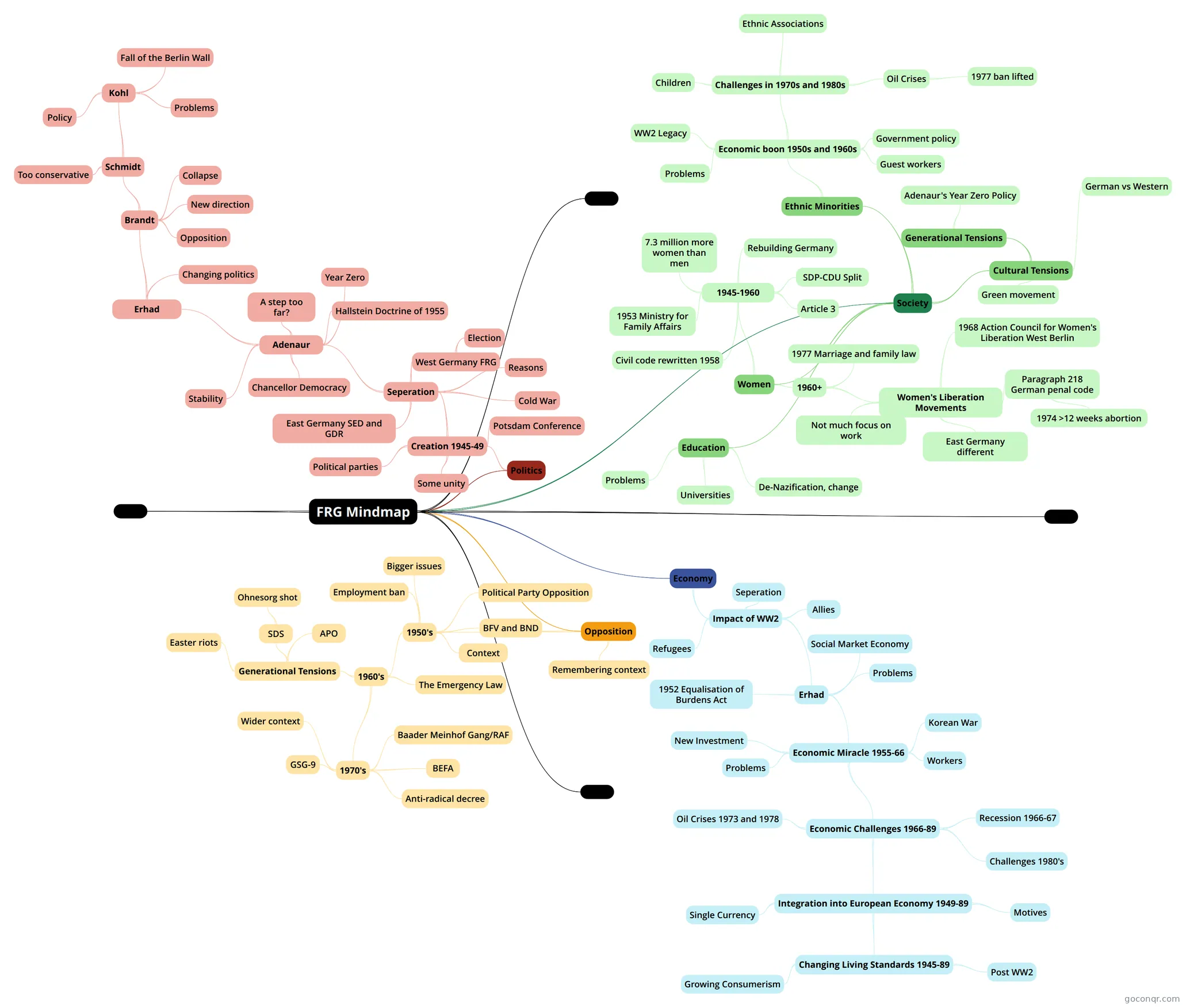
Mind map: FRG history
Map content
FRG Mindmap
Society
- Women
- 1945-1960
- 7.3 million more women than men
- Rebuilding Germany
- 1953 Ministry for Family Affairs
- SDP-CDU Split
- Article 3
- Civil code rewritten 1958
- -Women needed husband's permission to work and husband took control of the woman's property upon marriage
- 1960+
- 1977 Marriage and family law
- -Overturned civil code that said women could only work if it didn't interfere with their role as a mother
- Women's Liberation Movements
- 1968 Action Council for Women's Liberation West Berlin
- -Day care centres, campaing with Nursury school teachers to change how schools were run -1969 group split, mother faction left
- Paragraph 218 German penal code
- -Illegal for doctor or women to follow an abortion except if their is a strong medical reason
- 1974 >12 weeks abortion
- -Declared unconstitutional by federal court in 1975, pro-life
- Not much focus on work
- East Germany different
- -90% childcare compared with less than 5%
- 1968 Action Council for Women's Liberation West Berlin
- 1977 Marriage and family law
- 1945-1960
- Education
- De-Nazification, change
- -Got rid of Nazi textbooks and teachers -Stopped teaching Nazi propoganda History -Wanted American elementary, middle, high schools leading to University in Western zones-Wanted comprehensive schools-Allies closed schools over the Summer while reforms wre being made-Didn't want to reintroduce confessional education, less streaming by ability, not choosing career paths at 10
- Problems
- -Under Basic Law, Lander were responsible for educational and cultural policy. South more religous schools, North more secular -The Bund-Lander Komission failed to agree on policies. 1971 Brandt tried to restructure schools, Bundsetsag passed it by narrow majority, not enough votes in Bundesrat to become law. When it was passed, didn't restructure schools -Curcicullums varied within each Lander -Many Germans were proud of their education system and didn't want it tampered with -Class size of 85 in US zone in 1945, 510 000 children with no school
- Universities
- -1971 Federal Education Promotion act provided mixture of state funding and loans to encourage working class children to go to university -Number of students rose but students mostly upper class. curicullum old fashioned, facilities out of date
- De-Nazification, change
- Cultural Tensions
- German vs Western
- -Many Germans, especially older ones wanted Germany's return to a leader of culture in Europe like in the Golden age of the Weimar Republic -Free press, less censorship -Harder to keep culture, e.g. Wagner's music the Nazi's approved of, so many Germans adpoted Western culture instead
- Green movement
- -Anti-nuclear movement -Rejected consumerism, wanted a more peaceful and equal society -Younger film makers focused on these issues more "New German Cinema" set up in 1962. Yesterday Girl problems an East German female migrant worker faced in the FRG. Versus homeland film, films about Germany set in beautiful rural locations, a form of escapism rather than a social commentary
- Generational Tensions
- Adenaur's Year Zero Policy
- -Older people wanted traditional German culture, consumerist lifestyle (after war rationing) -Younger people wanted a less consumerist lifestyle, and a culture that faced up to Germany's past rather than hiding in American or old German culture -Inability to Mourn, published 1967, argued many Germans acted as if Nazism was an infectious disease not something they themselves were possibly responsible for. As a result some Lander changed teaching in schools to include Nazi Germany
- Adenaur's Year Zero Policy
- German vs Western
- Ethnic Minorities
- Economic boon 1950s and 1960s
- Challenges in 1970s and 1980s
- Oil Crises
- -Rise in unemployment. Guest workers under pressure to leave -1973 Government stopped hiring, banned permits for foreign worker's families in Germany. Voluntary severance packages -Many guest workers stayed but unemployed. Government gave guest worker's children same benifits as German children 1975
- 1977 ban lifted
- -1978 first Federal Comissoner for Foreign's Affairs appointed by Schmidt. Would help foreign workers to integrate, work for their rights -Set of rules for unrestricted residence, not citizenship laid down
- Children
- -Due to the Basic Law, Government wanted mixed German and foreign worker children classes -60% of foreign worker's children were Muslim, hard to receive pre-school education and language help due to confessional schools -Workers set up own National schools as a result, e.g. Koran schools which recieved lots of hostility -Increasing numbers of refugees and asylum seekers entering Germany
- Ethnic Associations
- -Varying attitudes. Some helped to settle, others slowed or stopped assimilation -Integration was hard with language barrier, different religions, suspicions towards foreigners. Little incentive for working towards long term assimlation
- Oil Crises
- WW2 Legacy
- -1947 10 million refugees and expelles. Initally seen as a problem as they required housing and food, but then seen as a help to the economy -In 1961 the Berlin wall was put up and the demand for foreign workers increased
- Government policy
- -1955 full employment, so Government wanted to recruit foreign workers, trade unions reluctant -Goverment promised foreign workers equal pay, to give preference to German workers when hiring -Federal Office for Labour Recruitment set up in Nuremberg. Offices in countries with labour recruitment treaties -When Blank made a speech in 1960 welcoming millonth guest worker, mentioned ageing population, help for long-term assimlation
- Guest workers
- -People went to the foreign labour recruitment offices, took a physical examnination, signed a contract for a particular job for 1 year. Employer provided basic accomandation, usually cut off -Men 20-40. Heavy manual labour, Germans didn't mind switching from industrial/ agricultural to white collar -Didn't have equal rights as German citizens
- Problems
- -Increasing number of illegal foreign workers. No guranteed employment, low paying poor working conditions -Some wanted to settle in Germany and bring their families over. Unions reluctant. Church organisations supported. Some Germans reluctant especially in 1966 recession, didn't speak German, didn't try to integrate, landlords sometimes refused tenancy so confined -Increasing hostiity as workers demonstrated for their rights
- Challenges in 1970s and 1980s
- Economic boon 1950s and 1960s
- Women
Economy
- Impact of WW2
- Allies
- -War industries banned, war related industries had output limits -Reparation in equipment and machinery taken from factories hindering economic recovery -Devalued Reichmark and thriving Black Market -Infrastructure crossed zones. Growing divisions between USSR and the rest of the Allies
- Refugees
- -160 000 German POW's in France stayed to avoid returning to Germany. Germans in Germany left -Outweiged by refugees from Germans travelling ahead of the Soviet Army, expelees from Eastern Europe after Potsdam, concentration ca,[s -Allies forced to introduce rations -Refugees contributed a lot to the economy, agriculture
- Seperation
- -DM backed by Western powers used to administer the Marshall plan -USSR responded by introducing its own currency helping to seperate the two zones -New DM stabilised the currency, broke up the blackmarket, increased employment, increased saving and spending, increased factory production -People could exchange their worthless RM to DM. DM in shorter supply
- Erhad
- Social Market Economy
- -Director of Economic Administration and then Economic Minister -Announced DM replacing RM -Removed wartime controls. Rations, price controls, given this power by Economic council -People switched from hoarding and buying without thinking to selling and choosing carefully as supplies increased
- -Erhad faced opposition from people who preferred a command economy. Socialists and unions feared it would lead to workers exploitation by buisness owners, industrialists wanted cartels and price fixing -Erhad wanted competition, no cartels or price fixing. But, responsible government with safety net for the poorest. Combination won him support to continue -Encouraged trade unions to be set up. All buisnesses had workers councils, part of co-determination -Introduced tax concessions and no wage limits
- 1952 Equalisation of Burdens Act
- -Passed by Bundestag. Tax on assets to redistribute money amongst everyone affected by the war, essentially giving them a fresh start
- Problems
- -Buisnesses struggled to stay afloat. Unemployment increased reaching a peak of 1.8 million in 1950. Coudn't afford training, workers, machinery -Then unemployment continued to fall, steel production increased, car production increased
- Economic Miracle 1955-66
- Korean War
- -As US switched to war production, the FRG supplied the US with war related goods -1955 FRG joined NATO, was allowed to re-arm
- New Investment
- -By 1955 buisnesses saved enough to invest in machinery, factories, raw materials. Increased production. Kept quality high, price low to stay competitive -Increased employment -Started to export more, especially Volkswagen. Adding to the cycle of investment
- Workers
- -Large influx of refugees. 1.5 million from GDR -Large pool of workers to choose from kept wages low, and created an efficent workforce -Workers from GDR young, skilled, highly educated. Spent money too, intrested in West German consumerism. FRG saved money on training and education
- Problems
- -High rate of growth was unsustainable -Rise of the Berlin wall reduced the influx of free professionals from the GDR -Once people bought consumer goods for the first time, they replaced them at different times so sales dropped
- Economic Challenges 1966-89
- Recession 1966-67
- -Unemployment increased, produectivity decreased -Government spending spiralling out of control -Economic minister Schiller increased Government involvement in the economy, e.g. subsidies for agriculture. Reintroduced cartels to stop prices rising -1967 Economic Stabilisation Law allowed Government intervention in a economic crisis to limit regional spending -Introduced five year plan for Government spending -1968 added provision in Basic Law to allow federal government to redistribute money amongst the Lander -Schiller's economic policies regarded as a failure
- Oil Crises 1973 and 1978
- -FRG became reliant more on oil than coal, increased petrol consumptions -Fourth Arab-Israeli war broke out, OPEC put up prices a lot in 1973 and 1978 -FRG got 40% of oil from OPEC -Unemployment rose, increased by baby-boomers coming of working age -Guest workers contracts were not renewed, ban on employing guest workers, helped German natives
- -Germany's exports reamined strong, more than imports. Schmidt helped to encourage world leadrs not to introduce protective tarrifs to limit world trade in first oil crisis -Government encouraged car free sundays, introduced speed limits on autobahns, didn't subsidise oil but let prices rise -Germany quickest to cut oil consumption, turn to alternative energy e.g. Atomic power -Introduced public spending cuts and higher income tax in 1975
- Challenges 1980's
- -Gap between richest and poorest widened creating friction with guest workers -Unemployment rose, Government spent more on unemployment benefits and helping long-term unemployed -Some wanted Germany to return to scial market -In 1982 Government cut spending blaming productivity loss on welfare induced dependency, slack baby-boomers -Schmidt made cuts on social welfare spending, cut public holidays, reduced retirement age to 58, sold shares in nationalised industries e.g. Volkswagen partial privitisation -By 1989 economic growth rose, unemployment low
- Integration into European Economy 1949-89
- Motives
- -Like Stressemann, Adenaur thought political and economic integration with the rest of Europe was vital for Economic and Political success -Adenaur wanted stronger relations with France -Allies included West Germany in organisations set up to rebuild Germany
- Single Currency
- -In response to 1971 oil crisis, in 1980's France and Germany pushed for the Single European act law in 1987, to link European economies together to deal with problems better such as variation in the dollar -FRG exports and imports within EEC increased
- Changing Living Standards 1945-89
- Post WW2
- -Mass starvation, homelessness, refugee influx -Ministry of housing set up. Building industry tax concessions, rents frozen, housing associations set up many soical housing
- Growing Consumerism
- -As real wages increased faster than prices people bought more consumer goods -90% covered by healthcare and benefits in 1980's, pensions reforms meant most had a state pension -Widening social inequality. 1973 top 1% of households owned 78% of the wealth
- Post WW2
- Motives
- Recession 1966-67
- Korean War
- Social Market Economy
- Allies
- Impact of WW2
Politics
- Creation 1945-49
- Potsdam Conference
- -Conference held after the war in 1945 to plan German reconstruction -Focused on the four d's, de-Nazification, decentralisation, demilitarisation, disarmament -Germany was split into 4 zones run by Britain, France, the USA, and the USSR. Berlin in the Soviet zone was also split into 4 zones
- Some unity
- -Due to existing transport and communication links Germany was initally treated as a single economic unit with the same currency -Allied Control Council set up to maintain unity across the zones for when Germany was re-unified
- Political parties
- -Initally based in Berlin -KPD first to form. Common moderate message. Land reform, new education system, democratic government, accepted Allied reconstruction plans. German socialism -SPD more radical. Nationalisation of banks, land, key industires, significant social welfare, moral advantage -CDU and CSU (Bavaria) 1947 most Christain groups except CSU joined CDU, Weimar. Social support for poorest -Liberal groups joined to create FDP
- Seperation
- Cold War
- -USSR Communism vs USA Capitalism -Marshall Plan where USA gave supplies and economic aid to European countries to help prevent Communist influence spreading -USSR's march to Berlin resulted in many Communist European States
- East Germany SED and GDR
- -SPD and KPD join together to form the SED or Socialist Union Party. This doesn't happen in West Germany -SED won the 1946 elections, Communists did badly elsewhere -USSR created the GDR as a response to the FRG -Neither republic ruled out reunification -The creation of different systems of Government helped to seperate out Germany into two different areas
- Reasons
- -Buffer zone between the US and USSR -Different idealogies -Allies in the West too most strong steps to sepration
- West Germany FRG
- Legislature: -Bundestag. Elected every 4 four years. Voters vote for a regional representative and party. Proportional representation, but 5% vote to gain a seat. Pass laws -Bundersrat. Representatives from the Lander -16 Lander have own legislature Executive: -Chancellor, ministers, Civil Service Head of State -President. Elected every 5 years Judicary -Federal courts -Each state divided into counties -Counties run locals services. Cities elected munincipal government
- -Basic Law had freedom of speech, equal rights, a state education for all but clauses such as banning political parties that are a threat to democracy
- Election
- -CDU and SPD most right and left wing very close. FDP needed for a coalition
- Adenaur
- Hallstein Doctrine of 1955
- -FRG refused to recognise the legality of the GDR as a seperate country -FRG would represent all of Germany in world affairs -Would no longer have diplomatic relations with countries that had diplomatic relations with the GDR. Cut off Yugoslavia and Cuba
- Chancellor Democracy
- -Until 1955 Chancellor and Foreign Minister -Appointed weak ministers excpet Erhad -Kept coalitions in tact -Unify Germany and integrate Germany with Europe, others argued two mutually exclusive
- Stability
- -Banned Socialist Reich paty in 1952. 1956 KPD stripped of seats. Small parties limited -Bundestag became a 3 party house
- Year Zero
- -Adenaur wanted to quickly rebuild Germany so took in ex-Nazis, all Government workers forced to join the Nazi party 1939 -Younger Germans disagreed -1945 seen as a year zero, with no questions asked for ex-Nazis. Article 131 extended this to civil service by -Some accused CDU of having Nazi sympathies-1952 Bundestag report found 4 ex-Nazis in the Foreign ministry. 1953 BHE league of expelles led ex SS officer Kraft got enough seats for a coalition but dissolved in 1954 -Similar problems with FRG rebuilding army 1955
- A step too far?
- -SDP 1959 supported idea of a social market economy free from Government interference (reformed) -1961 Adenauer tried setting up Government TV station. Overuled by Supreme Court, declaring it unconstitutional as executive body was interfering with legislative body via elections -1962 Der Spigel journalists arrested on orders of Strauss minister of Defence after articles on West German troops performance in Nato -FDP ministers resigned. Adenaur promised to resign in 1963 for SDP coalition
- Erhad
- Changing politics
- -Atlanticists believed in closer ties with the US and Britain -Guallists tolerated co operation with France but wanted more co operation with East Germany -Erhad like Adenaur was an Atlanticist -Erhad tried to tap phones in an emergency law, SDP refused to support -Erhad introduced heavy taxation in 1966 budget so FDP ministers resigned, and Erhad was forced to resigned after failing to form a coaltion -SDP becoming more popular, CDU splitting between Atlantacists and Gaullists
- Brandt
- New direction
- -Brandt pursued Ostpolitik (rejection of Hallstein Doctrine and working with GDR) -Introduced Liberal legislation on decriminalising homosexuality, lowered voting age to 18 -1970 FDP politicans joined CDU. 1972 SPD members joined CDU -Forced a vote of no confidence to replace Brandt with CDU Barzel. Lost by 2 votes -Brandt called early election 1972, highest turnout ever, SDP won -1974 discovered Brandt's advisor was a GDR spy. Brandt uneccesarily resigned
- Collapse
- Opposition
- -Grand Coalition formed between SDP and FDP -Violent opposition from extreme parties, e.g. neo-Nazi National Democratic Party, Trade unions, Students -Government more repressive. 1968 SDP agreed to emergency law -Ostpolitik seen as a way to gain support
- Schmidt
- Too conservative
- -Won elections due to no good CDU alternative -Economic measures, high taxation, welfare cuts, as conservative as CSU. Opposition -Rise of the Green Party -1982 vote of no confidence replaced Schmidt with Kohl
- Kohl
- Problems
- -Unelected chancellor, so called early elections and won -Faced opposition in Bundestag from the Greens and Republicans (formed 1983) -Media uncovering corruption scandals -Increased terrorism
- Policy
- -Continuity with Ostpolitik, economic policies
- Fall of the Berlin Wall
- -Soviet policy changed gave greater freedom to Communist Eastern Europe -1989 Hungary opened borders, lifted travel restrictions, pressured Germany -Austria abolished visa requirements for East Germans, Hungarians -Hungary allowed East Germans access to cross any border -Demonstations calling for open borders -German government lifted travel restrictions, causing people to flood through the Berlin wall in the collapse of the Berlin wall (unexpected)
- Problems
- Too conservative
- New direction
- Changing politics
- Hallstein Doctrine of 1955
- Cold War
- Potsdam Conference
- Creation 1945-49
Opposition
- 1950's
- Bigger issues
- -Generally in Germany opposition was less prominent in the 1950's and people focused on the most pressing issue of rebuilding the German government, economy, and war damage, and re-integrating Germany with Europe as well as creating a West German identity while still allowing for reunification -The FRG was a democracy so there was freedom of speech, freedom of the press, no opposition
- Political Party Opposition
- -SDP main voice of opposition. Adenaur's year zero policy, alignment with Europe -Not elected as voters wanted more moderate parties -Socialist Reich Party banned using clause in the Basic Law as their views were too similar to the Nazi Party -KPD organised Communist marches in cities after not winning enough seats in the Bundestag to feel represented
- 1960's
- Generational Tensions
- -Mainly from baby boomers who got caught up in the larger wave of youth protest spreading across Europe -Objected to Adenaur's year zero policy using the slogan "What did you do in the war Daddy?" Lack of family history -Protested against the military, Involvement with NATO, storing and building nuclear weapons or storing other NATO nuclear weapons -Rising discontent with the US, Vietnam war which involved high civillian casulties and the US fighting Communism -As you can see protest was usually aimed at specific issues, not attempts to overthrow the Government like in Weimar Germany
- APO
- SDS
- -Formed in 1961 after the SDP became more moderate -Coined the term the Autschwitz generation to describe former Nazi officals holding office in Government. Protested against the Vietnam War, FRG's involvement with NATO and Nuclear Weapons
- Ohnesorg shot
- -1967 demonstrations against the human rights record of the Shah of Iran when he was visiting Germany -Conflict with the police escualted, and a student, Ohnesorg was shot -Led to increased SDS membership and a split regarding the level of violence in protests -Ensslin, a prtestor, said violence was the only way to answer violence and that there was no way of arguing with the Autschwitz generation
- Easter riots
- -1968 SDS leader Dutschke shot by a right wing fanatic who read criticism of student protests in newspapers owned by Axel Springer, a conservative newspaper owner -Sparked a series of attacks on Axel Springer offices across Germany -SDS took part in last demonstration in Bonn against the Emergency Law. Was joined by many other protesters who felt this was a violation of the Basic Law's human rights principles, changed student protest after
- 1970's
- Baader Meinhof Gang/RAF
- -Set up 1970. Bombed Dahlem in 1970 -Trained with Palestinian terrorist group, PLO -Published the Concept of the Urban Guerilla in 1971 -By end of 1970's most of its members were in prison so hunger strikes were called. Meins died in prison as a result. Provoked bombings of Lawyers and Judges involved in trials that sent the gang members to prison -By 1975 all of the gang was in prison, bombings in European capitals Paris, Stockholm to show support but terrorist activity slowed. It was not acheiving much, and the Government was cracking down on it more -Bombings in the 1980's were not regular
- Wider context
- -Government pressure through the Emergency Laws and police control reduced the number of protests but increased their violence as groups felt marginalised -Initally caught off balance, then put up wanted posters, encouraged the public to turn them in -Terrorist groups were fluid -Regular gun battles with the police but also articles and pamphalets to spread awareness for their cause
- BEFA
- -A system that centralised access to all police information in the FRG when combined with the Emergency Law made the BFV and BND much more effective -End of 1970's much less terrorism in the FRG, a success? But Government activity was also responsible for terrorism
- GSG-9
- -Formed after shooting of Israeli athletes in the 1972 Munich Olympics -Close links with the SAS and Delta Force -Operated world wide and helped arrest Baader-Meinhof members
- Anti-radical decree
- -Passed in 1972 -Allowed vetting of everyone applying for a state job
- Baader Meinhof Gang/RAF
- The Emergency Law
- -Passed to help make the BFV and BND more effective -Government had tried to pass it several times to supplement the Basic Law and give special powers to BFV and BND in "moments of political tension" -Passed as protests became more violent -Led to a drop in the number of open protests, higher number of arrests. Forced protest underground, making it more extreme -Helped combat the fluidty of terrorist groups
- Generational Tensions
- BFV and BND
- -Set up in 1950 and 1956 -Investigated people suspected of working against the Basic Law -BFV worked inside Germany and reported to the ministry of the interior -BND worked in Germany and abroad. Reported to the Chancellor -Both organisations hampered by civil liberties under the Basic Law, coudn't search mail, listen to phone calls, etc
- Employment ban
- -Initially aimed at political parties seen as a threat to democracy, KPD, Socialist Reich Party -Rarely applied, but many people may not have bee hired in the first place -Was still in effect after Adenaur passed Article 131 which allowed ex-Nazi officals to be part of the civil service
- Context
- -Many Germans felt sympathetic towards terrorist groups, some would even activley support them by letting them stay in their house if on the run -Thus Government action against opposition did not always have a positive effect -Like in Weimar, the Government came down the most on left-wing groups, though arguably these were the most extreme groups with the terrorists being left wing -Government wanted to uphold civil liberty whilst also protecting democracy from extremism
- Bigger issues
- Remembering context
- -While many Germans opposed the policies of particular democratic Governments, on the whole support for democracy was high -Initally people thought the FRG would be another Weimar-High turnouts, higher than Britain, except in 1947-Allensbach institute research showed that number of people who believed Bundestag members represented the publics interest increased while number of people wanting a return of the monarchy decreased, many believed that the FRG was the best time in German History and democracy the best form of Government -Research funded by Western Allies, e.g. US -People supported ideals of democracy. Demonstrated agaisnt emergency law, repressive regimes in other countries including if the FRG indirectly supported them, protested against shift to Ostpolitik controversial
- 1950's
Information
- Description
- Mind Map on FRG Mindmap, created by Remi Bahar on 11/04/2016.
- Created by
- Remi Bahar
- Views
- 8
- Rating