
Mind map
Concept Map Chap. 1-4
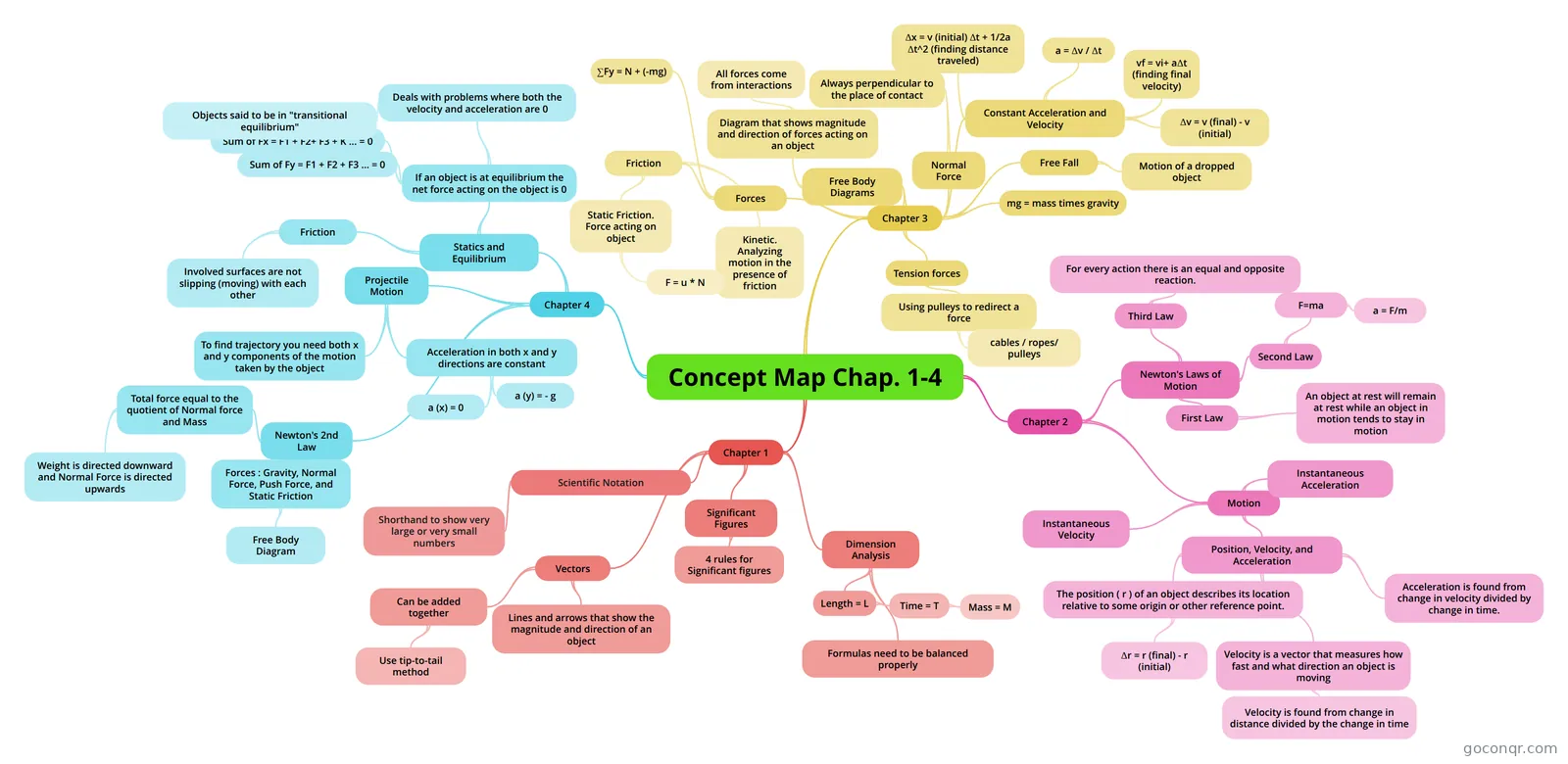
Mind map: physics chapters 1-4 concept map
Map content
Concept Map Chap. 1-4
Chapter 1
- Scientific Notation
- Shorthand to show very large or very small numbers
- Significant Figures
- 4 rules for Significant figures
- Dimension Analysis
- Length = L
- Time = T
- Mass = M
- Time = T
- Formulas need to be balanced properly
- Length = L
- Vectors
- Lines and arrows that show the magnitude and direction of an object
- Can be added together
- Use tip-to-tail method
- Scientific Notation
Chapter 2
- Newton's Laws of Motion
- Third Law
- For every action there is an equal and opposite reaction.
- Second Law
- F=ma
- a = F/m
- F=ma
- First Law
- An object at rest will remain at rest while an object in motion tends to stay in motion
- Third Law
- Motion
- Instantaneous Acceleration
- Position, Velocity, and Acceleration
- The position ( r ) of an object describes its location relative to some origin or other reference point.
- Δr = r (final) - r (initial)
- Velocity is a vector that measures how fast and what direction an object is moving
- Velocity is found from change in distance divided by the change in time
- Acceleration is found from change in velocity divided by change in time.
- The position ( r ) of an object describes its location relative to some origin or other reference point.
- Instantaneous Velocity
- Newton's Laws of Motion
Chapter 3
- Constant Acceleration and Velocity
- Δv = v (final) - v (initial)
- a = Δv / Δt
- vf = vi+ aΔt (finding final velocity)
- ∆x = v (initial) ∆t + 1/2a ∆t^2 (finding distance traveled)
- Normal Force
- Always perpendicular to the place of contact
- Free Body Diagrams
- Diagram that shows magnitude and direction of forces acting on an object
- All forces come from interactions
- Diagram that shows magnitude and direction of forces acting on an object
- Forces
- ∑Fy = N + (-mg)
- Friction
- Kinetic. Analyzing motion in the presence of friction
- Static Friction. Force acting on object
- F = u * N
- Free Fall
- Motion of a dropped object
- Tension forces
- Using pulleys to redirect a force
- cables / ropes/ pulleys
- Using pulleys to redirect a force
- mg = mass times gravity
- Constant Acceleration and Velocity
Chapter 4
- Statics and Equilibrium
- If an object is at equilibrium the net force acting on the object is 0
- Sum of Fx = F1 + F2+ F3 + K ... = 0
- Sum of Fy = F1 + F2 + F3 ... = 0
- Deals with problems where both the velocity and acceleration are 0
- Objects said to be in "transitional equilibrium"
- Friction
- Involved surfaces are not slipping (moving) with each other
- If an object is at equilibrium the net force acting on the object is 0
- Projectile Motion
- Acceleration in both x and y directions are constant
- a (x) = 0
- a (y) = - g
- To find trajectory you need both x and y components of the motion taken by the object
- Acceleration in both x and y directions are constant
- Newton's 2nd Law
- Forces : Gravity, Normal Force, Push Force, and Static Friction
- Free Body Diagram
- Total force equal to the quotient of Normal force and Mass
- Weight is directed downward and Normal Force is directed upwards
- Forces : Gravity, Normal Force, Push Force, and Static Friction
- Statics and Equilibrium
Information
- Description
- Hanna Engle Megan Fisher Zachary Bartman Alissa Barwinski Mikayla Bond Nick Bucci Joseph Dunphy Serena Foor
- Created by
- hannaengle421
- Views
- 124
- Rating