
Mind map
Astrophysics Unit 13
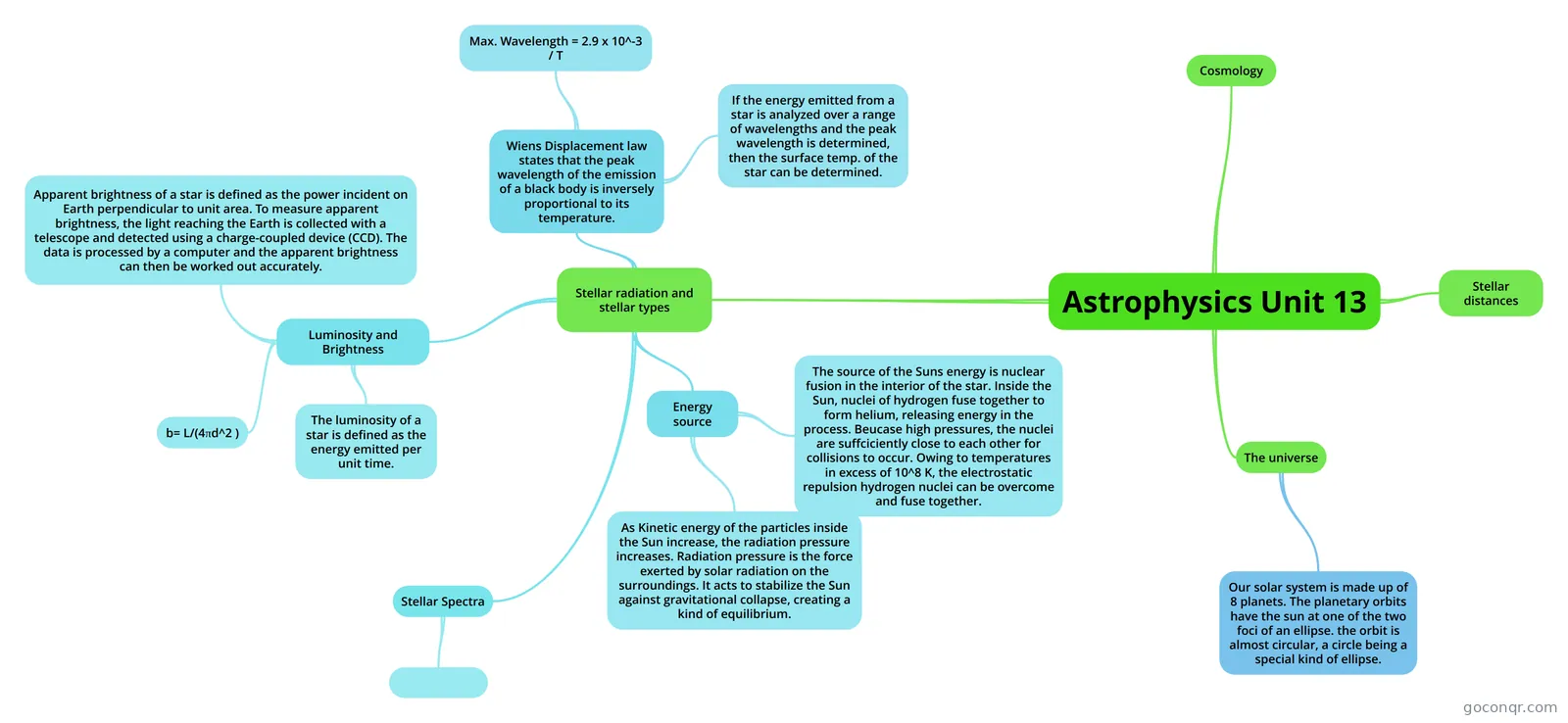
Mind map: Astrophysics Unit 13
Map content
Astrophysics Unit 13
Stellar radiation and stellar types
- Energy source
- The source of the Suns energy is nuclear fusion in the interior of the star. Inside the Sun, nuclei of hydrogen fuse together to form helium, releasing energy in the process. Beucase high pressures, the nuclei are suffciciently close to each other for collisions to occur. Owing to temperatures in excess of 10^8 K, the electrostatic repulsion hydrogen nuclei can be overcome and fuse together.
- As Kinetic energy of the particles inside the Sun increase, the radiation pressure increases. Radiation pressure is the force exerted by solar radiation on the surroundings. It acts to stabilize the Sun against gravitational collapse, creating a kind of equilibrium.
- Luminosity and Brightness
- The luminosity of a star is defined as the energy emitted per unit time.
- b= L/(4πd^2 )
- Apparent brightness of a star is defined as the power incident on Earth perpendicular to unit area. To measure apparent brightness, the light reaching the Earth is collected with a telescope and detected using a charge-coupled device (CCD). The data is processed by a computer and the apparent brightness can then be worked out accurately.
- Wiens Displacement law states that the peak wavelength of the emission of a black body is inversely proportional to its temperature.
- Max. Wavelength = 2.9 x 10^-3 / T
- If the energy emitted from a star is analyzed over a range of wavelengths and the peak wavelength is determined, then the surface temp. of the star can be determined.
- Stellar Spectra
- Energy source
Cosmology
Stellar distances
The universe
- Our solar system is made up of 8 planets. The planetary orbits have the sun at one of the two foci of an ellipse. the orbit is almost circular, a circle being a special kind of ellipse.
Information
- Description
- Physics SL Mind Map on Astrophysics Unit 13, created by r.strandang on 07/03/2014.
- Created by
- r.strandang
- Views
- 116
- Tags
- Rating