
Mind map
matter and measurement
Map content
matter and measurement
the cientific method
- 1º watching the phenomenon
- 2º thinking about an hypothesis
- 3º making experiments in the lab
- 5º presenting the conclusions
- 3º making experiments in the lab
- 4º analysing the results
mass , volume and capacity
- mass
- mass is the amount of containsmatter that a body
- the SI unit is the kilogram , a multiple of the ram . but we sometimes use multiples or submultiples of the unit . To obtain submultiples of a kilogram , we multiply by a factor of 10
- mass is the amount of containsmatter that a body
- volume
- volume is the space that a body occupies
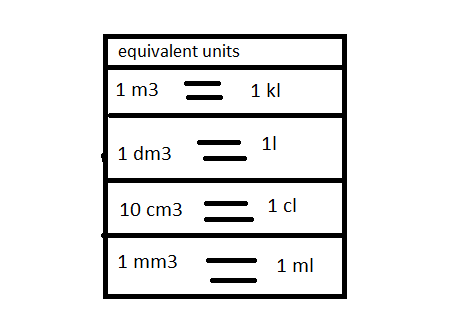
- the SI unit is the cubic metre , to obtain its multiples and submultiples , we divide or multiply by a factor of 1000
- volume is the space that a body occupies
- capacity
- capacity indicates the amount of space that a container has
- the SI unit is the litre , witch is equivalent to 1dm3. the factor is 10
- capacity indicates the amount of space that a container has
- mass
matter and its measurement
- matter
- the object of study for natural science is matter
- is everyting that occupies space and has mass
- the object of study for natural science is matter
- physical quantities
- some characteristics of matter are easy to describe because we can observe and measure them
- a physical quantity is any property of matter that can be measured , like the mass or size of a body
- properties of matter that are subjective or cannot be measuredare not physical quantities
- a physical quantity is any property of matter that can be measured , like the mass or size of a body
- some characteristics of matter are easy to describe because we can observe and measure them
- measurement
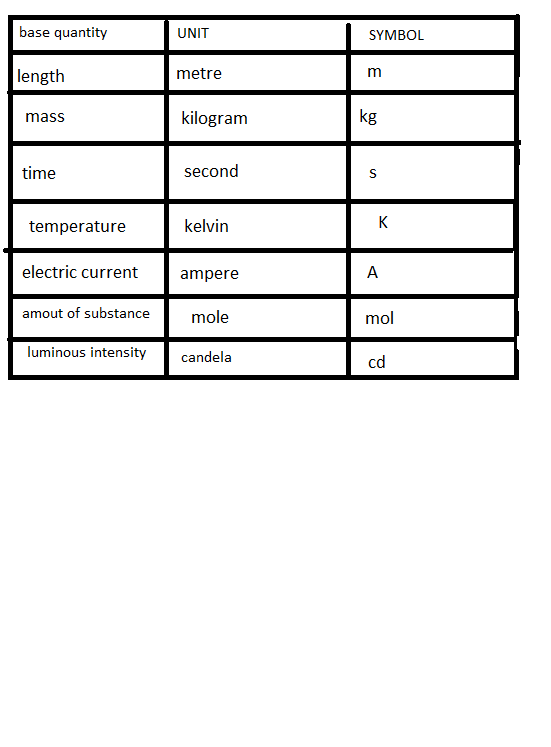
- to measure a physical quantity , we need to establish a standard of measurement that we can use to make comparisons with other examples. This standard is called a unit
- the international system of units
- in the past , were many different units of measurement.
- the rest of the units are derived from these base units and are called derived units
- in the past , were many different units of measurement.
- matter
length and surface area
- length is a physical quantity that expresses a distance between two points
- the SI unit of length is the metre (m) but we sometimes use multiples or submultiples of the unit
- To obtain multiples, we have to multiply or divide by a factor of 10
- the SI unit of length is the metre (m) but we sometimes use multiples or submultiples of the unit
- length
- surface area
- the external part of a body is called the surface
- to measure a surface , we need to work out this area
- the SI unit is the square metre . To obtain multiples and submultiples , we have to multiply or divide by a factor of 100
- to measure a surface , we need to work out this area
- the external part of a body is called the surface
- length is a physical quantity that expresses a distance between two points
properties of matter
- extensive poperties
- they depend on the amount of matter there is
- intensive properties
- they do not depend on the amount of matter
- intensive properties help us to differenciate between different types of matter
- they do not depend on the amount of matter
- density
- is an intensive property
- density is he quoetient of mass and volume . If the density is high , the body is heavy . If the density is low , the body is light . its formula is : d= m/v
- the SI unit is the kg/m3 , but it can also be expressed in g/cm3
- density is he quoetient of mass and volume . If the density is high , the body is heavy . If the density is low , the body is light . its formula is : d= m/v
- is an intensive property
- general properties
- they do not depend on the substance
- specific properties
- they depend on the substance
- two different substances can have the same general properties , but the can not have the same specific properties do not depend on the size of the body.
- extensive poperties
Images and files in the map
Information
- Description
- fisica y quimica bilingüe tema 1
- Created by
- nada nada nada
- Views
- 24
- Tags
- Rating