
Mind map
FUNCTION WORDS
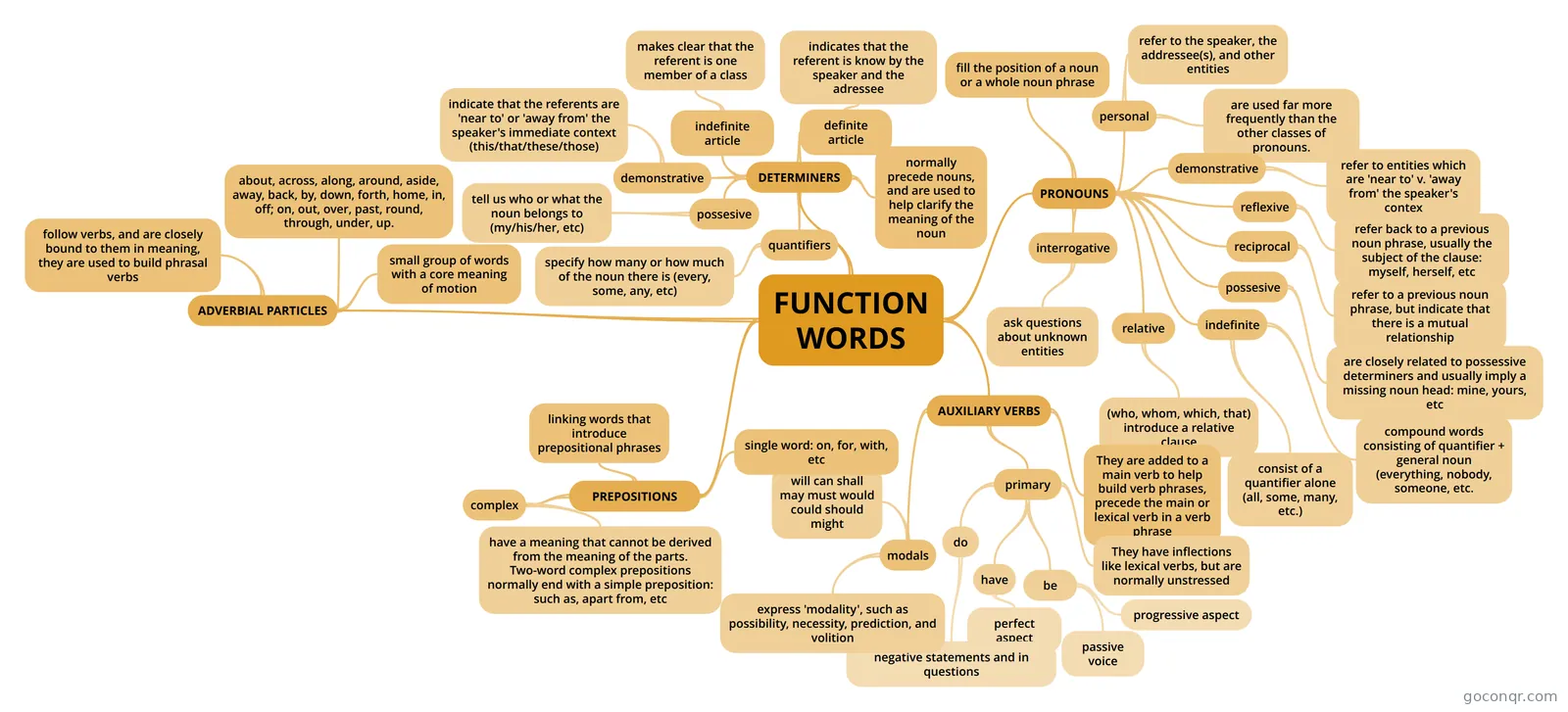
Mind map: function words
Map content
FUNCTION WORDS
DETERMINERS
- normally precede nouns, and are used to help clarify the meaning of the noun
- definite article
- indicates that the referent is know by the speaker and the adressee
- indefinite article
- makes clear that the referent is one member of a class
- demonstrative
- indicate that the referents are 'near to' or 'away from' the speaker's immediate context (this/that/these/those)
- possesive
- tell us who or what the noun belongs to (my/his/her, etc)
- quantifiers
- specify how many or how much of the noun there is (every, some, any, etc)
PRONOUNS
- fill the position of a noun or a whole noun phrase
- personal
- refer to the speaker, the addressee(s), and other entities
- are used far more frequently than the other classes of pronouns.
- demonstrative
- refer to entities which are 'near to' v. 'away from' the speaker's contex
- reflexive
- refer back to a previous noun phrase, usually the subject of the clause: myself, herself, etc
- reciprocal
- refer to a previous noun phrase, but indicate that there is a mutual relationship
- possesive
- are closely related to possessive determiners and usually imply a missing noun head: mine, yours, etc
- indefinite
- compound words consisting of quantifier + general noun (everything, nobody, someone, etc.
- consist of a quantifier alone (all, some, many, etc.)
- relative
- (who, whom, which, that) introduce a relative clause
- interrogative
- ask questions about unknown entities
AUXILIARY VERBS
- They are added to a main verb to help build verb phrases, precede the main or lexical verb in a verb phrase
- primary
- They have inflections like lexical verbs, but are normally unstressed
- be
- progressive aspect
- passive voice
- have
- perfect aspect
- do
- negative statements and in questions
- modals
- express 'modality', such as possibility, necessity, prediction, and volition
- will can shall may must would could should might
PREPOSITIONS
- linking words that introduce prepositional phrases
- single word: on, for, with, etc
- complex
- have a meaning that cannot be derived from the meaning of the parts. Two-word complex prepositions normally end with a simple preposition: such as, apart from, etc
ADVERBIAL PARTICLES
- small group of words with a core meaning of motion
- about, across, along, around, aside, away, back, by, down, forth, home, in, off; on, out, over, past, round, through, under, up.
- follow verbs, and are closely bound to them in meaning, they are used to build phrasal verbs
Information
- Description
- ingles ESCRITA 3 Mind Map on FUNCTION WORDS, created by Fede Jaime on 29/03/2014.
- Created by
- Fede Jaime
- Views
- 79
- Tags
- Rating