
Mind map
C1.1
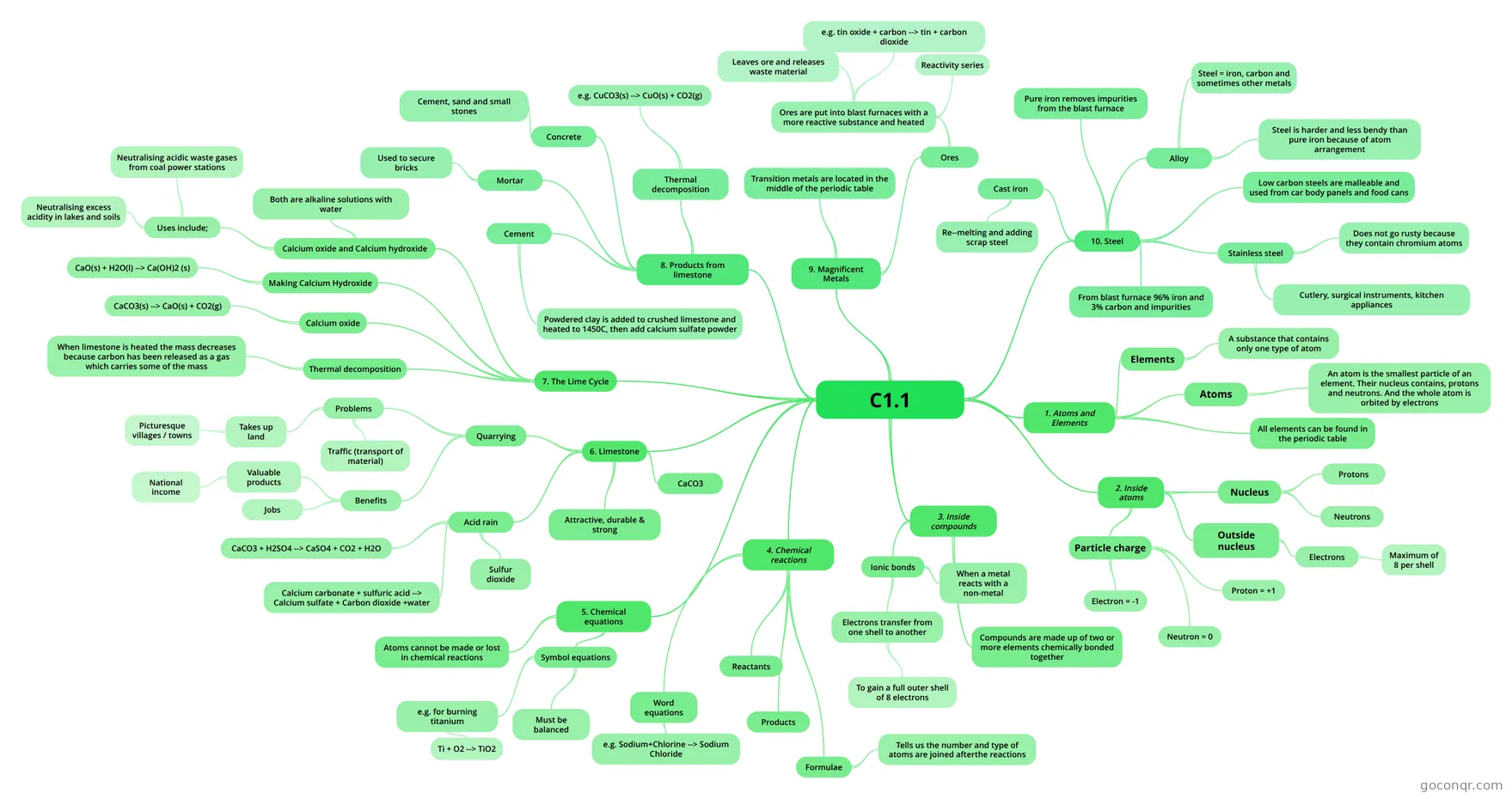
Mind map: atoms and elements chemistry
Map content
C1.1
1. Atoms and Elements
- Elements
- A substance that contains only one type of atom
- Atoms
- An atom is the smallest particle of an element. Their nucleus contains, protons and neutrons. And the whole atom is orbited by electrons
- All elements can be found in the periodic table
- Elements
2. Inside atoms
- Nucleus
- Protons
- Neutrons
- Outside nucleus
- Electrons
- Maximum of 8 per shell
- Electrons
- Particle charge
- Proton = +1
- Neutron = 0
- Electron = -1
- Nucleus
3. Inside compounds
- Compounds are made up of two or more elements chemically bonded together
- Ionic bonds
- When a metal reacts with a non-metal
- Electrons transfer from one shell to another
- To gain a full outer shell of 8 electrons
4. Chemical reactions
- Reactants
- Products
- Word equations
- e.g. Sodium+Chlorine --> Sodium Chloride
- Formulae
- Tells us the number and type of atoms are joined afterthe reactions
5. Chemical equations
- Symbol equations
- Must be balanced
- e.g. for burning titanium
- Ti + O2 --> TiO2
- Atoms cannot be made or lost in chemical reactions
- Symbol equations
6. Limestone
- Attractive, durable & strong
- Acid rain
- Calcium carbonate + sulfuric acid --> Calcium sulfate + Carbon dioxide +water
- CaCO3 + H2SO4 --> CaSO4 + CO2 + H2O
- Sulfur dioxide
- CaCO3
- Quarrying
- Benefits
- Jobs
- Valuable products
- National income
- Problems
- Traffic (transport of material)
- Takes up land
- Picturesque villages / towns
- Benefits
7. The Lime Cycle
- Calcium oxide
- CaCO3(s) --> CaO(s) + CO2(g)
- Thermal decomposition
- When limestone is heated the mass decreases because carbon has been released as a gas which carries some of the mass
- Making Calcium Hydroxide
- CaO(s) + H2O(l) --> Ca(OH)2 (s)
- Calcium oxide and Calcium hydroxide
- Both are alkaline solutions with water
- Uses include;
- Neutralising excess acidity in lakes and soils
- Neutralising acidic waste gases from coal power stations
- Calcium oxide
8. Products from limestone
- Cement
- Powdered clay is added to crushed limestone and heated to 1450C, then add calcium sulfate powder
- Mortar
- Used to secure bricks
- Concrete
- Cement, sand and small stones
- Thermal decomposition
- e.g. CuCO3(s) --> CuO(s) + CO2(g)
- Cement
9. Magnificent Metals
- Transition metals are located in the middle of the periodic table
- Ores
- Ores are put into blast furnaces with a more reactive substance and heated
- Reactivity series
- Leaves ore and releases waste material
- e.g. tin oxide + carbon --> tin + carbon dioxide
- Ores are put into blast furnaces with a more reactive substance and heated
10. Steel
- From blast furnace 96% iron and 3% carbon and impurities
- Cast iron
- Re--melting and adding scrap steel
- Pure iron removes impurities from the blast furnace
- Alloy
- Steel = iron, carbon and sometimes other metals
- Steel is harder and less bendy than pure iron because of atom arrangement
- Low carbon steels are malleable and used from car body panels and food cans
- Stainless steel
- Does not go rusty because they contain chromium atoms
- Cutlery, surgical instruments, kitchen appliances