
Mind map
MUSCLE TO MEAT
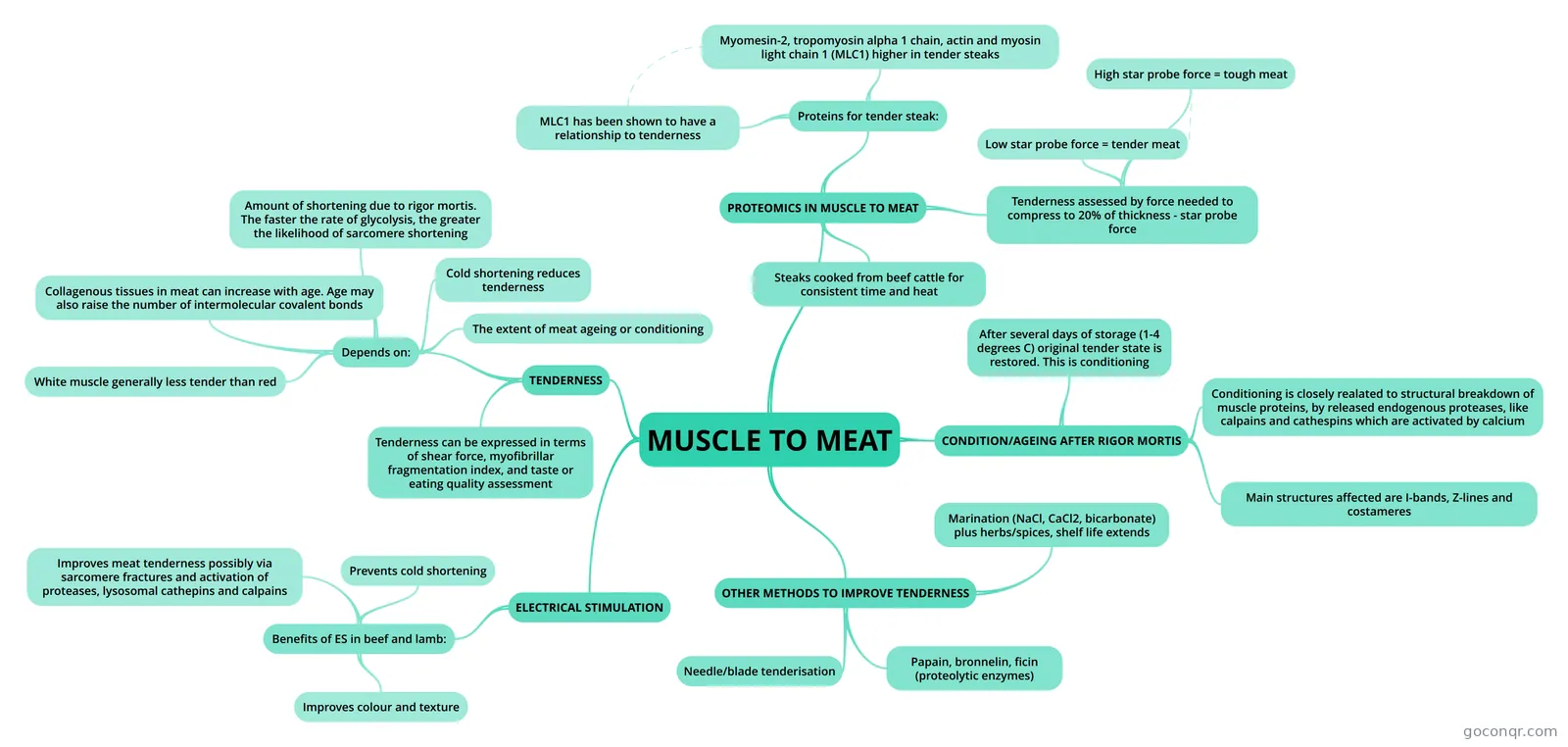
Mind map: muscle to meat
Map content
MUSCLE TO MEAT
TENDERNESS
- Tenderness can be expressed in terms of shear force, myofibrillar fragmentation index, and taste or eating quality assessment
- Depends on:
- Collagenous tissues in meat can increase with age. Age may also raise the number of intermolecular covalent bonds
- White muscle generally less tender than red
- Amount of shortening due to rigor mortis. The faster the rate of glycolysis, the greater the likelihood of sarcomere shortening
- Cold shortening reduces tenderness
- The extent of meat ageing or conditioning
ELECTRICAL STIMULATION
- Benefits of ES in beef and lamb:
- Prevents cold shortening
- Improves meat tenderness possibly via sarcomere fractures and activation of proteases, lysosomal cathepins and calpains
- Improves colour and texture
- Benefits of ES in beef and lamb:
OTHER METHODS TO IMPROVE TENDERNESS
- Needle/blade tenderisation
- Papain, bronnelin, ficin (proteolytic enzymes)
- Marination (NaCl, CaCl2, bicarbonate) plus herbs/spices, shelf life extends
CONDITION/AGEING AFTER RIGOR MORTIS
- After several days of storage (1-4 degrees C) original tender state is restored. This is conditioning
- Conditioning is closely realated to structural breakdown of muscle proteins, by released endogenous proteases, like calpains and cathespins which are activated by calcium
- Main structures affected are I-bands, Z-lines and costameres
PROTEOMICS IN MUSCLE TO MEAT
- Steaks cooked from beef cattle for consistent time and heat
- Tenderness assessed by force needed to compress to 20% of thickness - star probe force
- Low star probe force = tender meat
- High star probe force = tough meat
- Proteins for tender steak:
- Myomesin-2, tropomyosin alpha 1 chain, actin and myosin light chain 1 (MLC1) higher in tender steaks
- MLC1 has been shown to have a relationship to tenderness
Information
- Description
- Mind Map on MUSCLE TO MEAT, created by Flora Gunn on 06/12/2016.
- Created by
- Flora Gunn
- Views
- 5
- Rating