
Mind map
Quantum Phenomena
Map content
Quantum Phenomena
The Photoelectric Effect
- What is it?
- If radiation, of a sufficient frequency, is shone onto the surface of a metal, electrons are emitted. This frequency is normally in the Ultraviolet range. The electron will absorb energy from the light, eventually breaking the bonds holding it to the metal. The emitted electrons are called photoelectrons.
- The 4 Conclusions
- 1. For a given metal, no photoelectrons are emitted if the radiation has a frequency below a certain value, called the threshold frequency.
- 2. The photoelectrons are emitted with a variety of kinetc energy ranging from zero to some maximum value. This value of maximum kinetic energy increases with the frequency of the radiation.
- 3. The intensity of the radiation is the amount of energy per second hitting an area of the metal. The maximum kinetic energy of the photoelectrons is unaffected by varying the intensity of the radiation.
- 4. The number of photoelectrons emitted per second is proportional to the intensity of the radiation.
- The Work Function - The work function (Φ) is the minimum amount of energy a photon needs to release an electron from the surface of a metal. It can be given in Joules or electron volts.
- Threshold Frequency - The threshold frequency (f) is the minimum frequency of EM radiation required to release an electron from the surface of a metal. Given in Hertz.
- The Photon Model of Light
- The photon (particle) model of light is used to explain the photoelectric effect. The photos have a one-to-one interaction with the electrons in the metal surface. A photon transfers all its energy to a specific electron. The energy gained by an electron is equal to hf.
- The photon model of light also explains threshold frequency. This is due to the fact that hf must be greater than or equal to Φ for electrons to be released, then threshold frequency must be equal to Φ/h.
- The kinetic energy of the electrons is independent of the of the intensity of the light - as the electrons can only absorb energy from one photon at a time.
- Photoelectric Equation: hf = Φ + Max. Kinetic Energy
- Stopping Potential
- Photoelectrons that are emitted by the photoelectric effect can lose their energy by doing work against a potential difference.
- The stopping potential, Vs, is the potential difference required to stop the fastest moving electrons that are travelling with maximum kinetic energy.
- The work done by the p.d. in stopping the fastest electrons is equal to the energy they were carrying: eVs = E.K(MAX)
- What is it?
Atomic Energy Levels
- Emission Spectra
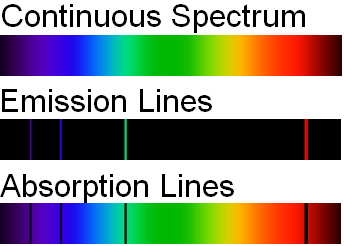
- Line Emission - Series of coloured lines against black background. Coloured lines correspond to a particular wavelength of light emitted. Produced when electrons in an excited gas cascade down energy levels. Different colours are characteristic of differences between energy levels.
- Continuous Spectrum - Shows when white light is split up with prism. Colours merge into each other. No gaps within the spectrum. All wavelengths are allowed as electrons aren't bound to energy levels.
- Line Absorption - Produced when white light passes through a cool gas. Some photons are absorbed by photons, so they're excited to higher energy levels. The photons that don't pass through the prism shows as black lines, and are characteristic of missing wavelengths.
- Atomic electrons can only exist within discrete energy levels. Energy levels are defined with values such as n=1, n=2. Lowest energy level in an atom is the ground state. When an electron goes to higher energy levels, it is 'excited'. Moving up energy levels requires the absorption of a photon, moving down requires emission of a photon.
- Energy carried by a photon emitted after a transition is equal to the difference in energies between two energy levels. Movement of electron to higher energy levels is 'excitation'.
- An atom becomes ionised with the removal of an electron. Ionisation energy is the energy needed to completely remove an electron from an atom.
- The electron volt is a unit that is used for energies of electrons in atoms. Defined as 'kinetic energy carried by an electron after it's been accelerated through a p.d. of 1 volt. 1 eV = 1.6 x 10^-19 J
- Emission Spectra
Wave-Particle Duality
- Light
- Diffraction occurs when light passes through a narrow gap. Can only be explained with the wave model of light.
- Photoelectric effect shows how light behaves like particles. This is because 'one-to-one' interactions occur between photons and electrons.
- Electrons
- Always known to be particles. Electrons can be deflected by magnetic fields.
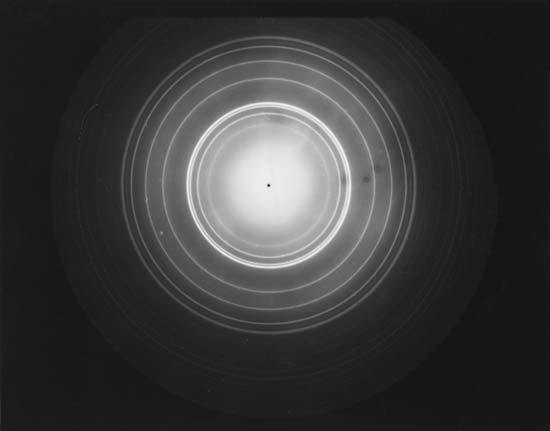
- However, when electrons are accelerated to high velocities and pass through a graphite crystal sheet, they interfere with each other and diffract like waves.
- As they pass through spaces between the atoms, they diffract like waves do, and show a pattern of rings.
- Increased velocities show the circles 'squashing' towards the middle. Fits in with de Broglie's equation as higher momentum results in shorter wavelength.
- Diffraction only occurs if particles interact with an the gaps are of similar size to its de Broglie wavelength.
- Normal wavelength for accelerating electrons in a vacuum tube is about the same for EM waves in the X-Ray part of the spectrum.
- Light
Images and files in the map
Information
- Description
- A level Physics (Particles and Radiation) Mind Map on Quantum Phenomena, created by Joe O'Dwyer on 15/12/2016.
- Created by
- Joe O'Dwyer
- Views
- 0
- Rating