
Mind map
Maintenance of relationships
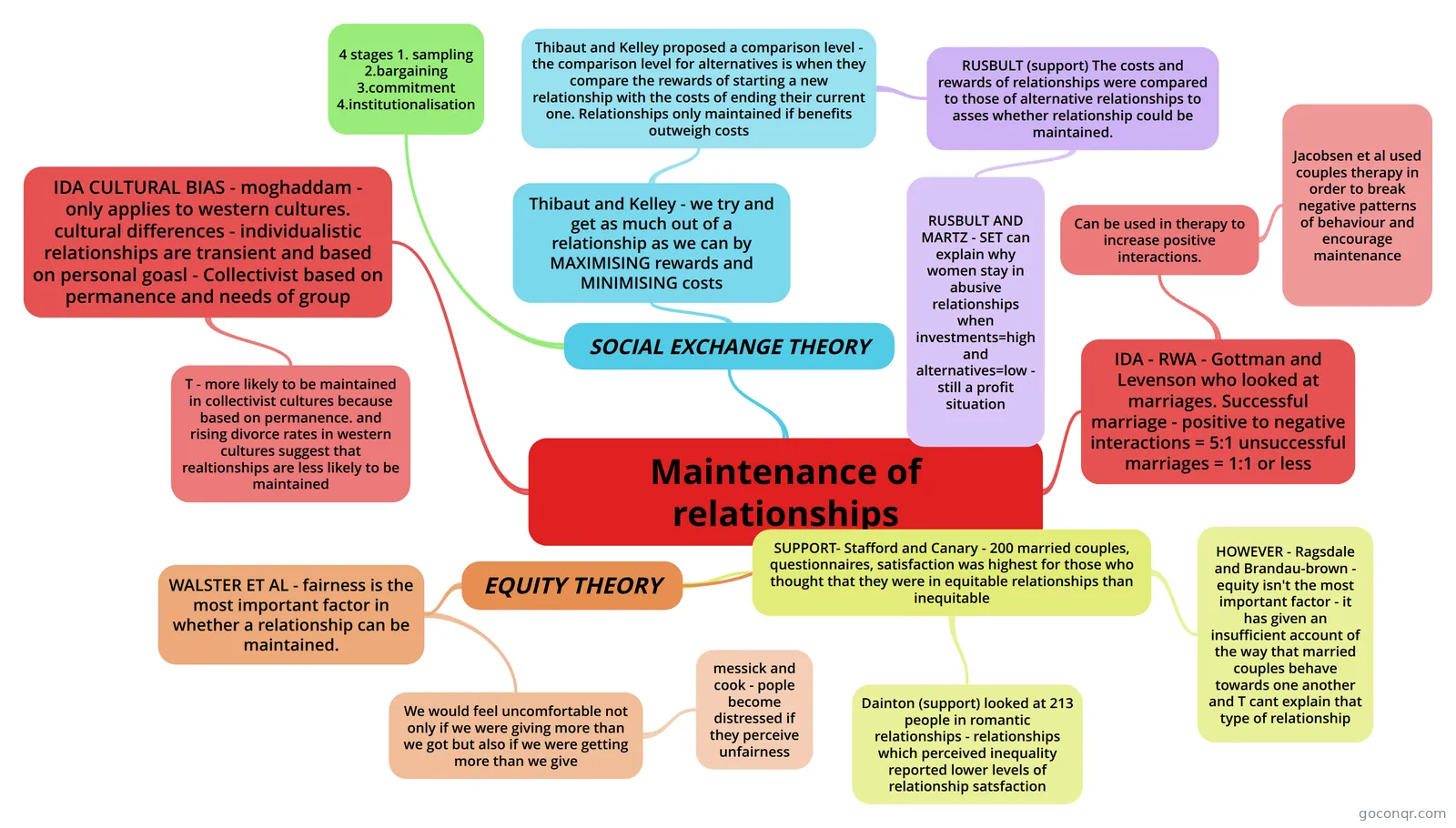
Mind map: Maintenance of relationships
Map content
Maintenance of relationships
SOCIAL EXCHANGE THEORY
- Thibaut and Kelley - we try and get as much out of a relationship as we can by MAXIMISING rewards and MINIMISING costs
- Thibaut and Kelley proposed a comparison level - the comparison level for alternatives is when they compare the rewards of starting a new relationship with the costs of ending their current one. Relationships only maintained if benefits outweigh costs
- RUSBULT (support) The costs and rewards of relationships were compared to those of alternative relationships to asses whether relationship could be maintained.
- RUSBULT AND MARTZ - SET can explain why women stay in abusive relationships when investments=high and alternatives=low - still a profit situation
- RUSBULT (support) The costs and rewards of relationships were compared to those of alternative relationships to asses whether relationship could be maintained.
- Thibaut and Kelley proposed a comparison level - the comparison level for alternatives is when they compare the rewards of starting a new relationship with the costs of ending their current one. Relationships only maintained if benefits outweigh costs
- 4 stages 1. sampling 2.bargaining 3.commitment 4.institutionalisation
- Thibaut and Kelley - we try and get as much out of a relationship as we can by MAXIMISING rewards and MINIMISING costs
EQUITY THEORY
- WALSTER ET AL - fairness is the most important factor in whether a relationship can be maintained.
- We would feel uncomfortable not only if we were giving more than we got but also if we were getting more than we give
- messick and cook - pople become distressed if they perceive unfairness
- We would feel uncomfortable not only if we were giving more than we got but also if we were getting more than we give
- SUPPORT- Stafford and Canary - 200 married couples, questionnaires, satisfaction was highest for those who thought that they were in equitable relationships than inequitable
- Dainton (support) looked at 213 people in romantic relationships - relationships which perceived inequality reported lower levels of relationship satsfaction
- HOWEVER - Ragsdale and Brandau-brown - equity isn't the most important factor - it has given an insufficient account of the way that married couples behave towards one another and T cant explain that type of relationship
- WALSTER ET AL - fairness is the most important factor in whether a relationship can be maintained.
IDA - RWA - Gottman and Levenson who looked at marriages. Successful marriage - positive to negative interactions = 5:1 unsuccessful marriages = 1:1 or less
- Can be used in therapy to increase positive interactions.
- Jacobsen et al used couples therapy in order to break negative patterns of behaviour and encourage maintenance
- Can be used in therapy to increase positive interactions.
IDA CULTURAL BIAS - moghaddam - only applies to western cultures. cultural differences - individualistic relationships are transient and based on personal goasl - Collectivist based on permanence and needs of group
- T - more likely to be maintained in collectivist cultures because based on permanence. and rising divorce rates in western cultures suggest that realtionships are less likely to be maintained
Information
- Description
- Mind Map on Maintenance of relationships, created by emilydriscoll10 on 07/04/2014.
- Created by
- emilydriscoll10
- Views
- 160
- Rating