
Mind map
Automation
Map content
Automation
systems have a mix of manual and automation
- human load machine, head of press line
- robots move part down press line
- human load machine, head of press line
some elements = automated, other = manual, clerical
automated elements = split into two
- automation of manufacturing systems in factory
- computerisation of the manufacturing support systems
- reduces manual effort in product design
- CAD/CAM
- reduces manual effort in product design
variety of piece of equipment
- can perform
- processing
- assembly
- inspection
- material handling
- CNC machines
- Engine blocks
- automated assembly lines
- JLR welding robots
- single mode or multi mode
- robotic arms
- material handling
- reduce risk or person dropping parts
- faster
- less error
- clean room - intel
- material handling
- CMM machine
- Renishaw probe
- plots co-ordinates
- overlay CAD model, check dimensions
- plots co-ordinates
- Renishaw probe
- can perform
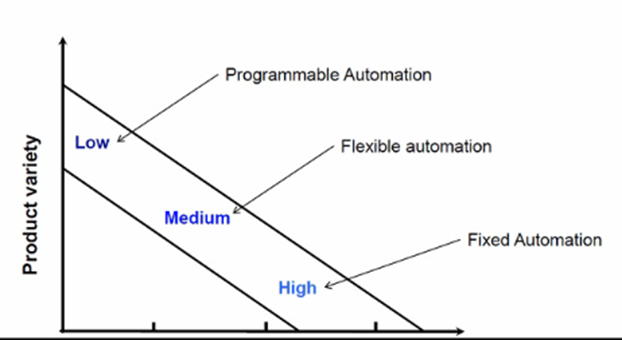
Three types
- fixed automation
- mass manufacture
- fixed by process
- fixed by the equipment
- high initial investment
- justified, parts produced at high rate, spread cost over many parts
- costs a lot why do it?
- improve quality
- mass runs spread costs
- complicated coordination
- mass manufacture
- programmable
- equipment must accommodate change in operation sequence
- can re program, sequence of operations can be changed
- every time we want something new
- suits batch production
- Paper, blanks
- can be re configured
- cost associated with this, down time
- PLC - programmable logic controller
- investment in general purpose equipment
- industrial robots
- flexible
- can re-program without downtime
- Machinery is flexible, can manufacture more parts
- Extension of programmable automation
- Can make changes and variation, as long as they are soft variety
- can use general equipment
- Can produce various combinations of products
- came into being in 1960
- initial automation, Ford 1912
- EXAM
- Tell me about flexible manufacuring, discuss the date, what it is , who it was broght in by, an example of flexible, product variety, variation
- Ball point pen?
- fixed automation
why do we Automate
- Speed
- reduce labour costs
- efficiency
- Accuracy
- increase labour productivity
- mitigate labour shortage
- improve worker safety
- improve product quality
- reduce lead time
- avoid costs of automating
Human automation
- humans = necessary for management and maintenance
- manual labour can be preferredover automation because:
- task is technologically to difficult to automate
- hand eye coordination
- product life cycle = short
- product is highly customised
- cope with variation in demand
- reduce risk of product failure
- Cadscan
- sometimes much less expensive
- task is technologically to difficult to automate
Manual labour
- routine / manual / clerical tasks = automated using computer systems like materials requirement planning MRP and CAD
- still require manual input / creativity
- required in maintenance
- programming
- always need someone to code computers
- routine / manual / clerical tasks = automated using computer systems like materials requirement planning MRP and CAD
EXAM
- Humans Vs Automated Machines
- human
- develop new solutions
- cope with abstract problems
- adapt to change
- generalise from observation
- learn from experience
- make difficult decisions based on incomplete data
- machine
- perform repetitive tasks
- store large amounts of data
- reliably retrieve data
- multiple tasks at once
- perform simple computations quickly
- make quick decisions
- human
- Humans Vs Automated Machines
Approaches to automation
- USA PRINCIPLE - EXAM
- U = understand the existing process
- comprehend the process
- write all details
- take and understand all detaisl
- set relationship between input and output
- S - simplyify the process
- does the step need to be there?
- what is it doing?
- is the technology for each step suitable?
- can you combine steps? do them simultaniously?
- once simplified you may not need to automate!
- A - Automate the process
- only do once simplified
- There is ten stratergies for automatin
- the following ten = a good road map to automation
- 1) Specialisation of operations
- 2) combined operations
- 3) simultaneous operations
- 4) integration of operations
- 5) increased flexibilty
- 6) improved material handling and storage
- 7) on-line inspection
- 8) process control and optimization
- 9) plant operations control
- 10) computer intergrated manufacutring
- the following ten = a good road map to automation
- There is ten stratergies for automatin
- only do once simplified
- U = understand the existing process
- USA PRINCIPLE - EXAM
Migration strategy
- company
- new product
- release in a short time period
- quickest / least expensive way to release product =manual production
- use a sequence of work stations
- operate independently
- tooling = low cost, fabricate quickly
- product requires more than one work cell to meet demand, replicate manual cell
- product = success = automate
- migration strategy
- Phase 1
- manual production
- single station manned cells
- operate independently
- quick product intro to market
- quick to make / low cost tooling
- Phase 2
- automatic production using single station automated cells, operating independently
- Demand for product grows = will become clear automation can be justified
- automate single stations to reduce labour, increasing production rate. Units = still moved between workstations manually
- Phase 3
- automated integrated production
- multi-station automated system with serial operations and automated transfer of work units between
- Know product will be produced for several years in mass quantities
- integration of single station automation cells is warranted to increase production rate
- Know product will be produced for several years in mass quantities
- Phase 1
- migration strategy
- use a sequence of work stations
- quickest / least expensive way to release product =manual production
- release in a short time period
- new product
- company
Images and files in the map
Information
- Description
- Mind Map on Automation, created by Tom Piggott on 15/01/2017.
- Created by
- Tom Piggott
- Views
- 2
- Rating