
Mind map
PRINCIPLES OF DESIGN
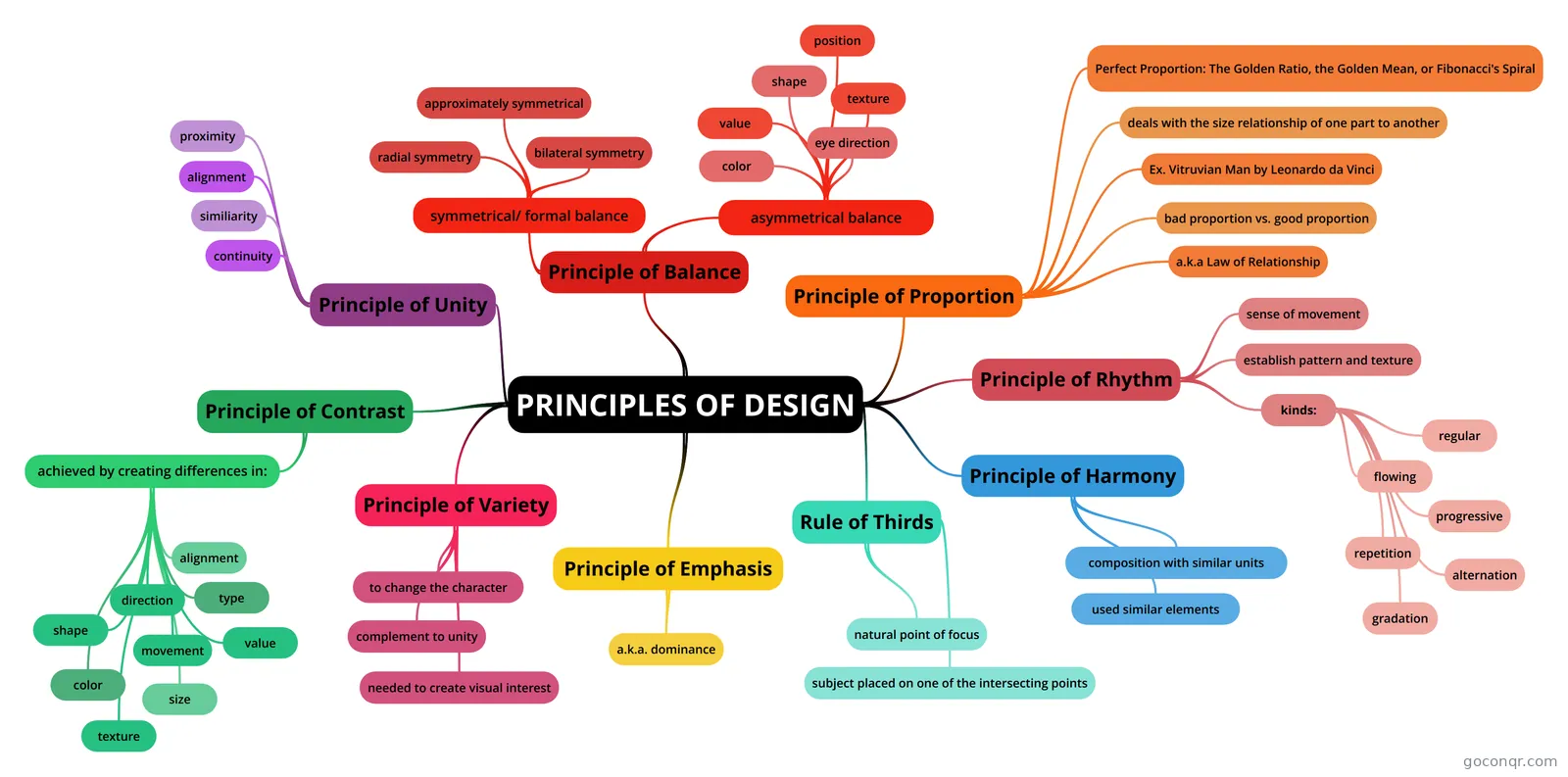
Mind map: principles of design
Map content
PRINCIPLES OF DESIGN
Principle of Balance
- symmetrical/ formal balance
- -equal "weight" on equal sides of a centrally placed fulcrum -weight of composition is equally distributed -identical forms on both sides of the axis
- bilateral symmetry
- -elements are arrange equally on both sides
- approximately symmetrical
- -equivalent but not identical
- radial symmetry
- -arranging elements equally around central point
- asymmetrical balance
- color
- -vibrant colors against neutral colors
- value
- black vs. white or contrast
- shape
- -flat vs. irregular shapes
- position
- -larger weight (closer) vs. lighter weight (farther)
- texture
- -smooth vs rough -soft vs. hard
- eye direction
- -by used of edges, shapes, groups
- color
- symmetrical/ formal balance
Principle of Proportion
- -relative size and scale of the various elements in a design
- deals with the size relationship of one part to another
- bad proportion vs. good proportion
- Ex. Vitruvian Man by Leonardo da Vinci
- a.k.a Law of Relationship
- Perfect Proportion: The Golden Ratio, the Golden Mean, or Fibonacci's Spiral
- Parthenon
Rule of Thirds
- -imagine breaking an image down into thirds (horizaontally & vertically) so that you have 9 parts.
- subject placed on one of the intersecting points
- natural point of focus
Principle of Unity
- similiarity
- -repetition
- continuity
- -family resemblances
- alignment
- arranging shapes
- proximity
- -cohesive group
- similiarity
Principle of Contrast
- achieved by creating differences in:
- shape
- color
- texture
- direction
- movement
- size
- value
- type
- alignment
- achieved by creating differences in:
Principle of Emphasis
- -provides focal point for the piece
- a.k.a. dominance
Principle of Rhythm
- -repetition or alternation of elements
- sense of movement
- establish pattern and texture
- kinds:
- regular
- -intervals bet. elements, -similar in size or length
- flowing
- -give sense of movement
- progressive
- -shows sequence of forms
- repetition
- -patterning -visual "beat"
- alternation
- -sequence of repeating motifs are presented in turn (short/long; fat/thin; round/square; dark/light)
- gradation
- patterned thru regular progression of steps
- regular
Principle of Harmony
- composition with similar units
- used similar elements
Principle of Variety
- to change the character
- complement to unity
- needed to create visual interest
Information
- Description
- Describe the ways that artists use the elements of art in a work of art.
- Created by
- Sherlyn A
- Views
- 282
- Tags
- Rating