
Mind map
IMPACTS OF AGGREGATE DREDGING
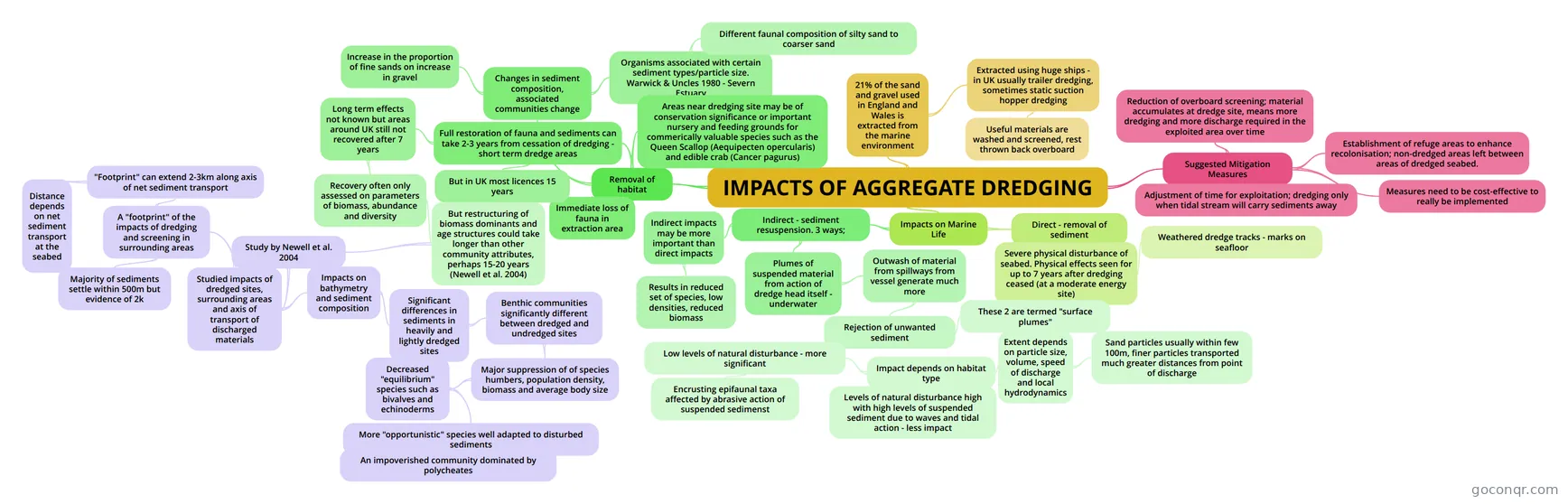
Mind map: Impacts of aggregate dredging
Map content
IMPACTS OF AGGREGATE DREDGING
Impacts on Marine Life
- Direct - removal of sediment
- Severe physical disturbance of seabed. Physical effects seen for up to 7 years after dredging ceased (at a moderate energy site)
- Weathered dredge tracks - marks on seafloor
- Severe physical disturbance of seabed. Physical effects seen for up to 7 years after dredging ceased (at a moderate energy site)
- Indirect - sediment resuspension. 3 ways;
- Plumes of suspended material from action of dredge head itself - underwater
- Outwash of material from spillways from vessel generate much more
- Rejection of unwanted sediment
- These 2 are termed "surface plumes"
- Extent depends on particle size, volume, speed of discharge and local hydrodynamics
- Impact depends on habitat type
- Levels of natural disturbance high with high levels of suspended sediment due to waves and tidal action - less impact
- Low levels of natural disturbance - more significant
- Encrusting epifaunal taxa affected by abrasive action of suspended sedimenst
- Sand particles usually within few 100m, finer particles transported much greater distances from point of discharge
- Impact depends on habitat type
- Extent depends on particle size, volume, speed of discharge and local hydrodynamics
- These 2 are termed "surface plumes"
- Rejection of unwanted sediment
- Outwash of material from spillways from vessel generate much more
- Indirect impacts may be more important than direct impacts
- Results in reduced set of species, low densities, reduced biomass
- Plumes of suspended material from action of dredge head itself - underwater
- Direct - removal of sediment
21% of the sand and gravel used in England and Wales is extracted from the marine environment
- Extracted using huge ships - in UK usually trailer dredging, sometimes static suction hopper dredging
- Useful materials are washed and screened, rest thrown back overboard
- Extracted using huge ships - in UK usually trailer dredging, sometimes static suction hopper dredging
Removal of habitat
- Immediate loss of fauna in extraction area
- Changes in sediment composition, associated communities change
- Organisms associated with certain sediment types/particle size. Warwick & Uncles 1980 - Severn Estuary
- Different faunal composition of silty sand to coarser sand
- Increase in the proportion of fine sands on increase in gravel
- Organisms associated with certain sediment types/particle size. Warwick & Uncles 1980 - Severn Estuary
- Full restoration of fauna and sediments can take 2-3 years from cessation of dredging - short term dredge areas
- But in UK most licences 15 years
- Long term effects not known but areas around UK still not recovered after 7 years
- Recovery often only assessed on parameters of biomass, abundance and diversity
- But restructuring of biomass dominants and age structures could take longer than other community attributes, perhaps 15-20 years (Newell et al. 2004)
- Study by Newell et al. 2004
- Studied impacts of dredged sites, surrounding areas and axis of transport of discharged materials
- Impacts on bathymetry and sediment composition
- Significant differences in sediments in heavily and lightly dredged sites
- Benthic communities significantly different between dredged and undredged sites
- Major suppression of of species humbers, population density, biomass and average body size
- Decreased "equilibrium" species such as bivalves and echinoderms
- More "opportunistic" species well adapted to disturbed sediments
- An impoverished community dominated by polycheates
- More "opportunistic" species well adapted to disturbed sediments
- Decreased "equilibrium" species such as bivalves and echinoderms
- Major suppression of of species humbers, population density, biomass and average body size
- Benthic communities significantly different between dredged and undredged sites
- Significant differences in sediments in heavily and lightly dredged sites
- A "footprint" of the impacts of dredging and screening in surrounding areas
- Majority of sediments settle within 500m but evidence of 2k
- "Footprint" can extend 2-3km along axis of net sediment transport
- Distance depends on net sediment transport at the seabed
- Impacts on bathymetry and sediment composition
- Studied impacts of dredged sites, surrounding areas and axis of transport of discharged materials
- Study by Newell et al. 2004
- But restructuring of biomass dominants and age structures could take longer than other community attributes, perhaps 15-20 years (Newell et al. 2004)
- Recovery often only assessed on parameters of biomass, abundance and diversity
- Areas near dredging site may be of conservation significance or important nursery and feeding grounds for commerically valuable species such as the Queen Scallop (Aequipecten opercularis) and edible crab (Cancer pagurus)
Suggested Mitigation Measures
- Reduction of overboard screening; material accumulates at dredge site, means more dredging and more discharge required in the exploited area over time
- Adjustment of time for exploitation; dredging only when tidal stream will carry sediments away
- Establishment of refuge areas to enhance recolonisation; non-dredged areas left between areas of dredged seabed.
- Measures need to be cost-effective to really be implemented
Information
- Description
- degree MBIO218 Mind Map on IMPACTS OF AGGREGATE DREDGING, created by amyycartwright on 28/04/2014.
- Created by
- amyycartwright
- Views
- 2,630
- Rating