
Mind map
Qualitative and Quantitative Research.
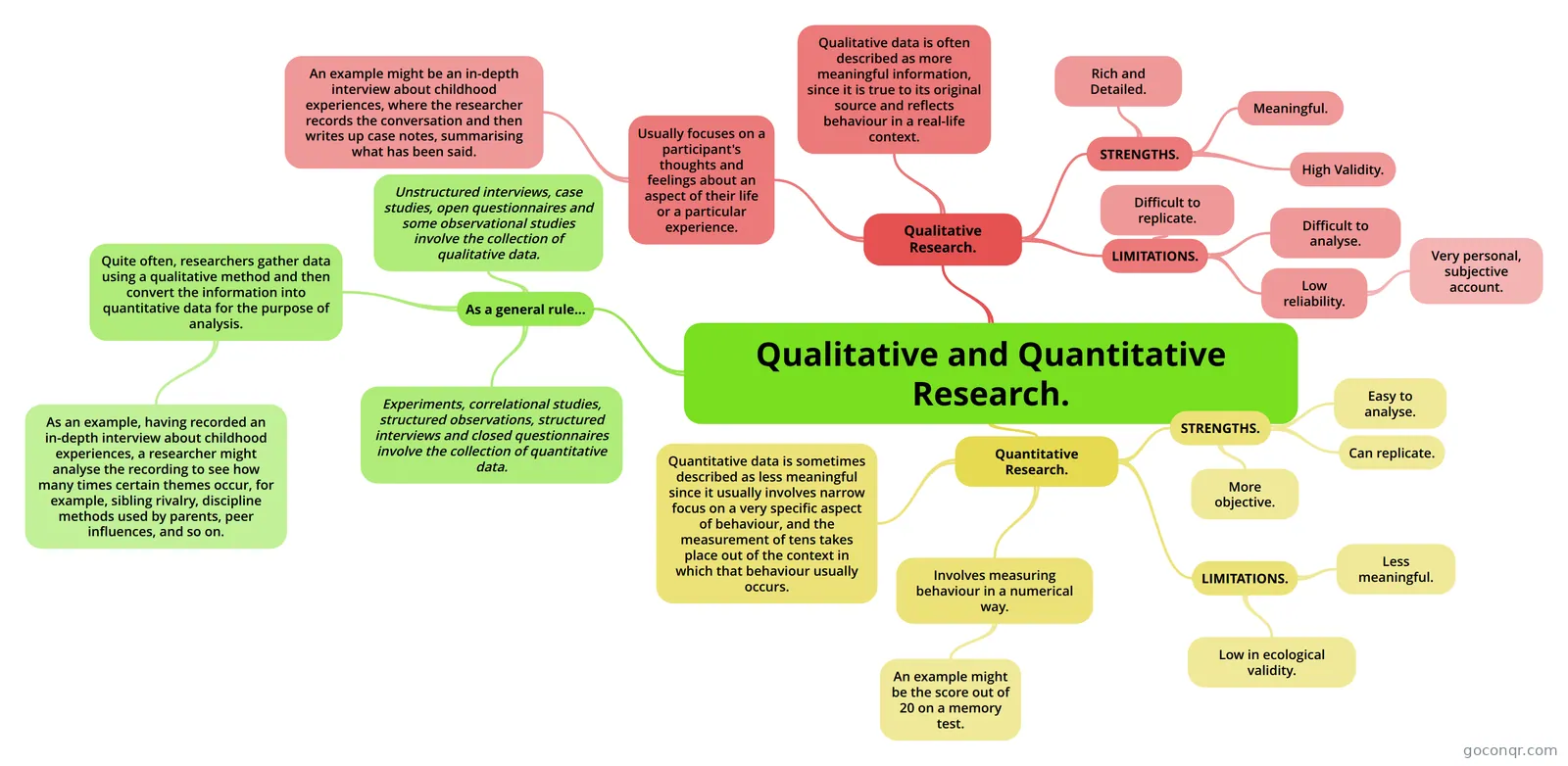
Mind map: Qualitative and quantitative research
Map content
Qualitative and Quantitative Research.
Qualitative Research.
- Usually focuses on a participant's thoughts and feelings about an aspect of their life or a particular experience.
- An example might be an in-depth interview about childhood experiences, where the researcher records the conversation and then writes up case notes, summarising what has been said.
- Qualitative data is often described as more meaningful information, since it is true to its original source and reflects behaviour in a real-life context.
- STRENGTHS.
- Rich and Detailed.
- Meaningful.
- High Validity.
- LIMITATIONS.
- Difficult to replicate.
- Difficult to analyse.
- Low reliability.
- Very personal, subjective account.
- Usually focuses on a participant's thoughts and feelings about an aspect of their life or a particular experience.
Quantitative Research.
- Involves measuring behaviour in a numerical way.
- An example might be the score out of 20 on a memory test.
- Quantitative data is sometimes described as less meaningful since it usually involves narrow focus on a very specific aspect of behaviour, and the measurement of tens takes place out of the context in which that behaviour usually occurs.
- STRENGTHS.
- Easy to analyse.
- Can replicate.
- More objective.
- LIMITATIONS.
- Less meaningful.
- Low in ecological validity.
- Involves measuring behaviour in a numerical way.
As a general rule...
- Unstructured interviews, case studies, open questionnaires and some observational studies involve the collection of qualitative data.
- Experiments, correlational studies, structured observations, structured interviews and closed questionnaires involve the collection of quantitative data.
- Quite often, researchers gather data using a qualitative method and then convert the information into quantitative data for the purpose of analysis.
- As an example, having recorded an in-depth interview about childhood experiences, a researcher might analyse the recording to see how many times certain themes occur, for example, sibling rivalry, discipline methods used by parents, peer influences, and so on.
Information
- Description
- Psychology AS Re-take. Mind Map on Qualitative and Quantitative Research., created by Stephanie Price on 02/05/2014.
- Created by
- Stephanie Price
- Views
- 118
- Rating