
Mind map
Ratio analysis
Map content
Ratio analysis
Measuring Overall Profitability
- ROE is a comprehensive indicator of a firm's performance
- it provides an indication of how well managers are employing the funds invested by the firm's shareholders to generate returns
- The value of the firm's equity is determined by the relationship between its ROE and its cost of equity capital
- That is, those firms that are expected over the long run to generate ROES in excess of the cost of equity capital should have market values in excess of book value and vice versa.
- ROE is a comprehensive indicator of a firm's performance
Decomposing Profitability: Traditional Approach
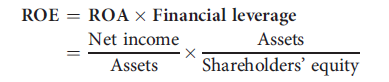
- ROE is affected by two factors
- How profitably it employs its assets
- How big the firm's asset base is relative to shareholders' investment
- ROE can be decomposed into
- Return on Asset (ROA)
- How much profit a company is able to generate for each dollar of assets invested.
- a product of two factors
- The ratio of net income to sales is called net profit margin or return on sales (ROS);
- indicates how much the company is able to keep as profits for each dollar of sales it makes
- The higher adjusted ROS for TJX is the result of lower current expense incurred as a result of the operating lease adjustment
- indicates how much the company is able to keep as profits for each dollar of sales it makes
- the ratio of sales to assets is known as asset turnover.
- adjusting for the operating lease impact for both firms brings the asset turnover of TJX closer to that of Nordstrom
- The difference in credit card strategies continues to drive a higher ROA for TJX
- The ratio of net income to sales is called net profit margin or return on sales (ROS);
- Limitations
- Assets claimed by all providers of capital to the firm, but the numerator includes only the earnings available to equity holders
- Assets themselves include both operating assets and financial assets such as cash and short-term investment
- Net income includes income from operating activities as well as interest income and expense, which are consequences of financing decison
- The financial leverage ratio used above does not recognize the fact that a firm's cash and short-term investments are in essence, "negative debt" because they can be used to pay down the debt on the company's balance sheet.
- a measure of financial leverage
- indicates how many dollars of assets the firm is able to deploy for each dollar invested by its shareholders.
- Return on Asset (ROA)
- ROE is affected by two factors
Decomposing Profitability: Alternative Approach
- Operating ROA is a measure of how profitably a company is able to deploy its operating assets to generate operating profits
- Operating ROA would be a company's ROE if it were financed entirely with equity
- Spread is the incremental economic effect from introducing debt into the capital structure
- The economic effect of borrowing is positive as long as the return on operating assets is greater than the cost of borrowing
- Assessment
- TJX's dramatically higher operating asset turnover as compared to Nordstrom's is driven
- Outsourcing its branded credit card -> not carrying a high accts receivalbe balance
- Leasing virtually all of its stores -> carrying low net long-term assets relative to Nordstrom
- Net financial leverage (net debt as a percentage of equity)
- TJX which actually calculates at a negative rate due to tis negative net debt position --> company had more cash than debt
- TJX used of off-balance sheet financing for tis stores (which results in having artificailly low reported financial leverage
- TJX which actually calculates at a negative rate due to tis negative net debt position --> company had more cash than debt
- TJX's dramatically higher operating asset turnover as compared to Nordstrom's is driven
Assessing Operating Management: Decomposing Net Profit Margin (ROS)
- Shows the profitability of the company's operating activities
- assess the efficiency of the firm'soperating management
- A popular tool used in this analysis
- Common-sized income statement
- Assessement
- an increase in profitability metrics (gross profit, EBITDA, NOPAT, and ROS)
- due to the depreciaton component of COGS being only a portion of the previously utilized lease expense
- shows increased interest expense
- due to the added debt component
- increased tax expense
- due to higher net income
- an increase in profitability metrics (gross profit, EBITDA, NOPAT, and ROS)
- Assessement
- Common-sized income statement
Gross Profit Margins
- The difference between a firm's sales and cost of sales is gross profit.
- (1) the price premium that a firm's products command in the marketplace
- (2) the efficiency of the firm's procurement and production process
Selling, General, and Administrative Expenses
- influenced by
- the operating activities it has to undertake to implement its competitive strategy
- the efficiency with which it managers its overhead activities
- Two ratios provide full signals
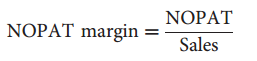
- NOPAT margin
- provides a comprehensive indication of the operating performance of a company because it reflects all operating costs and eliminates the effects of debt policy
- EBITDA margin
- provides smilar information, except that it excludes depreiation and amortizaation expense, a significant non-cash operating expense
- NOPAT margin
- influenced by
Tax Expense
- Taxes are an important element of a firm's total expenses
- Two measures one can use to evaluate a firm's tax expense
- One is the ratio of tax expense to sales
- The other is the ratio of tax expense to earnings before taxes ( also known as the average tax rate)
- The firm's tax footnote provides a detailed account of why its average tax rate differs from the statutory tax rate
Key Analysis Questions
- Are the company's margns consistent with its stated competitive strategy?
- For example, a differentiatiion strategy should usually lead to higher gross margins than a low-cost strategy?
- Are the company's margins changing? Why? what are the underlying business causes - changes in competition, changes in input costs, or poor overhead cost management?
- Is the company managing its overhead and administrative cost well? What are the business actitivies driving these costs? Are there actitives necessary?
- Are the company's tax policies sustainable, or is the current tax rate influenced by one-time tax credits?
- Do the firm's tax planning strategies lead to other business costs?
- For example, if the operations are located in tax havens, how does this affect the company's profit margins and asset utilization? Are the benefits of tax planning strategies (recuded taxes) greater than the increased business costs?
- Are the company's margns consistent with its stated competitive strategy?
Evaluating Investment Management: Decomposing Asset Turnover
- Asset turnover is the second driver of a company's return on equity
- Since firms invest considerable resources in their assets, using them productively is critical to overall profitability.
Images and files in the map


Information
- Description
- Business Valuation Mind Map on Ratio analysis, created by Trang Pham on 18/05/2017.
- Created by
- Trang Pham
- Views
- 0
- Rating