
Mind map
Action Cinema
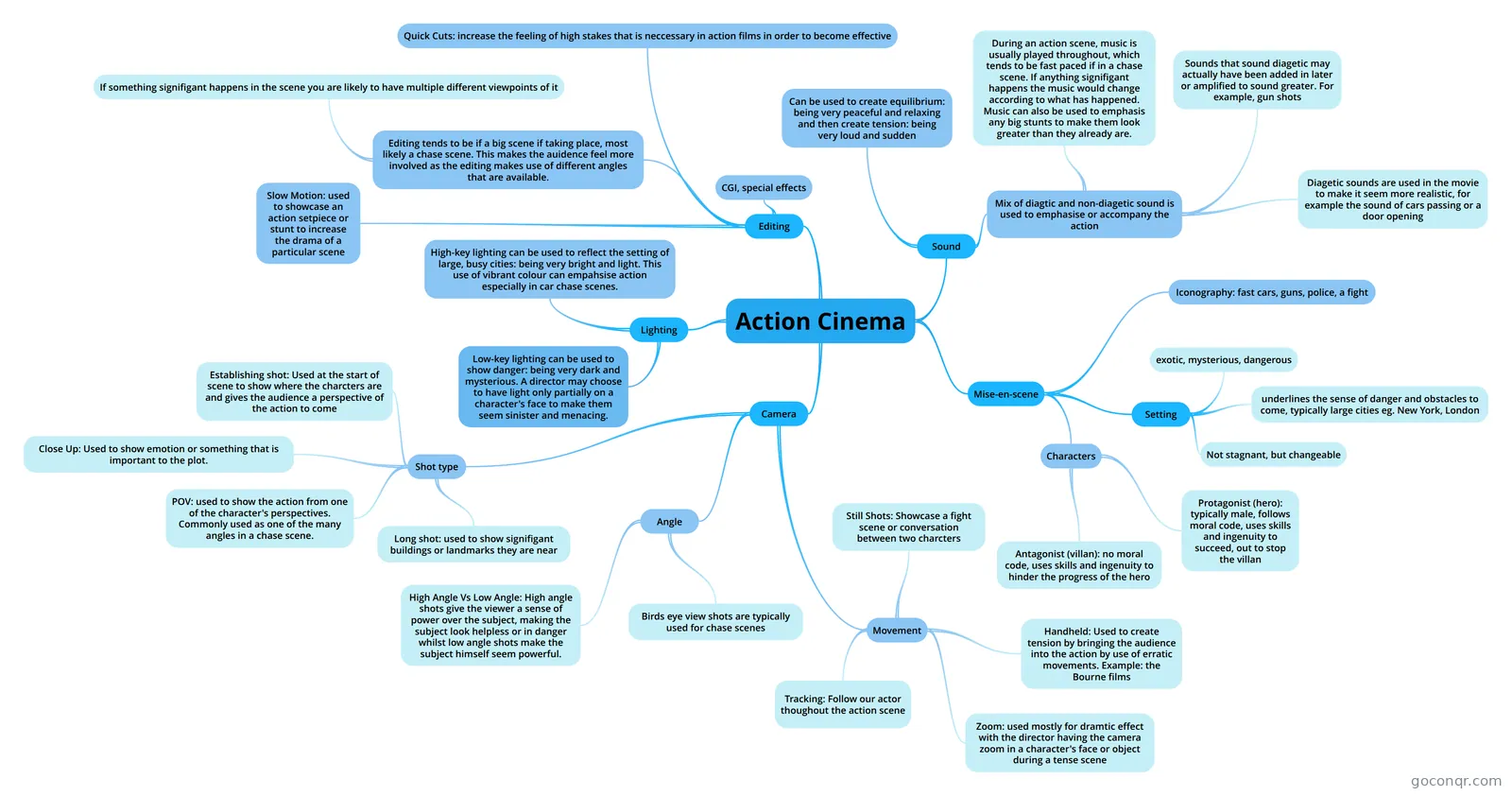
Mind map: Action cinema
Map content
Action Cinema
Camera
- Shot type
- Establishing shot: Used at the start of scene to show where the charcters are and gives the audience a perspective of the action to come
- Close Up: Used to show emotion or something that is important to the plot.
- POV: used to show the action from one of the character's perspectives. Commonly used as one of the many angles in a chase scene.
- Long shot: used to show signifigant buildings or landmarks they are near
- Angle
- High Angle Vs Low Angle: High angle shots give the viewer a sense of power over the subject, making the subject look helpless or in danger whilst low angle shots make the subject himself seem powerful.
- Birds eye view shots are typically used for chase scenes
- Movement
- Handheld: Used to create tension by bringing the audience into the action by use of erratic movements. Example: the Bourne films
- Zoom: used mostly for dramtic effect with the director having the camera zoom in a character's face or object during a tense scene
- Tracking: Follow our actor thoughout the action scene
- Still Shots: Showcase a fight scene or conversation between two charcters
- Shot type
Editing
- CGI, special effects
- Slow Motion: used to showcase an action setpiece or stunt to increase the drama of a particular scene
- Quick Cuts: increase the feeling of high stakes that is neccessary in action films in order to become effective
- Editing tends to be if a big scene if taking place, most likely a chase scene. This makes the auidence feel more involved as the editing makes use of different angles that are available.
- If something signifigant happens in the scene you are likely to have multiple different viewpoints of it
Sound
- Can be used to create equilibrium: being very peaceful and relaxing and then create tension: being very loud and sudden
- Mix of diagtic and non-diagetic sound is used to emphasise or accompany the action
- During an action scene, music is usually played throughout, which tends to be fast paced if in a chase scene. If anything signifigant happens the music would change according to what has happened. Music can also be used to emphasis any big stunts to make them look greater than they already are.
- Sounds that sound diagetic may actually have been added in later or amplified to sound greater. For example, gun shots
- Diagetic sounds are used in the movie to make it seem more realistic, for example the sound of cars passing or a door opening
Mise-en-scene
- Characters
- Protagonist (hero): typically male, follows moral code, uses skills and ingenuity to succeed, out to stop the villan
- Antagonist (villan): no moral code, uses skills and ingenuity to hinder the progress of the hero
- Setting
- Not stagnant, but changeable
- underlines the sense of danger and obstacles to come, typically large cities eg. New York, London
- exotic, mysterious, dangerous
- Iconography: fast cars, guns, police, a fight
- Characters
Lighting
- Low-key lighting can be used to show danger: being very dark and mysterious. A director may choose to have light only partially on a character's face to make them seem sinister and menacing.
- High-key lighting can be used to reflect the setting of large, busy cities: being very bright and light. This use of vibrant colour can empahsise action especially in car chase scenes.
Information
- Description
- Mind Map on Action Cinema, created by Cara McConnell on 29/05/2017.
- Created by
- Cara McConnell
- Views
- 3
- Rating
More on Film Genres and Conventions