
Mind map
Technology, environment and the future
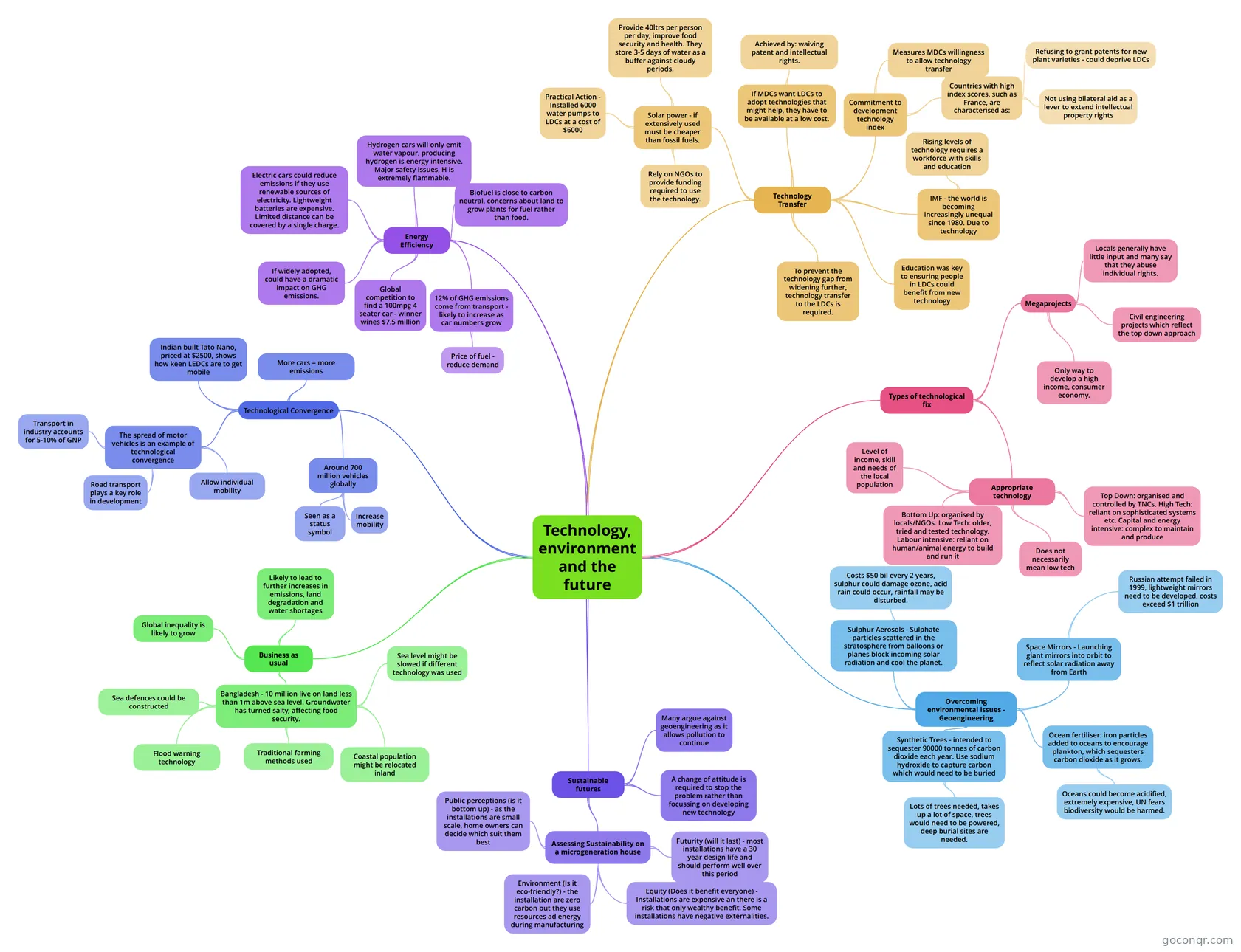
Mind map: Technology, environment and the future
Map content
Technology, environment and the future
Types of technological fix
- Appropriate technology
- Level of income, skill and needs of the local population
- Does not necessarily mean low tech
- Top Down: organised and controlled by TNCs. High Tech: reliant on sophisticated systems etc. Capital and energy intensive: complex to maintain and produce
- Bottom Up: organised by locals/NGOs. Low Tech: older, tried and tested technology. Labour intensive: reliant on human/animal energy to build and run it
- Megaprojects
- Only way to develop a high income, consumer economy.
- Civil engineering projects which reflect the top down approach
- Locals generally have little input and many say that they abuse individual rights.
- Appropriate technology
Overcoming environmental issues - Geoengineering
- Sulphur Aerosols - Sulphate particles scattered in the stratosphere from balloons or planes block incoming solar radiation and cool the planet.
- Costs $50 bil every 2 years, sulphur could damage ozone, acid rain could occur, rainfall may be disturbed.
- Space Mirrors - Launching giant mirrors into orbit to reflect solar radiation away from Earth
- Russian attempt failed in 1999, lightweight mirrors need to be developed, costs exceed $1 trillion
- Ocean fertiliser: iron particles added to oceans to encourage plankton, which sequesters carbon dioxide as it grows.
- Oceans could become acidified, extremely expensive, UN fears biodiversity would be harmed.
- Synthetic Trees - intended to sequester 90000 tonnes of carbon dioxide each year. Use sodium hydroxide to capture carbon which would need to be buried
- Lots of trees needed, takes up a lot of space, trees would need to be powered, deep burial sites are needed.
- Sulphur Aerosols - Sulphate particles scattered in the stratosphere from balloons or planes block incoming solar radiation and cool the planet.
Sustainable futures
- Many argue against geoengineering as it allows pollution to continue
- A change of attitude is required to stop the problem rather than focussing on developing new technology
- Assessing Sustainability on a microgeneration house
- Futurity (will it last) - most installations have a 30 year design life and should perform well over this period
- Equity (Does it benefit everyone) - Installations are expensive an there is a risk that only wealthy benefit. Some installations have negative externalities.
- Public perceptions (is it bottom up) - as the installations are small scale, home owners can decide which suit them best
- Environment (Is it eco-friendly?) - the installation are zero carbon but they use resources ad energy during manufacturing
Business as usual
- Likely to lead to further increases in emissions, land degradation and water shortages
- Global inequality is likely to grow
- Bangladesh - 10 million live on land less than 1m above sea level. Groundwater has turned salty, affecting food security.
- Sea level might be slowed if different technology was used
- Coastal population might be relocated inland
- Traditional farming methods used
- Sea defences could be constructed
- Flood warning technology
Technological Convergence
- Around 700 million vehicles globally
- Seen as a status symbol
- Increase mobility
- The spread of motor vehicles is an example of technological convergence
- Allow individual mobility
- Road transport plays a key role in development
- Transport in industry accounts for 5-10% of GNP
- Indian built Tato Nano, priced at $2500, shows how keen LEDCs are to get mobile
- More cars = more emissions
- Around 700 million vehicles globally
Energy Efficiency
- 12% of GHG emissions come from transport - likely to increase as car numbers grow
- Price of fuel - reduce demand
- Global competition to find a 100mpg 4 seater car - winner wines $7.5 million
- If widely adopted, could have a dramatic impact on GHG emissions.
- Electric cars could reduce emissions if they use renewable sources of electricity. Lightweight batteries are expensive. Limited distance can be covered by a single charge.
- Hydrogen cars will only emit water vapour, producing hydrogen is energy intensive. Major safety issues, H is extremely flammable.
- Biofuel is close to carbon neutral, concerns about land to grow plants for fuel rather than food.
- 12% of GHG emissions come from transport - likely to increase as car numbers grow
Technology Transfer
- IMF - the world is becoming increasingly unequal since 1980. Due to technology
- Rising levels of technology requires a workforce with skills and education
- Education was key to ensuring people in LDCs could benefit from new technology
- To prevent the technology gap from widening further, technology transfer to the LDCs is required.
- Commitment to development technology index
- Measures MDCs willingness to allow technology transfer
- Countries with high index scores, such as France, are characterised as:
- Refusing to grant patents for new plant varieties - could deprive LDCs
- Not using bilateral aid as a lever to extend intellectual property rights
- If MDCs want LDCs to adopt technologies that might help, they have to be available at a low cost.
- Achieved by: waiving patent and intellectual rights.
- Solar power - if extensively used must be cheaper than fossil fuels.
- Rely on NGOs to provide funding required to use the technology.
- Practical Action - Installed 6000 water pumps to LDCs at a cost of $6000
- Provide 40ltrs per person per day, improve food security and health. They store 3-5 days of water as a buffer against cloudy periods.
- IMF - the world is becoming increasingly unequal since 1980. Due to technology
Information
- Description
- Mind Map on Technology, environment and the future, created by gracering on 15/05/2013.
- Created by
- gracering
- Views
- 105
- Rating